
From Tourist Gem to Environmental Catastrophe: The Alcollarín Disaster
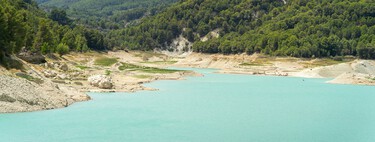
Just eight months ago, Alcollarín dressed in gala. This small town in Cáceres , with just over 300 residents, was showcased at the International Tourism Fair of Madrid as a privileged corner to observe birds, fish, or simply take a stroll beside its reservoir, a blue mirror nestled in the surrounding pasture. However, today, the picturesque postcard has turned into a nightmare.
Where water used to shimmer, a desolate muddy landscape now sprawls, marked by the presence of dead fish . The air is thick with a putrid smell, penetrating the streets of the town. Residents describe the situation as an “ ecological disaster ” and look on in disbelief toward the dam. Meanwhile, the Guadiana Hydrographic Confederation (CHG) justifies the operation, claiming it was “of vital importance” for the future of the basin.
The Operation That Changed Everything. The Ministry for Ecological Transition , facilitated by the CHG, initiated a plan to eradicate the invasive species Pseudorasbora Parva —commonly known as the Chinese fish or Gobio de Boca Túpe —which had been present in the reservoir and the Alcollarín River since 2010. This species is included in the Spanish catalog of invasive species and poses significant concerns for ecosystems within the EU, making its control not just recommended, but a legal obligation.
The eradication plan involved months of observational studies using specialized vessels and concluded with a “ controlled ” emptying of the dam to facilitate the capture of fish. According to the CHG, the reservoir was at 100% capacity—equivalent to 50 million cubic meters—before the operation commenced. Yet, as reported by local news outlets, the emptying inadvertently released thousands of invasive specimens downstream, allowing the species to spread into the Ruecas and Guadiana rivers.
The Enemy in the Waters of Alcollarín. The Pseudorasbora Parva made its way to Europe around 1960 and has since expanded to over 30 countries, primarily due to aquaculture practices. First detected in Spain within the Ebro basin in 2002, it has progressively colonized various regions, including Catalonia, Andalusia, Madrid, and Extremadura.
In Alcollarín, the species emerged in 2010, and according to the Ministry of Ecological Transition , its population density had reached a level that made total eradication technically challenging. Nevertheless, the CHG deemed it essential to mitigate its presence to prevent further distribution, particularly before planned connections with the Orellana Canal , and to ensure the reservoir’s viability for irrigation and recreational use.
Response to the Catastrophe. The contract for this operation, awarded in June 2024 to the engineering firm SAU , amounted to €787,861.99 (excluding taxes). It encompassed analyses of aquatic fauna, installation of containment barriers, extraction of native species, and controlled draining of the reservoir.
However, reports from neighbors and environmental organizations like the Fund for the Defense of Natural and Cultural Heritage of Extremadura (Fondenex) suggest the operation didn’t unfold as intended. Thousands of invasive fish escaped downstream during the draining, compromising the original goals of the project.
The sharp drop in water levels compounded by high temperatures led to the deaths of numerous native species, including the vulnerable barbo. Shores were littered with decomposing fish, local aquatic birds abandoned the area, and the community’s economy suffered devastating losses, particularly in terms of nature tourism.
Conflicting Narratives. While the CHG defends the operation as necessary and safely executed, citing minimal mortality among native species , local organizations criticize it as an act of “ecological nonsense” that failed to consider the broader environmental context. They argue that the operation was conducted inappropriately, particularly given the time of year—and have expressed intentions to file a complaint regarding the operation.
Future Forecasts. Following the removal of Pseudorasbora Parva , the CHG plans to introduce native species again, in coordination with the Extremadura Board , and focus on maintaining barriers and controls to prevent future invasions.
Yet, environmental organizations caution that the ecological and tourist recovery of the reservoir will take years, particularly since the invasive fish has now been documented in areas where it was previously absent.
An Open Question. In Alcollarín, the divide between official reports and local sentiments is stark: to the administration, it’s a necessary technical maneuver; for residents, it’s an “environmental catastrophe” that has compounded existing challenges.
Beyond this specific situation, the events raise a significant inquiry that transcends Extremadura: what are the environmental and social costs we are prepared to bear to combat a biological invasion, especially when full eradication proves nearly impossible?
Image | Chgguadiana and B. Schoenmakers