
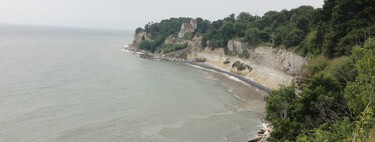
Sometimes, the most remarkable paleontological discoveries occur not in excavated sites, but by sheer coincidence in unexpected locations. This was the case in 2019 on Mount Còrneo in Italy, where two climbers crossed into a restricted area of a natural park and stumbled upon a perplexing sight: hundreds of unusual impressions etched into a vertical rock face.
The Sea Turtle Stampede Discovery
Identifying the Mystery. Research published in Cretaceous Research has unveiled that these markings are the fossilized traces of a stampede of sea turtles fleeing from an earthquake that struck approximately 80 million years ago.
The Climbers’ Encounter. Luca Natali and Paolo Sandroni, the climbers responsible for this astonishing find, discovered over 1,000 distinct fingerprints spread across an area of about 200 square meters in the Scaglia Rossa formation.
Challenges of the Site
The discovery site is both significant and problematic for researchers. Originally a flat seabed during the Cretaceous period, it has transformed into a vertical wall, making it difficult for scientists to study the area directly. To overcome this challenge, researchers resorted to using drones to photogrammetrically map the markings without endangering human life.
Date of the Event. To establish when this event took place, researchers employed magnetostratigraphy, analyzing the magnetic properties of the rocks to date the fossil traces to the Campanian period.
Imagining the Scene
When Earth Shook. About 80 million years ago, the location of their discovery was a deep, calm seabed approximately 300 meters below the surface. An earthquake disrupted this tranquility, sending sea turtles into a frenzied panic as they swam toward deeper waters. This chaos resulted in the semi-lunar impressions left behind as they flailed against the seabed.
Just moments to hours after the turtles passed, sediment from the earthquake—known as turbidite—covered their tracks, effectively sealing them in place as if it were an “underwater Pompeii.”
Identifying the Creators
Who Dug Those Tracks? Identifying the animal responsible for these traces was not straightforward. Initially, researchers considered other Cretaceous creatures like fish, plesiosaurs, or mosasaurs. However, the analysis revealed a different story.
Marks that displayed bilateral symmetry could not belong to fish, and the pattern was inconsistent with the four-fin propulsion of plesiosaurs. As a result, the semilunar impressions, characteristic of turtle fins, confirmed that these sea turtles were the creators of the fossilized tracks.
Healthy Skepticism
Questioning the Evidence. As is common in paleontology, skepticism persists. Various experts have suggested that while the seismic theory is credible, firmly attributing the markings to turtles requires further comparative analysis. This makes it a rare fossil record, especially from deep pelagic environments.
Beyond Species: A Paradigm Shift
What makes this discovery significant is not merely the identification of species, but the insight it provides into behavior during a moment of terror experienced millions of years ago. Unlike other fossils that primarily convey information about anatomy or death, these footprints reveal a vivid narrative of survival instinct among ancient sea turtles.
Images | Cretaceous Research