
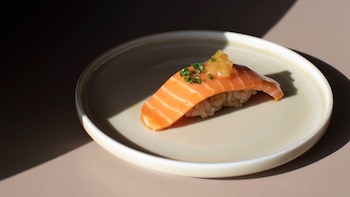
Laboratory Salmon: The Future of Sustainable Seafood
At the end of May, the Haitian restaurant “Kann”, located in Portland, Oregon, made headlines by being the first in the world to offer a dish featuring laboratory salmon. This milestone occurred shortly after the Food and Drug Administration of the USA (FDA) authorized the sale of salmon produced by the company Wildtype. Baptized as Wildtype Salmon Saku, it refers to a traditional cut commonly used in Japanese gastronomy.
The choice of Portland as the launch city is deliberate. Known as the “greenest city in the world,” Portland has implemented various measures aimed at reducing the community’s environmental impact. Wildtype’s founders recognized a perfect match for their sustainable initiative in this eco-conscious environment.
Looking ahead, Wildtype announced plans to serve its salmon at the Otoko restaurant in Texas. Despite venturing into this market, the founders have emphasized that their goal is not to eliminate traditional fishing or aquaculture but to provide an alternative in response to the increasing global demand for seafood.
Recent estimates suggest that by 2050, the world population will reach 10 billion inhabitants, making aquaculture crucial for global diets. Currently, more than 50% of the seafood consumed is sourced from water farms, contributing to a worldwide aquaculture production nearing 130.9 million tons.
Justin Kolbeck, co-founder of Wildtype, stated in an interview with The Washington Post, “We do not seek fishermen to run out of work or eliminate the need for fish farming.” This sentiment reveals a broader narrative: the rise of laboratory-grown products appears to be a sustainable solution rather than a replacement for traditional fishing.
The demand for salmon remains substantial. Currently, the salmon trade generates $23 billion annually, with projections estimating it could reach $44 billion by 2024. Market analysts believe that if laboratory salmon captures just 1% of the market, it could represent $400 million by 2034.
The dish served at “Kann” features cultivated salmon cubes, paired with strawberries, tomatoes, and a rice cookie. The restaurant promotes the dish with the tagline: “Be the first in the world to try the future of sustainable seafood.”
The initial journey to this point wasn’t easy; the first 453 grams of cultivated salmon cost around $400 million to prepare in 2016. This cost drastically dropped to $200 by 2022 and may soon reach $7 to $8, potentially making it more affordable than traditional salmon in the U.S.
It’s crucial to note that cultivated salmon differs from synthetic varieties produced by Revo Foods and New School Foods. The cultivated salmon originates from cells harvested during the fry stage, while synthetic options are plant-based.
The significance of time in food production cannot be overstated. Farmed salmon takes over two years to reach 5 kilograms, while wild salmon usually takes three to four years to mature. In contrast, producing a 220-gram block of laboratory salmon only takes about two weeks, a remarkable efficiency given the typical serving sizes at restaurants.
This process of creating cultivated salmon involves complex steps before it becomes edible. Salmon cells grow in stainless steel tanks, receiving a nutrient-rich mixture containing amino acids, vitamins, salts, and proteins. Kolbeck describes it humorously as a “sophisticated Gatorade” for salmon cells.
After the growth phase, the cells take on an amorphous form that doesn’t resemble the salmon most are familiar with. To give it structure and color, this mix is combined with a plant-based ingredient that mimics salmon’s texture and aesthetic.
Experts like Sebastian Belle, president of the National Aquaculture Association, argue that more comprehensive life cycle analyses are needed to compare laboratory-grown seafood with traditional methods.
As laboratory salmon gains traction, it’s essential to consider that investment in cultivated meat has fluctuated, dropping from $1.3 billion in 2021 to around $900 million in 2022 and less than $200 million in 2024 . Nonetheless, the cultivated salmon sector is betting on an ever-growing market.
In a nutshell, the presentation by Wildtype reveals a fascinating convergence of science, sustainability, and culinary innovation. The concept of “Saku”—a uniform cut of raw fish—strikes a chord with traditional and modern gastronomical practices alike, making it a compelling addition to any upscale restaurant menu. The journey from laboratory to plate signals not merely a trend but a signpost directing us toward the future of sustainable seafood.