
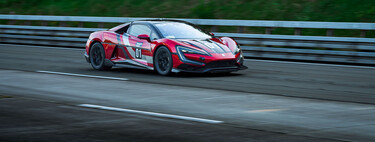
BYD Makes History with the Yangwang U9 Xtreme: Fastest Electric Car in the World
In an electrifying turn of events, the Chinese automaker BYD has outpaced its competition, establishing itself as the creator of the fastest electric car in the world. Just over a month ago, BYD introduced its Yangwang U9 , boasting a staggering 3,000 horsepower and speeds exceeding 470 km/h . Now, with the unveiling of the Yangwang U9 Xtreme , previously known as Track Day , the brand has officially surpassed Bugatti by achieving a peak speed of 496.22 km/h . This marks a significant milestone in the realm of electric vehicles.
<img alt="Yangwang U9: The Fastest Electric Car in the World" width="375" height="142" src="https://i.blogs.es/238f57/yangwan-u9_top-speed_1/375_142.jpeg"/>A Predicted Milestone
It was only a matter of time before an electric vehicle claimed the title of the fastest car . Over the years, electric cars have consistently demonstrated their superiority in acceleration, but with advancements in battery technology, they were inevitably bound to dominate peak speed records as well. The Yangwang U9, equipped with innovative BYD technology and boasting 1,288 horsepower , already laid the groundwork for high-performance electric vehicles.
The U9 incorporates advanced features, including intelligent body control that enables it to navigate obstacles adeptly. Its ability to perform a three-wheel hop showcases a level of agility rarely seen in cars of its caliber. However, the Xtreme version amplifies its performance, pushing its four motors to produce an astonishing 2,978 horsepower . This unique power-to-weight ratio promises an unmatched driving experience , turning the U9 Xtreme into an engineering marvel.
<img alt="BYD's Remarkable Off-Road Performance" width="375" height="142" src="https://i.blogs.es/8fd300/02yangwangu8premiumeditionoff-raodscene/375_142.jpeg"/>Innovative Engineering Breakthrough
One remarkable aspect of the Yangwang U9 Xtreme is its innovative 1,200-volt architecture , exceeding the standard 800 volts found in most current high-performance vehicles. This technological advancement allows for a denser energy accumulator, enabling the vehicle to store more energy in a compact form. Even though the car weighs in at 2,480 kg , the whopping 3,000 horsepower pushes its power-to-weight ratio to an impressive 0.82 kg/hp .
Previously, Bugatti’s Chiron Super Sport 300+ , which achieved 490.48 km/h in 2019, held the record for the fastest car. With the Yangwang U9 Xtreme’s remarkable performance, BYD has firmly taken the crown. Interestingly, the record was set during a unidirectional pass at the ATP Papenburg Circuit in Germany . However, the SSC Tuatara still leads in bidirectional speed tests, averaging 455.3 km/h .
Industry Impact and Future Aspirations
This achievement has compelled the supercar industry to reevaluate its benchmarks. Bugatti’s claim to high-speed performance, characterized by its W16 engine capable of producing 1,600 horsepower , has been momentarily overshadowed. Marc Basseng , the driver responsible for setting the U9 Xtreme’s record, attributed its capability to the advantages of electric motors. “Such speeds are unachievable with a combustion engine ,” he remarked, emphasizing the silent operation and sustained performance provided by electric technology.
Looking ahead, is it possible for BYD to be the first manufacturer to exceed 500 km/h ? With the U9 Xtreme paving the way, the company is positioned as a frontrunner in the race for future automotive records.
The advances made by BYD in electric vehicle technology are astounding, and their commitment to innovation is evident. With the Yangwang U9 Xtreme , BYD isn’t just redefining speed but also setting new standards for performance, safety, and technological capability in the automotive world.
Photo | BYD