
The Rise of Devstral 2: Europe’s Entry into Competitive AI Programming Models
In the ever-evolving landscape of assisted programming, the introduction of Devstral 2 by Mistral marks a pivotal moment for Europe. Open models like DeepSeek, Kimi, and Qwen have long dominated the benchmarks, particularly within the SWE-Bench Verified tests. These competitors, primarily from Asia, have effectively set the standard in complex software engineering tasks, leaving European ventures grappling to find their footing. However, Mistral’s latest offering reshapes this narrative, positioning a European company alongside the global leaders.
Technical Advancements: A Leap Worth Noticing
For months, open models have shown promising growth in Europe and the U.S., yet none could meet the high-performance benchmarks needed to compete effectively. The evolution was palpable; however, a robust project capable of demonstrating significant advancements was missing. With the launch of Devstral 2, which boasts a staggering 123 billion parameters and a context expansion of 256K tokens, Mistral enters the arena not merely as a contender but as a formidable player.
Performance Metrics: Understanding Devstral 2
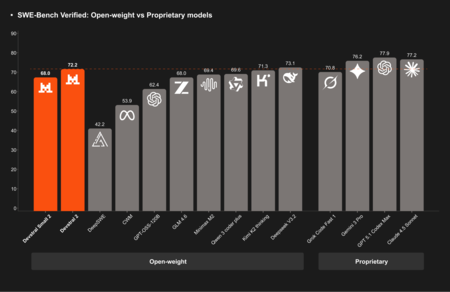
Devstral 2’s performance on the SWE-Bench Verified standards is impressive, achieving a score of 72.2%. This places it firmly within the competitive segment of open models, where the current leader is DeepSeek V3.2 at 73.1%, followed by Kimi K2 Thinking at 71.3%. Interestingly, these scores highlight a concentrated upper tier of performance among current options, while proprietary models still hold the higher benchmarks.
SWE-Bench Verified: What It Measures Matters
The SWE-Bench Verified test is crucial as it assesses a model’s ability to tackle real programming challenges. Rather than focusing on theoretical exercises, it confronts models with actual bugs from open-source repositories, requiring successful identification and rectification. This rigorous evaluation ensures that models like Devstral 2 can meaningfully contribute to the development process in practical environments, albeit with a current limitation to Python repositories.
Enhanced Functionality: Transforming Development Workflows
With the advent of Devstral 2, the landscape of programming tools transforms. The model offers capabilities that exceed mere code suggestions in editors to acting as intelligent agents that can analyze entire repositories, understand their structures, and implement necessary changes. Notably, the Vibe CLI tool allows direct terminal interactions, significantly streamlining a developer’s workflow.
Deployment and Accessibility: Tailoring for Diverse Users
To increase accessibility, Mistral has structured Devstral 2 to be free for an initial period, with subsequent usage costing $0.40 per million tokens for input and $2.00 for output. The model requires substantial infrastructure, needing at least four H100 GPUs for its full version, while the Devstral Small 2 version can operate with a single GPU or even CPU-only configurations. This versatility opens doors for both corporate use and individual developers, making advanced AI tools more approachable.
The Future of Assisted Programming Tools
The emergence of Devstral 2 not only challenges the previously established dominance of Asian firms but also ignites a conversation on Europe’s capabilities in the AI realm. Although it doesn’t disrupt the existing hierarchy, Mistral’s model invites a broader dialogue about the potential for evolution in assisted programming tools. It signifies that Europe, once hesitant in this field, is stepping up to compete on a global scale.
As the marketplace continues to evolve, the advancements shown by Devstral 2 herald a new era of opportunity within programming assistance technologies.