
The Dwindling Future of Affordable Mobile Phones
Once a treasure trove of innovations for budget-conscious consumers, the mobile phone market is inching towards a bleak future—particularly in the low-end segment. Take, for instance, the Realme C71, launched with a headline-grabbing price of just 149 euros for 8GB of RAM and 256GB of storage. This model, once considered a great value, may soon become nothing but a myth by 2026.
Shifting Economic Landscape
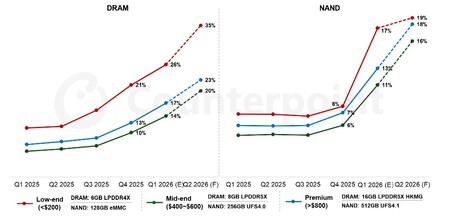
Recently, mobile manufacturers enjoyed an era marked by an oversupply of memory components, allowing outrageous specs at incredibly low prices. However, a report from Counterpoint Research indicates that this golden age is coming to an end. Prices for essential components, particularly RAM (DRAM) and storage (NAND Flash), have skyrocketed. Specifically, RAM prices surged by over 50% while NAND Flash has experienced an alarming increase of more than 90% in a single quarter in 2026.
The Critical Importance of Memory
Why does this matter? It’s not merely a matter of fluctuating market trends; we are witnessing a significant transformation that jeopardizes the financial stability of several manufacturers. Currently, the cost of memory already constitutes nearly half of the manufacturing costs for entry-level devices, frequently eclipsing even that of processors and displays.
The ramifications are dire. Producers face a tightrope walk between raising prices or incurring losses, compelling a downward revision of global shipment forecasts for 2026. Counterpoint predicts a modest decline of 2.1%, while IDC’s estimates are far grimmer, projecting a staggering drop of 12.9%—a far greater contraction than the 12% witnessed in 2022.
AI’s Role in the Crisis
The root cause behind this crisis is straightforward: the burgeoning demands of artificial intelligence (AI) infrastructure. As data centers ramp up their memory consumption for AI models, they inadvertently become fierce competitors for smartphone manufacturers seeking to source the same components. Existing capacity is limited, and profitability dictates that AI developments receive priority.
Impact on Retail and Pricing
Not all mobile devices are affected equally by exorbitant memory prices. According to Counterpoint’s estimates:
- Entry-level devices (priced under $200) will see memory costs account for an astonishing 43% of their total cost, with an expected increase of approximately $30 per unit.
- The mid-range segment ($400-$600) will experience a more moderate increase, with memory representing 25-36% of total costs, translating to potential increases of $60 to $80 per device.
- In the premium segment (over $800), the increases will be less transparent but could escalate by $100 to $150 due to cumulative pressures from both memory and processor costs.
What Lies Ahead?
Users might notice these price changes only subtly, as manufacturers are likely to prune their product offerings to eliminate less profitable models and impose more significant gaps between different tiers. Expect to see the re-emergence of older configurations, such as standard 128GB storage options, and possibly even a regression to slower memory types. This strategy aims to mitigate losses while managing dwindling inventories.
The affordable mobile phone segment is on the verge of a crisis that could irrevocably alter how consumers access technology. As the prices rise and the available options shrink, the dream of owning a high-spec phone at a low price could soon turn into a distant memory.