
The Rise of High-Speed Trains: A Global Perspective
The train is the backbone of many countries. For centuries, it has been key to mobility in Europe, while in Japan, it is essential . China has experienced a railway revolution, and even the United States and Latin America are beginning to invest in passenger mobility by train. However, possessing a railway network is one thing; having a rich high-speed network is another.
This article discusses the countries with the most kilometers of high-speed trains and their future plans , emphasizing the importance of trains in fostering connectivity and economic growth.
China: The Undisputed Queen of High-Speed Rail
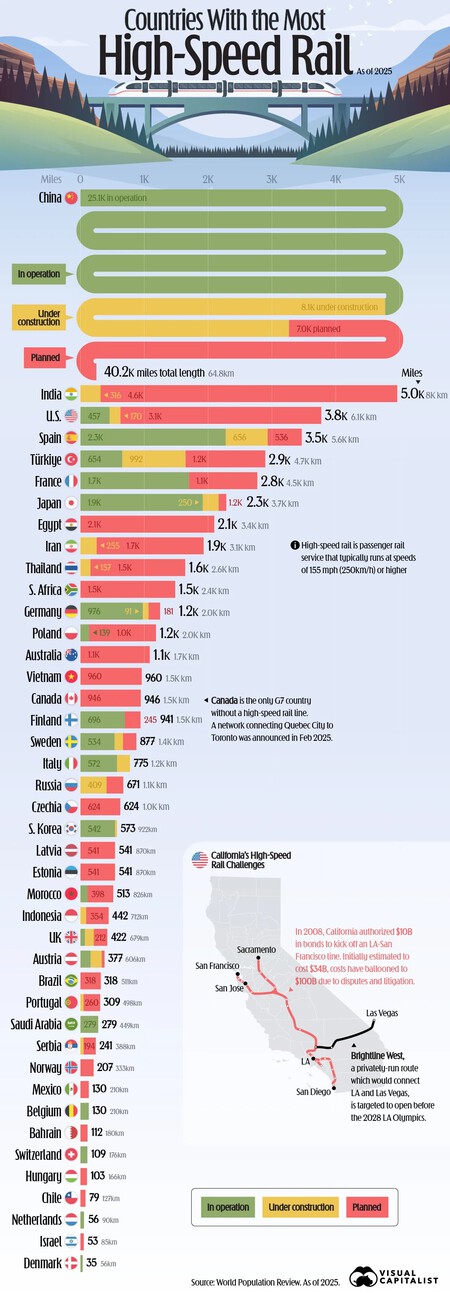
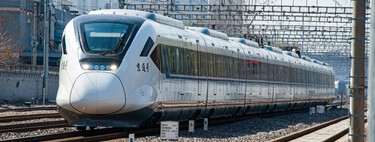
China, undisputed queen. The Olympic Games are an event in which countries “sell” themselves to the world, but for China, it involved a profound renovation of its infrastructure. It was in 2008 when China launched its first high-speed railway line: a mere 120 kilometers between Beijing and Tianjin. Fast forward 17 years, and China currently boasts more than 40,000 kilometers of high-speed tracks operational, with another 12,800 kilometers under construction and over 11,000 kilometers planned. This means that, in total, China has approximately 64,000 kilometers of high-speed tracks.
Moreover, advancements in maglev technology (magnetic levitation) are pushing the boundaries of speed, with trains already connecting cities like Beijing and Shanghai at speeds exceeding 430 kilometers per hour. This expansive network is revolutionizing travel, leading airlines to reassess their market strategies.
Spain and Japan: European and Asian Leaders
Spain and Japan. Despite not leading in overall rail kilometer coverage, both Spain and Japan rank high in operational high-speed rail. Spain has established an extensive high-speed network totaling 5,632 kilometers, with over 3,700 kilometers already operational. Additionally, 1,040 kilometers are under construction , while another 862 kilometers are planned, positioning Spain as the country with the most high-speed rail kilometers after China.
Japan, known globally for its Shinkansen (bullet trains), has established 3,700 kilometers of high-speed rail, with 3,050 kilometers currently in operation, and further expansions in the pipeline with 402 kilometers under construction and 193 kilometers planned. Both countries showcase how efficient rail networks can significantly enhance national and international travel.
Challenges in Expansion: The Reality of Promises
Promises, promises. As trains emerge as a preferable alternative to low-cost international flights, the question arises: Why are there so few countries with high-speed lines ? While several European nations like France, Germany, and Italy boast hundreds of operational kilometers, outside of Europe and instances like South Korea, the situation is quite different.
Take India, for instance. Though shown as the second country on the graph with 8,000 total kilometers, only 508 kilometers are under construction, and the remaining 7,400 kilometers exist only as plans. Similar situations can be seen in Egypt, Australia, and various European nations, where ambitious plans are laid out but little has been operationalized.
America: A Different Story
America. Contrary to what one might expect, high-speed rail in the United States is severely lacking. Spanning only 735 kilometers, with 273 kilometers under construction and almost 5,000 kilometers planned, the U.S. has much work ahead. Spain attempted to export its AVE technology, yet internal mobility still leans heavily toward air travel.
Neighboring Canada has 1,500 kilometers planned but has yet to break ground, while Mexico is in a similar situation with 210 kilometers in plans. Brazil aims for 510 kilometers, and Argentina is yet to make any appearances in the graph. While high speed remains elusive in the Americas, plans are being laid out for expanding railway networks, including international routes, like the proposed train connecting Brazil and Peru.
The driving force behind many of these ambitious projects? Mainly, China, which has gathered substantial experience by rapidly expanding its high-speed rail network. Countries are looking toward China for inspiration and expertise as they seek to transform their railway systems into a more modern and efficient means of travel.
High-speed rail is gradually reshaping the concept of distance and mobility. As nations invest in this crucial infrastructure, the economic, environmental, and social benefits are bound to unfold, redesigning our interaction with spaces and communities.