
Natural gas has emerged as a crucial bridge fuel in the quest for global decarbonization. When utilized for electricity generation, it emits significantly less carbon dioxide than coal or oil. As the world pivots towards renewable energy sources, natural gas remains a vital component in the energy mix, fulfilling energy demands and aiding in the transition. This situation is further complicated by the fuel’s geopolitical importance; countries rich in natural gas reserves play a pivotal role on the global stage.
The intersection of natural resources and geopolitics can be illustrated by a graph created by Visual Capitalist:
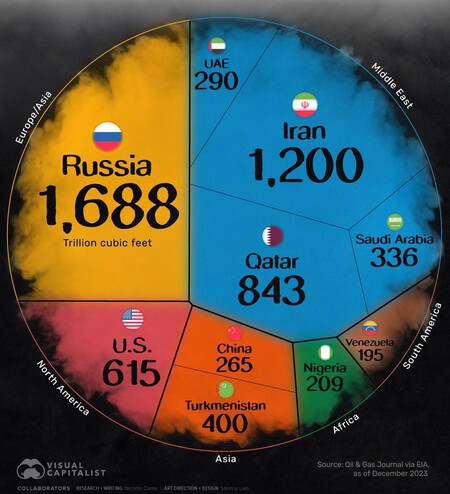
Among the countries with the largest natural gas reserves, Russia , Iran , and Qatar stand out as dominant players. Despite the United States’ significant production, these three nations collectively account for approximately 51% of global reserves. Notably, the first ten countries depicted in the graph hold an astounding 83% of the world’s natural gas reserves.
Russia leads the pack, boasting reserves that are almost three times greater than those of the United States, while Iran follows closely. The strategic presence and control of these resources significantly impact global energy dynamics.

Protagonist role. Control over natural gas translates into power over a significant portion of the world’s energy resources. Currently, natural gas accounts for around 23% of the global energy mix. In specific nations like the United States , this figure climbs to 40% for electricity generation.
This prominence is driven by the efficiency of natural gas as a ‘dispatchable’ energy source . It can be quickly activated and deactivated to adapt to fluctuating demand levels. Its emissions are approximately 50% lower than those from coal and 30% lower than oil, enhancing its attractiveness amid environmental concerns.
Trend. Although the graph represents data from 2023, recent analyses indicate that natural gas is still a critical energy source:
- Natural gas accounted for 33% of the increase in global energy supply.
- Demand for natural gas is projected to increase by 2.5% in 2024.
- Electric generation from natural gas has also seen a growth of 2.5%.
- Natural gas production is set to rise by 1.2%.
- Global trade, both via pipeline and liquefied natural gas (LNG), has increased by 3.3% for the first time since 2021.
Geopolitics. The limited number of countries controlling such a vital fuel makes it a pivotal economic and diplomatic resource. The geopolitical landscape became particularly pronounced during the Ukraine crisis. Prior to 2022, approximately 40% of Europe’s natural gas came from Russia. However, Russia’s invasion of Ukraine resulted in significant supply cuts, turning gas into a tool for geopolitical leverage.
Consequently, the European Union (EU) has re-evaluated its energy security strategies, diversifying its energy sources and investing in infrastructure such as green hydrogen corridors. During this shift, the United States has stepped up to become Europe’s largest gas exporter, wielding its resources in the face of competition.
Artificial intelligence. Beyond political implications, the reliability of natural gas in meeting energy demands is increasingly vital in today’s world. Data centers, which require operational reliability , often cannot rely solely on intermittent renewable sources and depend heavily on consistent energy supply.
As computational demands surge, data centers necessitate vast amounts of immediate energy. This need has led some companies to consider acquiring nuclear plants to ensure their energy requirements are met efficiently.

Gas for a while. Although there is an ongoing push to transition away from natural gas in favor of renewable energy, various factors are currently prolonging its usage. The energy demand of data centers in the United States is predicted to escalate from 180-290 TWh in 2024 to between 515-720 TWh by 2030. Globally, usage could rise from 415 TWh to a staggering 945 TWh within the same timeframe.
Furthermore, projections hint at a potential 50% increase in natural gas demand by 2027 and an even more alarming 165% rise by 2030. Beyond the energy needs of data centers, global demand for natural gas is anticipated to grow by 32% by 2050 , primarily driven by electrification and industrialization in Africa and Asia .
While unforeseen technological advancements in renewable energy could alter these forecasts, the role of natural gas will remain significant on the path to decarbonization. The current trajectory suggests that for the foreseeable future, natural gas will coexist with the effort to achieve a sustainable and greener energy landscape.