
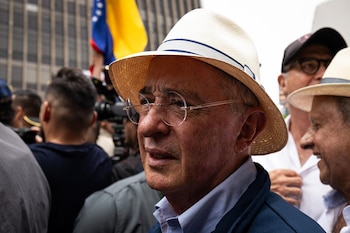
The Prosecutor’s Office of Colombia has officially lodged an appeal against the recent ruling that sentenced former president Álvaro Uribe to twelve years of house arrest. This decision, deemed an act of witness bribery and procedural fraud, has stirred considerable debate within the legal and political communities.
The appeal was filed on Monday, with the Prosecutor’s Office arguing that the initial ruling lacks substantial evidence. In the 81-page document presented by prosecutor Bladimir Table Crespo, the appeal describes the original ruling from Judge Sandra Liliana Heredia Aranda as rooted in “conjectures” rather than verifiable facts. The agency asserts that the decision fails to provide a solid basis for the conclusion of guilt, effectively undermining Uribe’s presumption of innocence.
In the appeal, several issues with the original ruling are highlighted, particularly regarding the evaluation of evidence. The letter states, “The errors in the appreciation of the evidence led to the improper application of legal articles governing this case, which should lead to Uribe’s acquittal.” It emphasizes that the magistrate did not adequately assess the level of awareness Uribe had regarding the alleged actions attributed to him.
Currently, the implications of the ruling against Uribe extend beyond house arrest. In addition to this sentence, he also faces more than eight years of disqualification from public office and a substantial fine of over 3.4 billion Colombian pesos, which is equivalent to about 720,700 euros.
Uribe, now 73 years old, has consistently denied any wrongdoing, claiming to be a victim of political persecution. According to the court, he allegedly instigated others to manipulate witnesses within Colombia’s prison system. The aim was to influence their testimonies in a way that would benefit him and discredit others, particularly in relation to his connections with paramilitary groups.
The controversy began in 2012 when Uribe accused Senator Iván Cepeda of orchestrating a campaign of false testimonies against him. Cepeda, he claimed, had been visiting prisons to recruit witnesses who would provide incriminating statements concerning Uribe’s alleged ties to paramilitary activities in the Antioquia region.
However, as the investigation progressed and evidence was produced, it became evident that Uribe’s legal team was attempting to manipulate witnesses to cast Cepeda in a negative light. Consequently, the senator transitioned from being a subject of investigation to a victim, while Uribe found himself facing serious legal repercussions.
The case has sparked widespread discussions regarding the ethics within the political and judicial spheres in Colombia. Legal experts are closely observing how this appeal unfolds, as it carries significant ramifications for the future of political accountability in the country.
Public opinion remains deeply divided regarding Uribe’s situation. Many supporters view him as a staunch advocate for national security who has been unfairly targeted. Conversely, critics argue that the evidence presented validates concerns about corruption and manipulation within the highest echelons of power.
As Colombia grapples with its turbulent political history, this appeal will undoubtedly play a role in shaping the nation’s legal landscape and the public’s trust in its institutions. The upcoming deliberations by the Bogotá Court could either reinforce or challenge existing perceptions of political immunity, accountability, and the pursuit of justice.
Ultimately, the legal journey of Álvaro Uribe extends beyond mere personal implications; it embodies larger societal questions about governance, ethics, and the ongoing struggle for justice in Colombia. The coming weeks will be critical as the legal proceedings evolve and the nation holds its breath in anticipation of the court’s decision.