
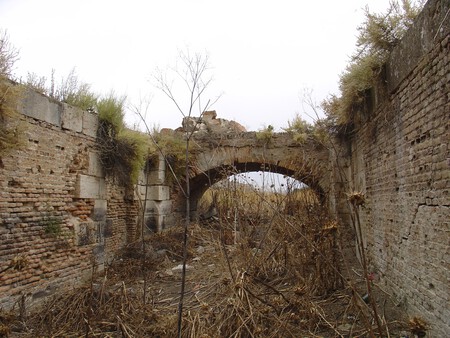
If all roads lead to Rome… Why couldn’t Madrid have at least one that connected it directly and, above all, navigably with the Atlantic? The idea sounds macaronic, but for a while, it seemed to take on all the logic in the world in the mind of King Philip II.
He had reasons to love it, of course. At the end of the 16th century, Spain received laden ships with generous treasures from the Americas in the form of precious metals, spices, and wood. These goods were unloaded in the south of the country, from where they had to travel to Madrid, the seat of the court, on a journey as complicated and perilous as the voyage across the Atlantic.
During this *journey towards the center of the plateau*, carts had to navigate poorly maintained paths that transformed into mudslides whenever it rained. To add to the chaos, they faced the constant threat of the bandits of Sierra Morena. This made transportation risky, complicating the journey and inflating the cost of goods.
The Ambitious Plan of Philip II
Philip II wanted to remedy all of that.
He had a vision. Having witnessed the benefits of river transport in Flanders, he believed that similar systems—locks and canals—could be applied to the Iberian Peninsula. In the 16th century, there were no swamps to hinder ship passage, and the rivers had flows conducive to navigation. Importantly, Portugal was under Austro-Spanish rule, which allowed Madrid to focus its gaze towards Lisbon, rather than the Mediterranean.
With an Eye on Portugal
The mastermind behind this audacious scheme was the Italian engineer Juan Bautista Antonelli, a military engineer with a history of fortification designs under Charles V.
In April 1581, Antonelli secured a royal mandate to explore the Tagus River’s navigability. The ambitious project aimed not only to facilitate transport between Lisbon and Alcántara but to expand navigation from the Tagus to Aranjuez and further along the Jarama and Manzanares rivers. This proposed navigable route spanned approximately 600 kilometers, overcoming a 650-meter elevation difference.
Three months later, Philip II enthusiastically backed Antonelli’s project, understanding the immense commercial benefits, potential wealth for the Royal Treasury, and the prestige it would confer upon his reign. Financial support quickly followed, with the king eager to make the Italian engineer’s ambitions as straightforward as possible.
The Hope and Downfall
By 1583, Antonelli had successfully improved navigability on the Tagus, and Philip II himself traveled from Madrid to Aranjuez to witness the results. A trial run with seven barges subsequently demonstrated the effectiveness of the new routes.
However, the grand dream faced significant setbacks. The first blow came in March 1588 with Antonelli’s death. His absence left the project in the hands of his nephew, Cristobal de Roda Antonelli, who struggled to sustain momentum. Just ten years later, Philip II himself passed away, further jeopardizing the project.
There were also considerable financial challenges, exacerbated by luxury expenditures on the ill-fated “Invincible Armada” against England. The financial drain severely hampered the project, compounded by a significant political shift in 1668 when Portugal regained independence, complicating relations and aspirations for a navigable route from Madrid to the Atlantic. Instead of pioneering infrastructure, the canal became an interesting footnote in the historical narrative of the Habsburg dynasty.
Legacy of the Idea
Despite the initial failure, the idea of enhancing navigable paths remained alive for decades. Various engineers and Bourbon monarchs sought to improve river communications, shifting focus towards southern waterways and even the Cantabrian Sea. Efforts to create waterways, such as the Royal Manzanares Canal between the Toledo Bridge and Jarama River, illustrate the enduring aspiration to connect Madrid to other vital regions.
Ultimately, while the grand vision of Philip II and Antonelli may not have come to fruition, their ambitions catalyzed a broader dialogue about infrastructure and connectivity that echoes in Spain’s waterways today.