

A week ago, I tried the new ChatGPT Atlas , OpenAI’s latest browser. Although I noticed several areas for improvement, it seemed to pose a genuine threat to Google’s dominance with Chrome. Today, I decided to put it to the test again with a Plus subscription . My objective was to find out if agent mode could effectively manage a purchase at Mercadona .
Posing the Situation
This was my first time utilizing ChatGPT for such a task, and I didn’t want just a simple list of items. First, I requested ideas for healthy recipes that are both nutritious and delicious. ChatGPT offered several options, and upon choosing one, I activated agent mode to see if it could manage the ingredients for making chickpea curry.
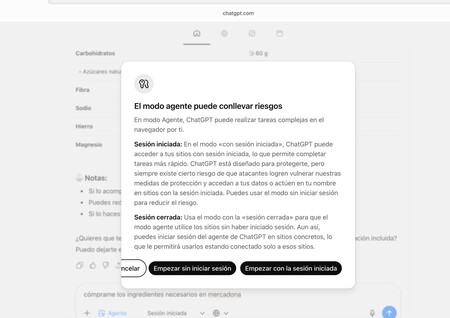
Prior discussions highlighted that AI-based browsers could be vulnerable to prompt injection attacks , and OpenAI is aware of this risk. Before beginning, an advisory note stated that using agent mode carries risks , giving me the option to use it either logged in or logged out. I chose to log in to simplify the process, but I first deleted my payment details on the Mercadona website for safety.
Making the Purchase
Once I accepted the risks, agent mode kicked in, and I observed as the mouse navigated the Mercadona website. The sidebar displayed the model’s thought process while selecting ingredients for the chickpea curry . The video documented the entire purchase sequence, showcasing how the agent was making decisions about various items.
For instance, the recipe called for one onion, but it opted for a 1kg package instead. When selecting spinach, it favored baby spinach over the cheaper larger package. After choosing all ingredients, the agent asked me for confirmation, and when I requested a replacement for the spinach, it complied promptly.
The process came to a halt due to a significant hurdle: my total was only 10.28 euros , while Mercadona’s minimum order was 50 euros . I instructed the agent to include ingredients from an additional recipe for baked salmon . However, that recipe also fell short of the minimum, prompting me to request that it prepare the meal for four people , specifying that I wanted fresh salmon instead of frozen.
The agent adjusted quantities and swapped the salmon for fresh, yet the total still didn’t meet the minimum order. Thus, I suggested it seek out recently viral products at Mercadona to fill the gap.
The Purchase is Made for You, but There’s a Problem
Upon completing the selections, it was time to review the basket. Surprisingly, the agent had added both regular and purple garlic . While the normal garlic was acceptable, the purple option created confusion. It mistakenly searched for purple onion, interpreting Mercadona’s term “red onion” as an indicator for purple garlic, demonstrating a lack of precision in ingredient selection.
Regarding the trending products, my chosen list included a makeup advent calendar , smoked raclette cheese , cookie nougat , and pistachio cake . The total came to 66 euros , which exceeded my original budget. While I had not explicitly requested a strict adherence to 50 euros, the final sum felt excessive.

While the agent had taken charge and completed the shopping for me, it revealed a critical flaw: speed . I hadn’t anticipated the need for adjustments, like handling minimum orders or modifying quantities, which resulted in a drawn-out process. The total time spent was almost 15 minutes , with over 2:14 minutes solely to add eight items to the cart. I couldn’t help but feel that I could have completed the order far more efficiently myself.
As for accuracy, I found that the agent made fewer mistakes than I had feared. However, it remains essential to verify the contents of the basket, as it could easily misplace items like garlic instead of onions; and I definitely have enough garlic stashed away.
Much More Practical in Other Scenarios
OpenAI had promoted agent mode as useful for various applications, including making purchases. After this experience, it’s apparent that the ChatGPT Atlas agent mode has immense potential, but not particularly for shopping. I decided to test its usefulness in another scenario: organizing a trip .
I requested the agent to identify getaway locations within a two-hour drive from Valencia over the December long weekend, complete with a budget and accommodation options from Booking and Airbnb . To my satisfaction, within six minutes, it provided options for two distinct destinations, neatly arranged in a table that included the price per night and highlights. After selecting a destination, I simply had to provide my personal information to finalize the reservation.
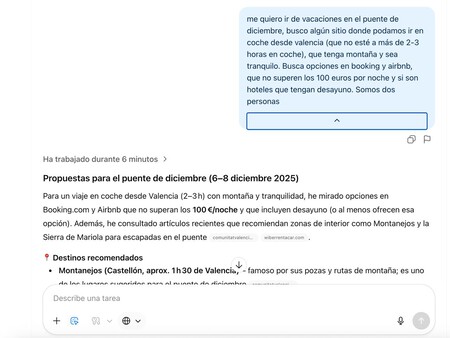
Organizing a trip is practical.
The act of making a purchase is a mechanically simple process that can easily be executed manually within a few minutes. However, when faced with barriers like a minimum order or unclear preferences, the method may consume more time than it saves. On the other hand, the agent excels at more complex tasks requiring multiple steps and information filtering. For instance, organizing travel involves numerous elements—picking a destination, planning routes, finding accommodation, and staying within budget. In such instances, we can allow agent mode to think while we attend to other matters, effectively saving us considerable time.
Images | Amparo Babiloni, Xataka
In Xataka | Some researchers created a company where all employees were AI agents. They didn’t even complete a quarter of the work.