
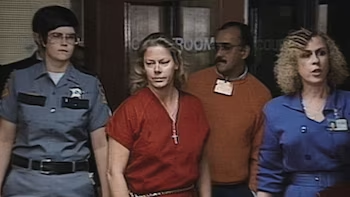
Aileen Wuornos: The Disturbing Life of a Serial Killer
Aileen Wuornos emerged as a chilling figure in American crime during the late 1980s. Born in Michigan in 1956, her early life was riddled with abandonment and abuse. These traumatic experiences profoundly shaped her existence, ultimately leading to a life of prostitution from her teenage years. Between 1989 and 1990, Wuornos, often referred to as the “Queen of the Assassins,” murdered seven men along the highways of Florida, igniting one of the most intense manhunts in U.S. history.
The Elusive Fugitive
For several months, Wuornos eluded law enforcement by constantly moving between cheap motels. Investigators closely monitored her, tracking stolen items linked to her victims in local pawn shops. The combination of her transient lifestyle and the complicity of her partner, Tyria Moore, complicated matters further. Their passionate yet turbulent relationship nurtured an environment that ultimately triggered Wuornos’ downfall.
The Defining Phone Call
A critical turning point in Wuornos’ saga stems from a surprisingly emotional phone call. After her arrest on January 9, 1991, police sought out Moore for assistance in obtaining Wuornos’ confession. Moore, having fled after the crimes, agreed to cooperate with authorities in return for immunity. Under police surveillance, she made a series of recorded calls from a hotel room in Ocala.
In one particularly poignant conversation, Moore implored Wuornos to help clear her name, stating, “I’m not going to jail for something you did.” Wuornos’s heartfelt response was, “I love you. If I have to confess everything to keep you from getting in trouble, I will.” This moment, revealed in the Netflix documentary “Aileen: The Queen of the Assassins,” set the stage for the confession that sealed Wuornos’s fate.
A Dark Confession
With the police present, Wuornos confessed to the murders that had shocked the nation. This marked her transition from a fugitive to one of America’s most infamous serial killers. Her criminal career was fueled by a tumultuous past characterized by abandonment and abuse. By sixteen, she was living on the streets, relying on prostitution to survive, before meeting Moore in 1986.
The List of Victims
Between late 1989 and 1990, Wuornos committed a series of heinous acts, murdering seven men, including Richard Mallory and David Spears. Most of her victims were middle-aged white men, whom she would rob after killing them. The bodies were often discovered near highways, sometimes with their vehicles abandoned, a pattern that led investigators to connect the dots.
Ballistic evidence, used condoms, and DNA evidence from hair found at the crime scenes provided further links to Wuornos. Witness testimonies also described seeing two women leaving the scene of one of the murders, which heightened police interest in the couple.
The Trial and Aftermath
During her trial, Wuornos claimed that her first victim, Richard Mallory, had raped and tortured her before she shot him in self-defense. However, much of this context was not shared with the jury. After just two hours of deliberation, she was convicted of first-degree murder and sentenced to death.
Wuornos expressed a desire for an end to her life, frequently stating her intent to “die as soon as possible.” In her isolation, she grappled with her deteriorating mental health, often feeling betrayed by those close to her, including Moore, who sold her story to the media.
The End of a Grim Legend
Aileen Wuornos’s story concluded on October 9, 2002, when she was executed by lethal injection at Florida State Prison. In her letters from prison, she openly acknowledged her crimes, stating, “I killed those men, I robbed them cold as ice. And I would do it again.” Her confessions and continuing mental instability painted a harrowing picture of one woman’s tragic descent into infamy.