
Chile’s Historic Elections: Presidential and Parliamentary Voting
This Sunday, Chile will witness presidential and parliamentary elections in a climate marked by intense political polarization. The ruling party, led by a left-wing candidate, is vying for the citizen vote against eight candidates for the highest office in the Executive branch.
These elections mark the ninth presidential elections since Chile’s return to democracy in 1990, this time featuring mandatory voting for all citizens aged 18 to 65. Officials anticipate that this new mandate will double citizen participation compared to prior elections and may increase the likelihood of requiring a second-round election on December 14.
Key Issues in the Campaign
A variety of pressing issues dominate the campaign narrative, including public safety, immigration, and economic recovery. The eight candidates competing for the presidency include Franco Parisi of the People’s Party, Jeannette Jara from Unidad por Chile, Marco Enríquez-Ominami of the Progressive Party, Johannes Kaiser of the National Libertarian Party, José Antonio Kast of the Republican Party, Eduardo Artes of the Proletarian Action Party, Evelyn Matthei from Chile Vamos, and independent Harold Mayne-Nicholls.
The Safety and Security Measures in Place
The Strong Operation for Elections
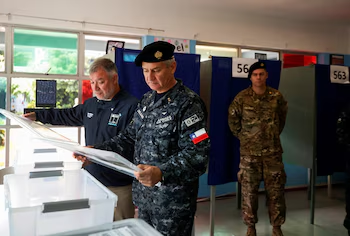
Over 23,700 members of the Carabineros de Chile will be deployed across the nation to ensure a safe and secure election day. Authorities are optimistic that the voting process will transpire peacefully throughout all regions.
Vote Counting and Transparency
The Counting of Votes
Approximately 18,945 officials will oversee the smooth functioning of election day, ensuring effective vote counting. The Electoral Service of Chile (SERVEL) will be responsible for scrutinizing votes and transmitting results, which will be available on their official website post-election.
What’s on the Ballot?
Renewing Parliamentary Seats
In addition to the presidential vote, citizens will cast ballots to renew the Chamber of Deputies across 16 provinces: Arica and Parinacota, Antofagasta, Atacama, Metropolitana, O’Higgins, Maule, Ñuble, Biobío, La Araucanía, Aysén, Magallanes, Tarapacá, Coquimbo, Valparaíso, Los Ríos, and Los Lagos. Electoral duties also include electing senators in seven regions: Arica and Parinacota, Valparaíso, Maule, Tarapacá, Atacama, La Araucanía, and Aysén.
Time for Change: New Leadership
When Will the New President Take Office?
In the event that no candidate achieves over 50.01% of the votes in the first round, a second round will be held. The top two candidates will face off on December 14, with the elected president assuming office in March 2026 as the thirty-fifth president of the Republic.
Key Details for Voters
Voting Hours and Locations
Polling stations will operate from 8:00 a.m. to 6:00 p.m. local time, allowing citizens to cast their ballots at any of the 3,498 voting centers across the nation and abroad. Results will be disseminated the same day.
Electoral Responsibilities and Penalties
Mandatory Voting Compliance
With mandatory voting enforced, citizens over the age of 18 who fail to vote without an official justification face fines between $41 and $122, as established by electoral authorities.
Global Participation
Voting from Abroad
Polling stations have been set up in locations such as Auckland and Wellington to allow Chileans abroad to vote, with around 160,000 citizens authorized to participate globally across 64 countries.
Anticipation Builds for Election Day
Engaging the Voter Base
A total of 15,776,102 Chilean citizens are registered to vote, along with 886,190 foreigners residing in Chile for over five years. This election is crucial for setting the future political landscape of the country and determining the legislative paths for various political factions in Parliament.