
For years, the domain of commercial aviation has been in the hands of two giants : Airbus and Boeing. China wants to break that hegemony, and is ready to do it with its own name in the cabin. Comac, the China Commercial Aircraft Corporation , has been striving for years to produce aircraft that can compete with these global titans. First came the C919; now, the focus has shifted to the ambitious C929.
This new model, still in the preliminary design phase , signifies Beijing’s serious ambition to introduce a long-range aircraft into the international market. The objective is straightforward: to rival heavyweights like the Airbus A330neo, the A350, and the Boeing 787 Dreamliner. Notably, the C929 is expected to accommodate approximately 280 passengers and boasts an estimated range of 12,000 kilometers , allowing it to potentially service routes such as Beijing to New York .
The Internal Deployment of C919: A Discreet but Strategic Conquest
The C919 might not yet dominate the global skies, but it has made significant inroads within China. Since its official unveiling in 2017 , it has undergone years of testing, certification, and modifications. According to SCMP, by June 2025, around 18 aircraft are expected to be operating domestic routes, primarily operated by airlines like China Eastern Airlines.
While this number might appear modest, the fact that the aircraft operates solely within China isn’t necessarily a failure. On the contrary, China is one of the largest aviation markets globally. In this context, establishing an indigenous aircraft capable of covering regional routes without relying on Western manufacturers represents a significant strategic move.
Comac’s real commitment, however, lies in the C929. This aircraft, featuring a wide-body structure and long-range capabilities , aims to compete with the most advanced models already available. Recent months have seen increased momentum for the project; Air China signed an agreement to become a launch customer, and a supplier has anticipated delivering the first fuselage section by 2027 .
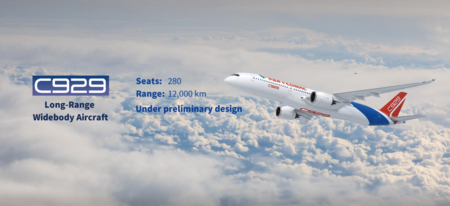
Promotional Image of Comac C-929
The development trajectory of C929 is rather unique. Originally a collaborative project with Russia, it was designated CR929 and spearheaded by a joint venture called CRAIC (China-Russia Commercial Aircraft International Corporation). However, given political tensions , the invasion of Ukraine, and subsequent international sanctions on Moscow , this collaboration was ultimately dissolved. Since 2023 , Comac has opted to proceed independently, transforming the C929 into a purely Chinese endeavor.
Comac has positioned this aircraft as a result of advanced technologies, including optimized aerodynamics , cutting-edge engines, and the integration of intelligent flight systems. Theoretically, it is designed to compete with its Western counterparts in performance and efficiency.

A C-919 Landing in China
However, there’s a crucial aspect to consider: the C929 depends significantly on Western technology. Safran , the prominent French aerospace manufacturer, has entered a Memorandum of Understanding with Comac to supply essential components such as the brake system, ice detection systems, tire pressure sensors, and the oxygen system . Additionally, American firm Crane Aerospace will provide sensors for cabin doors.
These agreements illustrate Comac’s ability to attract international suppliers, but they also reveal an uncomfortable truth: the program remains heavily dependent on foreign technology . This creates latent risks, especially in today’s unpredictable global environment.
The Russian Precedent That China Cannot Ignore
Russia serves as a cautionary tale. Recent Western sanctions have severely restricted the country’s access to crucial components in the aerospace sector. The TU-214, a mid-range aircraft, faced significant operational challenges due to its reliance on foreign technologies for critical systems. While Moscow is working on local solutions, it may come at the expense of performance and reliability .

China, while resilient and capable of navigating industry challenges, could find itself constrained by a sudden change in U.S. commercial policy. Such a shift might leave them without access to key Western engine technologies . As a Safran spokeswoman indicated during the Paris Air Show, this scenario raises critical questions about the future viability of the C929 project.
Images | Comac
In Xataka | The C919 Comac