
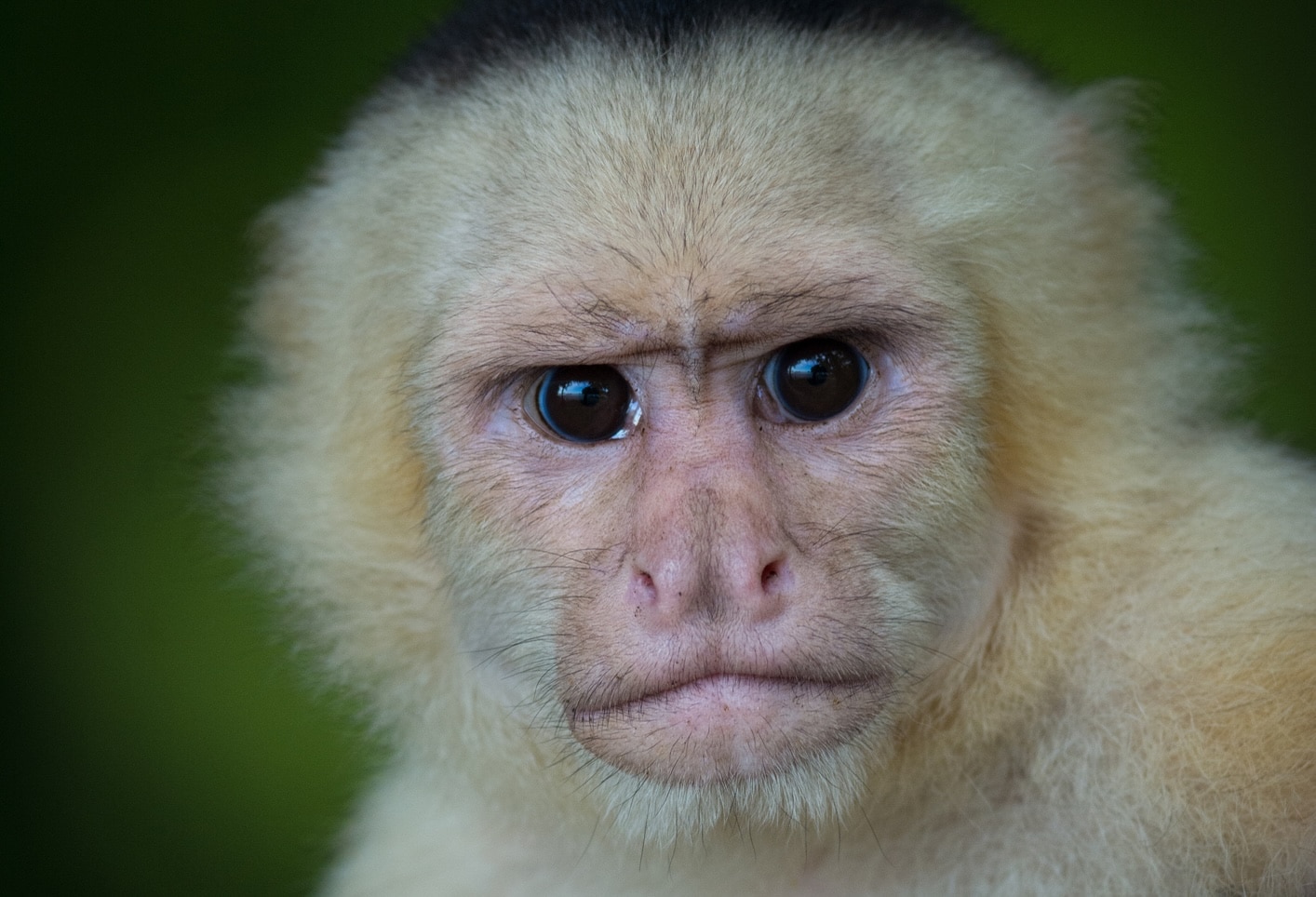
On the isolated island of Jicarón , off the coast of Panama , a perplexing phenomenon is captivating primatologists: white-faced capuchin monkeys have adopted behaviors that have never been observed before in wild primates. Since 2022, several young males have begun kidnapping infants from another species of monkey — the howler monkeys — for reasons that remain unclear.
Initially, this might have seemed like a behavioral anomaly. However, what began as a rare incident has transformed into a genuine social trend , alarming researchers who have been monitoring this unique population for years.
A Confounding Scene in the Jungle
The whole situation started when doctoral researcher Zoë Goldsborough was observing the capuchins of Jicarón through motion-detection cameras . These primates are known for their intelligence and use of stone tools, and they were the subject of intensive observation. One day, while reviewing the thousands of videos accumulated, she stumbled upon a surprising scene: a young male capuchin carrying a baby howler monkey on its back.
This type of interspecies interaction had never before been documented on the island. Curious, Goldsborough delved into the archives and discovered four similar cases, all involving the same individual, nicknamed “Joker.” At this point, researchers considered it a peculiar form of adoption.
But soon, things took a dramatic turn.
When a Peculiarity Becomes Fashionable
Five months later, videos revealed that other young male capuchins began doing the same. Over a period of 15 months, eleven distinct incidents of howler monkey baby kidnapping were recorded. Always very young (under four weeks), these infants were spotted clinging to the bellies or backs of their abductors, following the group through the forest.
The most puzzling aspect? The capuchins do not appear to be aggressive. “They do not harm them,” Goldsborough emphasizes. However, they also do not feed them. Evidence suggests that none of the kidnapped infants survived due to the lack of maternal milk.
A Cultural Tradition… Without Purpose
This behavior, as strange as it is tragic, does not seem to provide any clear advantage to the capuchins, nor does it appear to cause them any evident disadvantage. Researchers are observing the emergence of a “ social tradition ” — a non-human cultural phenomenon, passed down through learning among individuals.
“It’s like a social trend that spontaneously appeared in one individual and then spread to other young males,” explains researcher Brendan Barrett .
A tradition, yes — but without a clear function. A kind of gratuitous innovation , born out of boredom?
The Luxury of Animal Indolence?
This is precisely one of the hypotheses put forward by the team. On Jicarón, the capuchins live in an exceptionally safe environment : no predators, few competitors, and a lush forest. This unique context might encourage the exploration of new behaviors, even those that appear absurd or non-adaptive.
Meg Crofoot, director at the Max Planck Institute of Animal Behavior and co-founder of the project, succinctly summarizes the situation:
“Life is easy on Jicarón. The capuchins have free time and little constraint. Boredom, combined with their social intelligence, might explain the emergence of this strange tradition.”
A Threat to the Howler Monkeys
Yet beyond the fascinating aspect of this discovery, the ecological consequences are troubling. The howler monkeys of Jicarón are already a threatened species. If this trend of kidnapping continues, it could severely impact the renewal of local populations.
The phenomenon thus raises a disturbing paradox: a cultural behavior in an intelligent species, but with deleterious consequences for another.
A Unique Story Worldwide
To date, no other population of wild primates has been observed practicing this kind of behavior. For researchers, this underscores the importance of monitoring these behavioral dynamics in real-time, especially in a context of global change, where ecological pressures and imbalances may lead to unexpected behaviors.
“Witnessing the birth and diffusion of this behavior has been overwhelming,” concludes Crofoot. “It reminds us of how capable animals are of imitating, innovating, but also disrupting their environment.”