
| IN BRIEF |
|
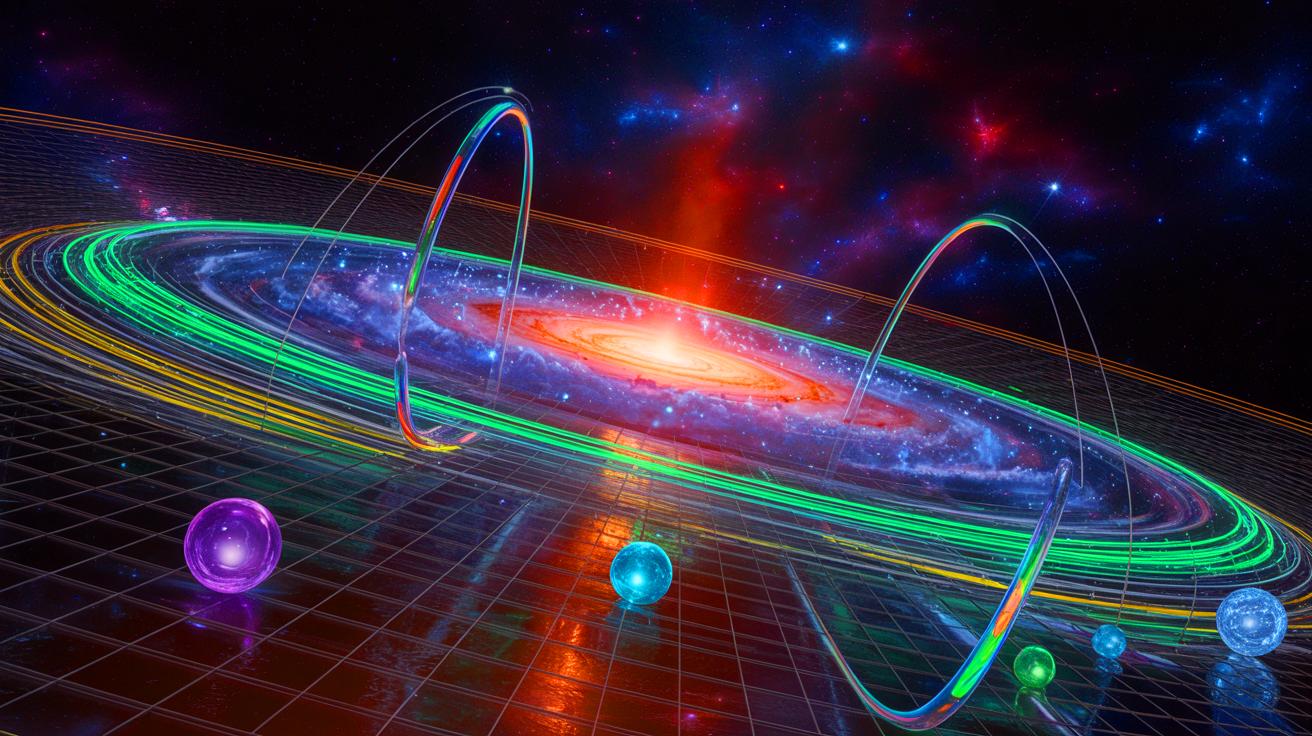
The quest to unify Einstein’s general relativity with quantum physics has been a significant challenge for physicists. Although both theories have proven effective, they describe vastly different scales of the universe. A new study proposes a fascinating advancement by linking these two theories and suggesting that gravity might emerge from quantum entropy. This groundbreaking discovery led by Ginestra Bianconi from Queen Mary University of London could transform our understanding of the universe’s fundamental forces.
Understanding the Link Between Quantum Entropy and Gravity
For decades, physicists have tried to find a unified theory that integrates quantum mechanics with general relativity. This challenge is monumental because quantum mechanics deals with the unpredictable nature of particles at microscopic scales, while general relativity explains gravity as the curvature of space-time caused by massive objects. These two theories thus address forces that exist on different scales.
Bianconi has adopted an innovative approach to overcome this challenge, proposing an entropic action in which space-time no longer serves as a fixed backdrop but functions as a quantum operator. This operator acts on quantum states, determining how they evolve over time. By introducing a mathematical tool known as the G field into this entropic action, she managed to maintain the validity of equations when space-time interacts with matter as a quantum operator. Modified Einstein equations and equations of motion for matter and the G field emerge from this approach.
What if gravity came from disorder? This bold hypothesis challenges the foundations of physics
Equations Beyond General Relativity
In addition to elucidating the connection between gravity and entropy, the equations in Bianconi’s study offer a constant that may explain why the universe is expanding at an accelerated rate. The theory goes further by predicting the emergence of a small positive cosmological constant, a value that aligns well with experimental observations of the universe’s accelerated expansion.
These intriguing discoveries could profoundly change our understanding of gravity, dark matter, and the universe as a whole. However, further research is necessary to gather more evidence supporting these findings. Published in the journal Physical Review D, this study opens exciting perspectives for the future of theoretical physics.
Possible Implications for Dark Matter
Dark matter remains one of the greatest mysteries of modern cosmology. The modifications proposed by Bianconi in Einstein’s equations could offer new clues to unravel this enigma. The G field introduced in the entropic action could be a potential candidate for dark matter.
Traditionally, dark matter is described as a form of matter that does not interact with light, making its direct observation impossible. However, it exerts a significant gravitational influence on galaxies and galaxy clusters. If the G field is indeed linked to dark matter, this could revolutionize our understanding of the universe’s composition.
This hypothesis requires experimental research for verification, but it opens doors to new ways of comprehending the universe and its hidden forces.
Future Challenges for Scientific Research
While Bianconi’s propositions are fascinating, they also present numerous challenges for the scientific community. The experimental validation of these ideas necessitates advanced technologies and international collaborations.
One of the main obstacles is designing experiments capable of testing these new theories on both quantum and cosmological scales. Additionally, it may take technological advancements to directly observe the effects of the G field or to measure the entropic influences on gravity.
How will physicists overcome these challenges to integrate these concepts within existing theoretical frameworks? This remains an open question, sparking vigorous debate and new research in the field.
Ginestra Bianconi’s theory presents a bold perspective on gravity and entropy, potentially capable of changing our understanding of the universe. However, this proposal raises many questions requiring thorough investigations. How might this new vision reshape our approach to the fundamental laws of physics, and what impact could it have on our understanding of the universe?
The author relied on artificial intelligence to enrich this article.
Did you enjoy this? 4.4/5 (26)