

In May 2024, the New York Times published a startling report revealing the depths of the real estate crisis in China. The scale of the problem was staggering: there were four million finished apartments lacking buyers, along with another ten million sold but still under construction. This significant oversupply mirrors a historical precedent set in Japan during its own economic downturn in the 1990s.
A year later, the situation in China has worsened.
The Japanese Precedent
The inevitable comparison between the current Chinese economy and Japan’s in the 1990s stems from both countries grappling with the fallout of inflated real estate bubbles created by erratic fiscal policies, excessive optimism, and challenging demographic trends. Japan enjoyed a housing boom that saw prices double relative to rents, fueled by first-time buyers, favorable tax policies, and financial deregulation.
This illusion of wealth spurred consumption and employment in Japan, but as the population aged and fewer first-time buyers emerged, real estate values plunged. This initiated a deflationary trap characterized by rising unemployment and declining birth rates.
The Japanese Solution
Japan’s political response, which leaned heavily on aggressive monetary and fiscal interventions, failed to address the issue’s root cause: a chronic demographic crisis rather than a temporary one. This misguided approach exacerbated existing socio-economic imbalances, artificially inflated housing prices, delayed marriages, and inhibited birth rates.
Over time, Japan emerged from deflation , yet found itself ensnared in a cycle of long-term inflation . This was driven by increased labor costs due to workforce shortages, industrial stagnation, and a decline in global competitiveness, compounding the challenges posed by an aging population. What began as “lost decades” could potentially stretch into “lost centuries.”
The Chinese Challenge
Today, China confronts an even more dire scenario. Rapid urbanization, stringent land sale policies, and local governments’ fiscal dependence on real estate led to an inflation of housing prices to unprecedented levels . At its peak, the real estate sector accounted for one-fourth of the national GDP and a significant portion of public revenue, representing around 70% of household assets —in contrast to 50% in Japan in 1990.
When factoring in the price-to-income ratio, which was over twice that of Japan, and the housing investment that surged to 1.5 times greater relative to GDP than Japan, the bursting of this bubble resulted in millions of unsold homes, abandoned construction projects, chronic overcapacity, and a destruction of family wealth totalling the entire output of a year’s national economy.
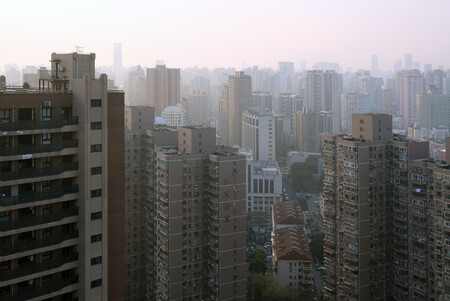
Residential Zone in Shanghai
The Demographic Trap
While Japan experienced a decline in first-time buyers over 40 years , China’s predicament is exacerbated by its former one-child policy . Today, new homeowners typically enter the market between the ages of 28-32 . That peak demographic reached its height in 2019 , just prior to the bubble’s burst—meaning there’s an absence of the secondary demand that Japan experienced in the 2000s.
Moreover, China’s elderly population is set to grow startlingly fast; it will take just two decades to reach what Japan achieved in 28 years . In addition, China’s low internal consumption —only 38% of GDP in 2020 compared to Japan’s 50% in 1990—restricts the domestic demand necessary to cushion the crisis.
The Evergrande Case
The Evergrande saga symbolizes the struggles of a once-booming real estate market, now trapped in a downward spiral for five years. Their staggering debts, peaking at $360 billion , forced them to withdraw from Hong Kong’s stock market, showcasing the overall debt-laden reality of the sector.
At its zenith, Evergrande mismanaged its growth through aggressive debt accumulation. The government’s financial restrictions in 2020 precipitated its collapse, exposing the fragility inherent in a sector so reliant on speculation and easy credit.
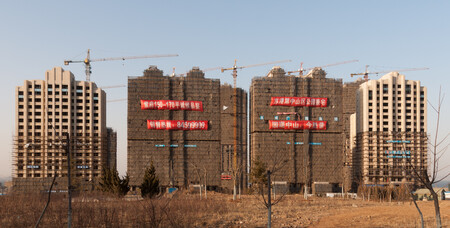
Urbanization, Debt, and Speculation
The seeds of today’s crisis were sewn back in 1998 , when China liberalized its housing market amid a largely rural population. This policy change prompted an unprecedented urban migration of nearly 500 million people , transforming real estate into the primary asset for Chinese families, which now represents 80% of their wealth.
Between 2000 and 2015 , housing prices skyrocketed by sixfold , fueled by speculative buying and a system allowing developers to pre-sell homes that were yet to be constructed. Simultaneously, local governments became increasingly reliant on land sales for revenue, thereby further inflating property values.

The “Three Red Lines”
In a bid to stave off a financial cataclysm, the Chinese government introduced strict measures known as the “three red lines” in 2020. These restrictions capped developers’ debt levels, limited liquidity, and curtailed mortgage offerings, starving companies reliant on credit and coinciding with the Covid-19 pandemic , which halted construction and diminished consumer demand.
The crisis officially began when Evergrande defaulted in 2021 , a trend followed by companies like Country Garden and Sunac. The judicial system in Hong Kong has since ordered the liquidation of several major real estate firms, including China South City Holdings as of August 2024, highlighting the structural weaknesses in the sector.
Price Drop and Excess Supply
The housing demand flattened in 2022; economic uncertainties and rising unemployment diminished consumer confidence. By August 2024, home prices experienced their steepest decline in nine years , while China now faces a staggering 400 million square meters of unsold properties, in addition to countless incomplete buildings.
Excessive family debt exacerbates the crisis, with mortgage burdens soaring to 145% of disposable income per person. As defaults rise, families are increasingly selling homes at a loss, further deepening the price decline and eroding buyer confidence.
Beijing’s Dilemma
The Chinese government is at a critical juncture. On one hand, it needs to support an industry employing over 50 million workers , while maintaining vital local government revenues and stabilizing the banking system. On the other, there is a pressing need to move beyond the debt-driven growth model that triggered this crisis.
Despite promises from officials like Li Qiang to introduce new policies addressing home-buying flexibility in suburban regions, the scale of the challenge remains daunting. The enormity of the overdeveloped housing market makes any remedy seem more a damage-control effort rather than a sustainable solution.

A Stagnant Future
As historical contexts illustrate, Japan struggled for decades to recognize that its crisis was fundamentally demographic rather than financial. China now risks repeating this oversight, albeit with potentially more severe implications. With a more inflated real estate bubble , diminishing consumer demand, and an aging populace, China is entering a tumultuous period of chronic vulnerability .
Should the response involve merely short-term financial stimuli without tackling essential structural reforms regarding birth rates, welfare systems, and economic models, China could not only echo Japan’s “lost decades” but also potentially sink into a protracted era of stagnation, undermining its global economic prospects.
As aptly summarized by sources at Bloomberg , the overarching concern may not be whether China can regain the dynamism of past decades, but whether it can innovate its economic structure to avert an implosion that jeopardizes its social stability and government credibility.
Image | Pexels, Kallerna, Cephoto, Uwe Arana
In Xataka | China is moving whole buildings at the same time to build underneath. Because? Because it can
In Xataka | China wanted to turn a village into a great tourist resort. Did not have the numantine resistance of a neighbor.