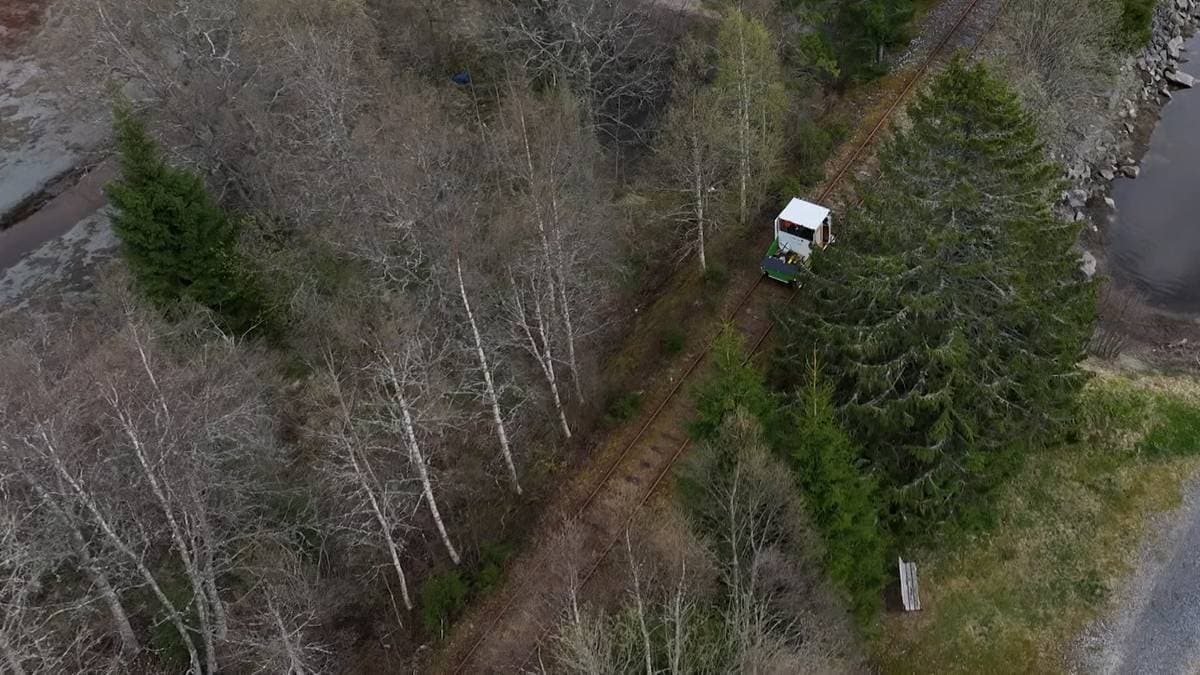
In recent years, researchers and students from universities in Norway and Sweden have worked together to develop the railway. They have now been in Namsos to test remote control of trains on the closed Namsosbanen. Develop new rail technology The train is built by students in both Trondheim and in Linköping in Sweden, and it is controlled from a control room close by. The goal is first and foremost to test remote control and develop this technology. – We want to develop new rail technology. For the railway, perhaps has been perceived as being a little in arrears with the development of technology. We will now change that, says Professor Nils Olsson at NTNU in Trondheim. The driverless train is built by students in Linköping and Trondheim. Photo: Espen Andreas Sandmo / news The Norwegian-Swedish collaboration is part of a major European development project. Future Remote Train is a collaboration between 50 partners to develop the future trains in Europe. – Our part of the project looks specifically at this with remote control. There is rapid development in many areas, such as driver support for cars, remote control of drones, and not least technology development in the oil industry, says Olsson. In Namsos, the small train runs up and down the over 90 years old, and long ago closed railway track up towards Overhalla. The research team believes they have taken big steps in the development of new technology over the past year. Believe in driverless trains – we want to ensure that the railway is included in the development. And I imagine that in the future we can get driverless trains. What we are doing here is a good start, and I think it can be a reality in a few years. This is stated by NTNU student Emilia Salvesen Kozarovic, who writes a master’s thesis on the project. NTNU student Patrick Urassa controls the train from this control room. Photo: Espen Andreas Sandmo / news In the control room sits NTNU student Patrick Urassa from Tanzania. He has full control over the train via a control panel and a large screen. In the future, perhaps more driverless trains can be controlled from a control room with the new technology. – We will end this research project during the autumn of 2026, but we are already seeing if it is possible to continue it, says Nils Olsson. New hope for railway routes Project manager Tomas Rosberg from the University of Linköping in Sweden has been working on this in recent years. He has a lot of faith in the development of new technology that can change the way to rail in the future. – Yes, absolutely. We cooperate on this because we have equal challenges when it comes to railway operations in Sweden and Norway. We have the same conditions with demographics and geography. We have many railways that have little traffic and challenges around it, says Rosberg. Researchers and students have tested the driverless train in Namsos in recent days. From the left we see Tomas Rosberg, Emilia Salvesen Kozarovic and Nils Olsson. Photo: Espen Andreas Sandmo / news Driverless trains controlled from a larger central can thus become the solution of the future to improve the economy of low traffic rail and who are struggling today. – I think so. In the past year, we have only come a long way in the development of technology. So maybe in 10-15 years, remote -controlled trains are a reality in both Norway and Sweden. Not least thanks to the development of the telecommunications network. For 4G and 5G it makes it possible to control the trains over the net, says Rosberg. – Remote control is perhaps a preliminary solution before we get full autonomy, and a reserve system if something goes wrong. This is really exciting, and some of the most fun I’ve been working on, says Tomas Rosberg. The small train has run up and down the closed railway track in Namsos in recent days. Photo: Tariq Alisubh / news Published 28.04.2025, at. 16.58
ttn-69