
A mega cruise can offer so many attractions that at times it’s easy to forget you’re sailing. Carnival aims to respond to this contradiction with the Carnival Destiny, a ship of enormous dimensions designed not just for volume or capacity, but to foster a profound connection with the ocean. The shipping company envisions an open architecture featuring abundant glass surfaces, expansive views, and spaces crafted to maintain a constant visual link with the sea.
Carnival Destiny: A New Era of Cruise Ships
Carnival Destiny will be the inaugural vessel in the forthcoming Ace class, which comprises three ships slated for delivery between 2029 and 2033. Construction officially commenced at the Fincantieri shipyard in Monfalcone, Italy, where a 3D hologram of its design was revealed. With its launch scheduled for summer 2029, the ship will embark on voyages to popular destinations in the Caribbean, Bahamas, and Mexico.
In terms of size, the Destiny will rank among the largest cruise ships, boasting approximately 230,000 GT of gross tonnage and a capacity of around 8,000 passengers. While it won’t be the largest by volume—Royal Caribbean’s Icon class ships, such as the Icon of the Seas, measure around 250,800 GT—Carnival’s design aims to create a unique cruising experience focused on engaging with the ocean.
A Giant that Emphasizes Ocean Exposure
The distinctive feature of the Carnival Destiny is its design—the ship will not prioritize a central attraction or thematic space but will instead concentrate on engaging with the outside environment. Carnival asserts that this ship will be the most outward-oriented megacruise vessel available, aiming to make the ocean a central theme rather than merely a background element.
Innovative Glass Architecture
To realize this vision, the ship will incorporate over 18,200 m² of glass surfaces, including multi-story glass walls that will enhance sightlines and provide more external-facing spaces. The architectural layout aims to minimize visual obstructions, allowing for unobstructed views across the vessel. Full details of this innovative design remain forthcoming, but early announcements reflect a commitment to integrating the sea into the ship’s overall aesthetic.
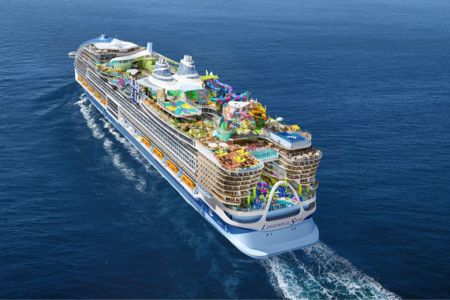
This image shows Royal Caribbean’s Legend of the Seas, not the future Carnival Destiny. Delivered in June 2026 as the third ship of the Icon class, it represents the current reference against which Carnival will place its new giant
Accommodations Designed for Ocean Lovers
The Destiny promises an unprecedented number of cabins featuring balconies and stunning sea views, although specific numbers have yet to be confirmed. The redesign of the Lanai, an exterior promenade that promotes continuous interaction with the ocean, reflects Carnival’s ambition to redefine the onboard experience beyond just grand viewing areas.
New Concepts Awaiting Unveiling
Significantly, Carnival plans for over 70% of the spaces and attractions to include unique concepts not utilized in previous ships. This encompasses dining venues, bars, lounges, entertainment spaces, and outdoor areas, paving the way for a fresh cruising experience. However, details are still sparse; prospective travelers will have to remain patient for further announcements.

Rethinking the Cruise Experience
The Destiny’s approach highlights a fundamental contradiction in the cruise industry: as ships grow larger and activities proliferate, the vast ocean may become overlooked. Carnival aims to address this by enhancing the presence of balconies, exterior walkways, and expansive glass to blur the lines between ship and sea. As we await its unveiling in 2029, we remain curious to see if this new architecture will indeed transform the cruise experience or if it remains an ambitious promotional promise.
Images | Carnival