
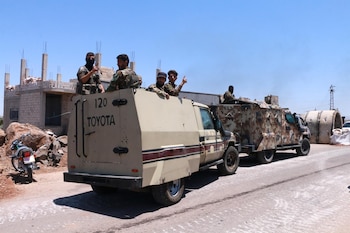
The Syrian regime announced on Tuesday the entry of its security forces in Sweida, a city predominantly inhabited by the Druze community located in the southern part of the country, following three consecutive days of intense clashes. These confrontations, which erupted between militias of the Ismaelite minority and Bedouin groups, have left over a hundred casualties. The decision to deploy security forces was backed by local religious leaders , who also urged armed factions to surrender their weapons .
The offensive launched by the Syrian army , coinciding with an announced ceasefire, occurred against a backdrop of escalating tensions in a region afflicted by sectarian strife . As reported by the Interior Ministry in Damascus, an indefinite curfew has been implemented in the city. “The forces of the Ministry of Interior and Defense will begin to enter the center of Sweida,” stated General Ahmad Dalati, the head of security in the area.
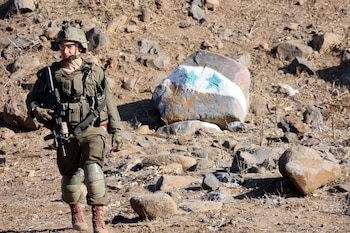
In response to escalating tensions, Israel launched several airstrikes targeting positions held by the regime in the city. The first attack occurred on Monday, followed by additional strikes on Tuesday, as reported by the official Syrian news agency SANA . The Israeli government confirmed these operations, emphasizing that it will not permit hostile military presence near its northern borders.
“We are acting to prevent the Syrian regime from compromising the Druze population and ensuring the demilitarization of the border area ,” stated Prime Minister Benjamin Netanyahu alongside Defense Minister Israel Katz . Both officials have ordered the army to target tanks and armored vehicles of the Syrian regime identified in convoys heading towards Sweida, as well as strategic routes leading to the city.
An official statement from Israel’s defense forces ( IDF ) confirmed the action, detailing that they had begun attacking military vehicles belonging to the Syrian regime in the AS-SWEIDA region. This operation was launched after convoys containing personnel carriers and tanks were observed moving towards southern Syria.
The Syrian defense minister, Murhaf Abú Qasra , declared a total ceasefire in Sweida and assured that government forces would take action against any illegal groups that violate the agreement. He also reassured residents that they could return home once order is restored, warning, “Those who violate the ceasefire will face consequences,” he asserted in a social media post.
The hostilities prompting this escalation began with armed clashes between Druze and Bedouin militias , resulting in at least 102 fatalities , as reported by the Syrian Observatory for Human Rights. The casualties include 61 Druze , including two children, 18 Bedouins , 16 security personnel , and seven unidentified individuals wearing military uniforms. The same agency reported many wounded, several of whom are in critical condition.
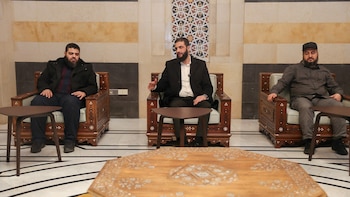
The province of Sweida serves as the main bastion for the Druze community in Syria, a religious minority regarded as an esoteric branch of Shia Islam , with an estimated population of around 700,000 in the country. Significant Druze communities are also present in Israel and Lebanon . In this context, Israeli authorities have reiterated their commitment to protecting Druze individuals in Syria, reflecting historical and familial ties with the Druze in Israel.
Since the collapse of the regime led by Bashar al-Assad in December 2024, an outcome of a robust rebel offensive spearheaded by the group Hayat Tahrir Al-Sham (HTS) , the transitional government led by Ahmed al-Shara (previously known as Mohamed al-Golani Abú) has been confronting serious security challenges , many marked by ingrained sectarian violence.
Despite Damascus’s efforts to expand its territorial control and integrate local militias into its framework, the situation in Sweida reveals the challenges faced by the new political order in stabilizing vital regions of the country. It also underscores the limitations of central authority when confronting military interventions from foreign powers such as Israel . The sustainability of the ceasefire and the disarmament of Druze militias will be critical to prevent further escalation in violence.