
Understanding the Recent Update in Spain’s Copyright Enforcement
The Spanish Ministry of Culture has taken significant steps to combat the infringement of intellectual property rights by publishing a list of websites accused of such violations. This list, separate from those already blocked due to recent court rulings, highlights a broader initiative aimed at fostering a more lawful digital landscape.
The initiative has arisen as part of a growing concern regarding the piracy of creative works, leading to potential economic losses for content creators. As per the new regulations, the aim is to increase awareness among consumers and provide guidelines on which sites are considered illicit.
The Government’s Striking Notice
When attempting to access these flagged websites, users may encounter a stern message stating, "You are trying to access an illegal website." Until now, users relied on social media updates and personal experiences to identify blocked sites. However, with the enforcement of this law allowing providers like Telefónica to block websites upon judicial order, accessing certain sites has become increasingly difficult.
If you’ve ever tried to browse for music downloads, torrent files, or streaming media, it’s likely that you’ve noticed your internet service provider (ISP) prevents you from visiting those URLs, even when the sites appear active.
A Detailed Listing of Blocked Websites
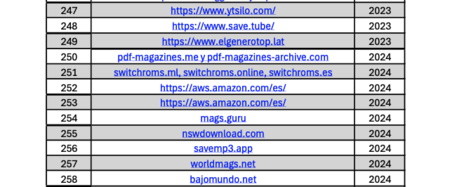
Within the realm of copyright enforcement, the Ministry of Culture has unveiled a dedicated section of its website to highlight the specific URLs identified as illegally disseminating content. The document, aptly named the "List of Blocked Websites," serves as a key resource for consumers and industry stakeholders alike.
Prominent names on this list include well-known torrent sites such as The Pirate Bay, Zippyshare, and Elitetorrent, among others. Surprisingly, even aws.amazon, the web service platform of Amazon, appears in this context. This complex situation leads to various nuances in how these blockages are perceived.
Part of the PDF released by the Ministry of Culture.
The Inclusion of Amazon’s AWS
The inclusion of Amazon’s AWS is particularly noteworthy. The provider serves as a host for numerous websites implicated in copyright infringement. However, they are not deemed guilty in this process. The second section of the Intellectual Property Commission often points fingers at these providers when the definitive infringer cannot be pinpointed. This dynamic reflects the complex web of online infringement where service providers may find themselves unintentionally entangled in legal proceedings without direct culpability.
Recent Chaos in Internet Access
In recent news, there have been reports indicating struggles in accessing Amazon Prime Video through local ISPs like Digi, especially during critical events such as Second Division matches. Notably, users encountered the standard notification that their IP addresses had been blocked according to the December ruling. Yet, LaLiga distanced itself from allegations of blocking AWS IP addresses, leaving the cause of these disruptions vague and unresolved.
This instance exemplifies the recurring issue wherein Amazon’s services face interruptions due to legal enforcement on unrelated domains, demonstrating that the consequences of these laws reverberate beyond the intended targets.

A List with Complications
Despite the ministry’s efforts to curb websites violating copyright, the issue is far from straightforward. Many of these domains have simply shifted to alternative URLs to continue operations, rendering legal efforts nearly futile. A brief glance at the blocked list reveals that numerous URLs redirect users to the same services with merely slight tweaks in their domains.
Moreover, this listing does not capture the spontaneous blocking of domains on match days, a real challenge for everyday internet users in Spain. The wide-reaching effects of such policies often leave consumers grappling with access issues across various platforms, imposing further complications on their browsing experience.
In summary, the Spanish government’s proactive approach to protect intellectual property rights appears commendable on the surface; however, the intricacies involved in enforcing these laws expose significant challenges. Navigating the online world amid these restrictions continues to affect thousands of users who simply wish to access content without legal hurdles.