
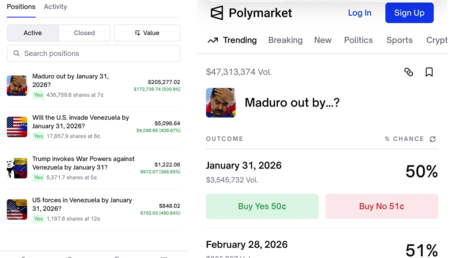
The Dramatic Fall of Nicolás Maduro: A $30,000 Bet Pays Off Big
On January 3, a dramatic raid by the U.S. Delta Force at Caracas’ Fuerte Tiuna military complex led to the capture of Nicolás Maduro and his wife, Cilia Flores. The day before the operation, a savvy bettor placed a $30,000 wager on Polymarket, predicting Maduro’s ousting. With his arrest, this investment ballooned into a staggering profit of $436,759.61—a testament to the unpredictable nature of political events.
A New Account with a Fortuitous Hunch
The bettor’s Polymarket account, known as Burdensome-Mix, was less than a week old when it became a hotspot for predicting Maduro’s departure. Just hours before the raid, the bettor strategically invested when the odds were most favorable, resulting in an astonishing return exceeding 1,333.33%. This profit surged to at least 1,233.33%, showcasing the lucrative opportunities available in prediction markets.
Advanced Tools for Predictive Betting
While many were caught off guard by Maduro’s arrest, some traders appeared to have foreseen this pivotal event. Tools have emerged to track suspicious activity on platforms like Polymarket, enabling astute investors to capitalize on trends and patterns. This development raises questions about the information access that influenced such a profitable bet.
One creator discussed leveraging Polymarket API keys for investigating unusual wallet activity. On the eve of the operation, alerts for five separate suspicious transactions flooded in, indicating possible insider knowledge affecting market behavior.
Context of the Venezuelan Crisis
Maduro’s capture by U.S. special forces via Operation Absolute Resolve raises significant concerns about international law and sovereignty. Following his arrest, he was transported to the Stewart Air National Guard Base in New York City, where he awaits trial for charges reportedly connected to drug trafficking and weapon possession.
Political Implications Post-Arrest
The operation has sparked numerous political reactions, including from Donald Trump, who underscored America’s commitment to guiding Venezuela toward a safe transition. Following the operation, American energy companies are positioned to take over Venezuela’s oil industry, intensifying the stakes for both the local and international economy.
Suspicion and Controversy in Prediction Markets
The nature of the bettor’s operation has aroused criticism, suggesting possible insider trading activities akin to what is seen in traditional financial markets. While insider trading is generally vilified, the decentralized, anonymous nature of platforms like Polymarket complicates assessments of ethical implications. Transactions are transparent and operate under blockchain technology, making verification challenging yet ensuring user confidentiality.
The Evolution of Polymarket and Betting Culture
This isn’t the first time Polymarket has captured attention through significant political bets. Similar to instances in the past, recent events show that these markets can reliably predict political outcomes—highlighting their growing role as alternative indices for assessing public sentiment.
As these markets expand, they bridge the gap between casual betting and serious investment, establishing a new language around event contracts. This transformation invites more players and challenges existing regulatory frameworks.
Conclusion: The Future of Predictive Investing
The case surrounding Maduro’s arrest and the lucrative betting activity it spawned represents a microcosm of the shifting landscape of prediction markets. Individuals can express their insights on potential outcomes, transforming political events into profitable ventures. The implications of such trends will continue to resonate as these platforms evolve within the broader financial landscape.
For investors, understanding the intersection of insights, market behaviors, and ethical standards in predictive betting could become increasingly critical as the world navigates a complex political landscape.