
In the photo, the kid smiles, absolutely happy . His mother, also smiling, hugs him while looking at the camera. The photo could belong to any of us with our mothers, but there’s one crucial detail: an AI has transformed it into a video . One that instantly holds the potential to become a cherished memory.
A memory of life .
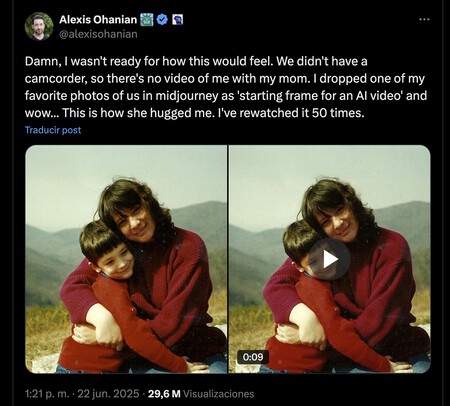
</div>That photo was shared by Alexis Ohanian, co-founder of Reddit and an entrepreneur. Ohanian, who has been with Serena Williams since 2017, explained that when he created this video, he was “not prepared for how profoundly it would make me feel.”
His family never owned a video camera; thus, he never had a video of his mother. Almost on a whim, he utilized the newly released Midjourney video generator, creating a video from that cherished photo. The outcome astonished him. “This is how she hugged me,” he elaborated. “I have watched it 50 times already.”
However, this revelation sparked a significant moral and philosophical debate . It raised critical questions about how such technology can affect us both individually and collectively. While Ohanian defended his choice against criticism—saying, “I really don’t understand why you wouldn’t use AI for this”—others countered him by asserting that such memories aren’t authentic: “Creating a video for someone loved is not to create a memory of them. You are putting words they never said in their mouth.” As another user, Erich Thilow, stated, “It’s [a memory] fake. But seeing it will make it real in your memory. I’m not a fan of something like that.”
<img alt="Alone and connected, the paradox of loneliness at the time of the thousand "friends" In networks" width="375" height="142" src="https://i.blogs.es/65b5c3/7465687106_e4533b40b7_o/375_142.jpg"/>Some users invoked cinema as part of the discussion. A user named Vanillaelle shared a Harry Potter scene that depicted a false memory of his parents in the mirror. Another user named Andro drew an analogy with *The Matrix*, articulating that, in the movie, the question was whether people would want to confront reality. “Now there’s no need to ask,” he remarked.
The Era of False Memories
This new ability of generative AI to produce false memories raises alarming possibilities, potentially connected to concepts already explored in psychology. False memories are either events that did not happen or distortions of real events. According to experts like American psychologist Elizabeth Loftus, it is possible to induce such memories through hypnosis or techniques involving repeated affirmations of an event. Upon hearing or visualizing similar events, individuals can begin to remember them as if they occurred in reality.
This notion, proposed by Loftus, is echoed by Francisco Tabernero, a clinical psychologist. He maintains, “Memories are usually quite distorted,” but believes there’s no inherent risk in creating a façade of memories. He asserts:
“The general experience of memory is subjective; it can be more or less aligned with what we originally had. I do not think that a few seconds of generated movement change the memory that you already possessed. At an emotional level, the memory remains tied to the same emotions, irrespective of what you have fed to the AI.”
Loftus, known for the controversial “false memory syndrome,” published a study with Ira E. Hyman Jr. They elucidate how “memory is always constructive.” Humans create their past based on retained information, general knowledge, and social cues to recall events.

</div>Ethical and moral dilemmas abound, leading us to consult more experts. Santiago Sánchez-Migallón (The von Neumann machine) describes himself as a “philosopher of AI” and regularly collaborates with Xataka. He insists that we must regard technology as an opportunity, not merely a threat, especially when dealing with sensitive subjects like memory and mortality.
Sánchez-Migallón emphasizes that safety must come first: users should be able to discern between true and false memories. Following this, he perceives immense potential in using technology to assist in “erasing traumas” and even imagines a future where procedural memories or skills could be uploaded to our brains. “Could we record our ability to play the piano or communicate fluently in a new language?”

</div>Darío Benítez, psychologist and co-founder of PSYCHOFLIX and the podcast Validly, sees optimism in AI but notes there are “little to no advantages” to this application. “If you relive an image of a loved one, you risk exposing yourself to emotions that may resurface and reignite a grief process you believed was resolved.” Such experiences could alter your values, as these false memories might lead you to believe you had lived them.
Benítez elaborates on Ohanian’s case, suggesting that a generated video could depict the mother with subtle disdain, prompting the child to think, “Yes, my mother did treat me poorly.” This misperception could distort beliefs about one’s childhood and complicate emotional processing.
The Danger of Molding Memory
This technology poses another peril that has been recognized across various domains, especially in smartphones and social media, which can isolate individuals and entice them into doomscrolling .
With content created by generative AI, “it could indeed lead people to prefer false lives , giving up on reality,” states Sánchez-Migallón. Despite this concern, he continues to view it as an opportunity:
“Some individuals already spend more time on social media than in real settings, which portrays their online world as more significant than their daily life. This new technology could present an alternate reality. If someone despises their life and prefers to escape into a fabricated existence , who am I to deny them that? Moreover, if living in these invented memories brings more satisfaction than confronting an unpleasant reality, should humanity endure suffering merely because creating false memories seems odd?”
Furthermore, Sánchez-Migallón points out that memories shape our personality; painful experiences contribute to our identities. “To what extent could I erase painful memories without creating incongruities in my being?” he questions.
Benítez cautions that evoking memories is inherently simple; our minds are easily misled. Relying on such false memories when making decisions or moral judgments is dangerous and may create problems unnecessarily.

</div>Tabernero concurs that certain risk populations may be vulnerable to such applications, particularly individuals with post-traumatic stress or unresolved grief. In those situations, generating such memories may trigger experiences akin to the original traumatic loss, inducing deep waves of nostalgia and pain that could have been avoided.
“That tool could reignite memories that provoke emotions as intense as the first day of grief,” he explains. “At the very least, the evocation is bound to lead to a period of mourning and sadness that could have been spared.”
While Benítez acknowledges the benefits of existing technological platforms in fostering connections that may not otherwise occur, he warns that technologies like these can also isolate us. “People often escape to virtual environments that feel more real than tangible realities, leading them to experiences detached from authentic social interactions,” he adds.
“This trend can cause individuals to live in a fabricated reality that fails to resonate with their genuine experiences.”
Tabernero highlights the unpredictability of outcomes associated with this technology; he sees two dimensions. On one hand, he calls the social media aspect “harmless, almost like a hobby.” On the other, there is a more unsettling potential for creating “a period of escape , in which individuals feel good.” If such avoidance becomes habitual, adjusting to the reality can become significantly more challenging.
AI is designed to please, to provide consistent support. Yet, as Tabernero notes, it may prevent individuals from developing essential coping strategies , making genuine experiences increasingly hostile in the long run.
Image | Warner Bros.
In summary, the ethical implications of AI-generated memories compel us to question the very foundation of our experiences. While these artificial constructs can evoke joy and nostalgia, they may also lead to unforeseen emotional turbulence. As technology continues to evolve, the need for a conscientious dialogue on its implications becomes more crucial than ever in shaping our perceptions of reality.