
The Rising Number of Social Children in Uruguayan Hospitals
Understanding the Issue
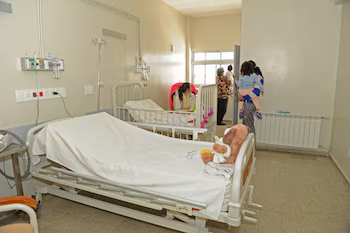
In Uruguay, an alarming trend is emerging: numerous healthy children are being admitted to public hospitals despite having no medical necessity for such care. These children, often referred to as “social children,” are left in a precarious situation where their parents are either unable or unwilling to care for them due to various societal issues. This has resulted in an increasing number of minors spending extensive periods in public hospitals, where they form bonds with medical staff rather than with family.
What Are Social Children?
Social children are those who, for different reasons, end up in healthcare facilities without any medical justification. They often come from complicated family backgrounds, and during their time in hospitals, they lack parental presence or proper guardianship. Reports indicate that children become attached to nurses, receiving affection and care in the absence of family connection.
Real-Life Stories
Consider the case of three children hospitalized at the Las Piedras hospital for over a month. During their stay, they had no visitors and received no family attention. One child was born to a mother who had reservations about raising him, while another child was separated from his mother by legal action due to her troubled background. These distressing scenarios are becoming commonplace in Uruguayan public hospitals, highlighting a systemic failure that leaves vulnerable children behind.
Legal Framework and Shortcomings
According to Uruguayan regulations, the Institute for Children and Adolescents of Uruguay (INAU) is mandated to notify the courts about such instances within 24 hours. The Judicial system then has another 24 hours to place the child with a relative or a suitable guardian. However, the rise in cases suggests a failure to adhere to these regulations, resulting in children remaining in hospitals for far longer than necessary.
Statistical Insights
The statistics surrounding social children reveal a troubling trend. The number of healthy babies admitted to the Pereira Rossell pediatric hospital has drastically increased: 119 admitted in 2022, 135 in 2023, and projected to reach 189 by 2024. This data reflects not only the rising number of unaccompanied children but also a growing concern among child welfare authorities about their wellbeing.
The Call to Action
Claudia Romero, president of INAU, has expressed the urgent need for a “disinternment” strategy focused on children aged zero to three. She highlights the detrimental effects of institutional living on emotional and cognitive development and emphasizes the necessity for children to grow in family settings rather than hospitals.
Conclusion
The situation faced by these social children underscores a pressing social issue in Uruguay, where legal protections and child welfare must evolve to ensure that every child has the right to a nurturing family environment. Advocating for policy changes and better resource allocation is crucial to rectify these alarming trends and prioritize the best interests of children in need.