
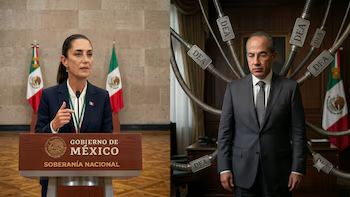
Claudia Sheinbaum Challenges Felipe Calderón’s War on Drugs Justifications
In a recent public event organized by the National Action Party (PAN), former President Felipe Calderón Hinojosa defended his controversial security strategy, infamous for its escalation of violence known as the “war on drugs.” The current president, Claudia Sheinbaum Pardo, responded decisively, questioning the true origins and motivations behind Calderón’s policies.
Calderón’s Claims
Calderón asserted that, during his presidency, he faced a stark choice between protecting citizens and addressing a deepening insecurity crisis. He emphasized that he assumed full responsibility for his decisions, framing them as a commitment to the Mexican populace.
Sheinbaum’s Controversial Inquiry
In her morning conference on June 1, Sheinbaum posed a provocative question regarding the authority behind Calderón’s war on drugs. She asked, “Was the initiative truly Felipe Calderón’s, or was it suggested by Barack Obama or directed by U.S. agencies like the DEA?” She suggested that perhaps the former president was merely a pawn, as the DEA had unprecedented access to Mexico during his administration. This statement raised eyebrows, igniting discussions on foreign influence over national policy.
Historical Context of U.S. Intervention
Sheinbaum highlighted that such interference from U.S. agencies during Calderón’s tenure has been well-documented, even by previous presidents, including Andrés Manuel López Obrador. This adds depth to her accusation that Calderón’s decisions might not have solely originated from domestic considerations but were influenced by external forces.
The Broader Implications
Calderón’s remarks were part of a broader context of defending Chihuahua Governor Maru Campos against accusations of collusion with U.S. agencies. He pointedly raised concerns regarding potential political persecution while others, implicated in criminal activities, were seemingly shielded by the federal government. This adds another layer to the debate about accountability and the role of U.S. agencies in Mexican politics.
As this public discourse unfolds, it brings to light the complexities and challenges surrounding Mexico’s security policies. The allegations of foreign influence underscore a critical need for transparency and a reevaluation of the historical contexts informing national security strategies.
Information in process…