
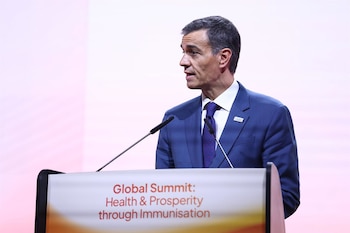
The President of the Government, Pedro Sánchez , has made headlines by announcing a significant increase in Spain’s financial commitment to the World Alliance for Vaccines and Immunization (Gavi) . This increase amounts to €130 million for the years 2026-2030, marking a 30% rise compared to the previous funding period. This renewal underscored Spain’s dedication towards investing in public health , particularly in prevention and immunization .
During his participation in the global summit for the future—co-organized by Gavi, the European Union , and the Gates Foundation —held in Brussels , Sánchez articulated his firm commitment to multilateralism and the global health system . He emphasized the need for global cooperation, stating that it is essential to foster trust in international institutions capable of addressing common challenges.
“Today, more than ever,” Sánchez remarked, “it is crucial to step forward and bolster the confidence of citizens in international bodies.” He highlighted worrying trends regarding the donor community , which has been decreasing amid escalating armed conflicts and a global economic crisis that continues to overwhelm the most vulnerable populations. This concerning backdrop occurs simultaneously with increasing skepticism towards multilateralism as an effective mechanism for tackling global issues.
In addressing the audience, Sánchez utilized Spain as a prime example of commitment to the global health framework, citing the nation’s strong societal faith in vaccination. He underscored scientific findings which indicate that vaccination, alongside access to clean water and sanitation , is the most effective strategy to eradicate diseases .
Sánchez recounted Spain’s historical support for the Gavi vaccine alliance, emphasizing that from its inception, Spain has consistently worked to extend vaccination benefits universally. Furthermore, he assured attendees that Spain is prepared to “step forward” precisely at a time when “others hesitate, doubt, or retreat.” He reaffirmed the government’s commitment to increasing investment in health, especially in areas of prevention and immunization through the slated increase to €130 million for the Vaccine Alliance.
As the summit progressed, the conversation also shifted towards the forthcoming IV International Conference on Financing for Development , scheduled from June 30 to July 3 in Seville . During this event, health financing is expected to take center stage with the introduction of concrete initiatives aimed at generating a substantial impact . “We can and must promote reforms in financing and governance within global health to ensure a better future,” Sánchez stated, underscoring the collective responsibility to foster improvements in how health systems are financed and governed.
An equally notable engagement during the summit involved Bill Gates , the founder of the Gates Foundation and a prominent figure in global health philanthropy. In their meeting, Sánchez and Gates discussed the critical need to renew commitments to international cooperation —the backbone of shared global responsibility. They focused on the principles of global solidarity and the necessity of achieving sustainable, fair, and inclusive development for all .
Gavi has been pivotal in advancing access to vaccines for children in the world’s most impoverished countries, saving millions of lives and dramatically reducing mortality rates. Spain’s renewed commitment comes at a crucial juncture when international support is increasingly vital yet fragile. While challenges like economic instability and conflict threaten to undermine progress, this display of solidarity and proactive investment by Spain serves as a beacon of hope for the future of global health.
With its renewed financial investment and continued commitment to global health initiatives, Spain is not only addressing immediate public health needs but is also affirmatively stepping towards a more resilient global health ecosystem. The imperative to invest in health systems is clearer than ever as nations grapple with the compounding effects of recent global challenges.