
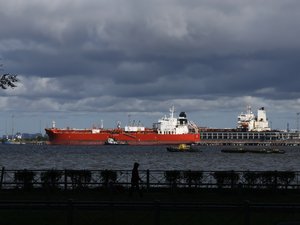
An oil tanker from the Russian “ghost fleet”, targeted by European sanctions, has been arranged off Brittany and is the subject of a French judicial investigation for lack of pavilion and refusal to comply. The ship, suspected of having operated near Denmark during suspect drone overflights, would have left a Russian port at the end of September.
What to remember:
The Russian oil tanker “Pushpa/Boracay”, under Beninese pavilion and targeted by sanctions, was arrested on Saturday September 28 off Saint-Nazaire; a judicial investigation was opened for irregularities on the pavilion and refusal to comply.
Suspected of having served as a basis for drone overflights in Denmark between September 22 and 25, the ship would have left Primorsk (Russia) for India, passing near Copenhagen during incidents.
Emmanuel Macron and the Danish Prime Minister call for a “very strong response” in the face of the “hybrid war” waged by Russia, accused of multiple provocations in European airspace.
An oil tanker from the Russian ghost fleet, arranged off Brittany, was targeted on Wednesday, October 1, by a French judicial investigation, a week after sailing near Denmark when the country experienced suspicious flights of drones over airports.
Called “Pushpa” or “Boracay”, the 244-meter-long ship, currently flying the Beninese flag, is under European sanctions for its affiliation with the fleet used by Moscow to circumvent Western sanctions against its oil sales.
Soldiers Hooded on the Ship
According to a military source, the ship was “arranged last Saturday.” A team was ready to “go on board.” On Wednesday afternoon, aerial images shot by AFP off Saint-Nazaire (west) showed hooded soldiers present on the ship’s bridge.
President Emmanuel Macron had mentioned earlier a “very important operation” from the Navy, on the sidelines of a European summit in Copenhagen.
“The intervention teams acted in time,” he stated, adding, “There have been very important faults committed by this crew, justifying that the procedure is judicialized today.”
Justice has opened an investigation for “failure to justify the nationality of the ship/pavilion” and “refusal to comply.” The Brest prosecutor, Stéphane Kellenberger , told AFP, without providing further details.
Suspected Involvement in Danish Drone Overflights
This ship, which has changed its name and pavilion multiple times with successive registrations in Gabon, the Marshall Islands, or Mongolia, is also suspected of being involved in the recent drone overflights that have disrupted Danish air traffic. According to the specialized site The Maritime Executive , the ship has served as a “launch platform” or even as a “lure.”
When questioned about this aspect, Macron urged caution, stating, “Let us be very careful.” According to an AFP analysis of the maritime site Veselfinder , the oil tanker departed from the Russian port of Primorsk , near Saint Petersburg, on September 20, heading towards Vadinar , in northwestern India.
It sailed off the Danish coast between September 22 and 25, coinciding with suspicious drone overflights over the country.
On September 22, a first overflight led to the closure of Copenhagen Airport . Additional overflights from various airports and a military base were reported on September 25.
The origin of these overflights remains unclear; however, Danish authorities have not hesitated to lay the blame on Russia, which has already been accused of using drones in previous incursions into Polish airspace.
A “Very Strong Response” to Hybrid Warfare
The drone overflights put Denmark , which was hosting an EU summit, under immense pressure, drawing attention to the increasing tensions with Russia. Danish Prime Minister Mette Frederiksen called for a “very strong response” in light of the “hybrid war” being waged by Russia.
Macron further stressed that “Anyone who violates European airspace is likely to face reprisals,” adding the necessity to “continue to equip ourselves” militarily at the European level and emphasizing the importance of having “very effective pre-alert systems” against drones.
He articulated, “We are in confrontation with Russia, which has, for several years, been a highly aggressive actor, multiplying cyber-attacks, launching an assault war in Ukraine, and now provoking incidents in airspaces.”
In addition to European sanctions, the ship is also under penalties from Canada, Switzerland, New Zealand, and the United Kingdom. The French president estimated that the oil trade attributed to this ghost fleet, containing between “600 and 1,000 boats,” represents “tens of billions of euros for the Russian budget” and finances 40% of the Russian war effort according to collective assessments.
In light of these developments, the coordinated international response, particularly from European nations, is critical in addressing and mitigating the influence of the Russian ghost fleet. The emergence of this type of vessel signifies a broader issue of sanctions evasion and maritime security. As global tensions rise, understanding the interlinkages between maritime operations and geopolitical strategies becomes increasingly essential, shaping not only regional dynamics but global peace and security as well.