

Staying under a budget of 150 euros can be quite challenging, but Realme has been making strides with its ‘C’ series, offering Android phones that minimize excess for a reasonable user experience without breaking the bank. I’ve spent a few weeks with the Realme C71 to determine how far entry-level performance can go in this price bracket.
The Chinese brand has proven its prowess in the premium sector with models like the Realme GT7 Pro and mid-range phones like the Realme 14 Pro+. However, the entry-level market is a different ballgame, often coming with compromises and key questions: Where should you invest your money? Realme knows the game well, and here’s how it plays out.
Technical Specifications of the Realme C71
Realme C71 | |
|---|---|
SCREEN | 6.67-inch LCD HD+ resolution (1,604 x 720 pixels) 120 Hz refresh rate 725 nits maximum brightness |
DIMENSIONS AND WEIGHT | 165.8 x 75.9 x 7.79 mm 196 grams |
PROCESSOR | UNISOC T7250 |
RAM | 8 GB Dynamic RAM up to 16 GB |
STORAGE | 256 GB |
FRONT CAMERA | 5 MP, f/2.2 |
REAR CAMERA | Main: 50 MP, f/1.8 |
BATTERY | 6,000 mAh 45 W fast charging |
OPERATING SYSTEM | Android 15 |
CONNECTIVITY | 4G WiFi AC Bluetooth 5.2 NFC USB-C |
OTHER FEATURES | Side-mounted fingerprint reader Pulse Light IP54 rated 3.5 mm headphone jack |
PRICE | From 149 euros |
Realme C71 4G Smartphone, 8GB+256GB, Forest Owl, 6.67-inch Display, 120Hz Refresh Rate, 45W Fast Charging, 6000mAh Battery, 50MP Camera, Powerful 8 Core Processor, IP54
* Prices may have changed since the last review
Simple Design, Familiar Back
You don’t have to spend much to own a beautiful device, and the Realme C71 certainly feels well-built, predominantly featuring polycarbonate. The materials evoke a robust and durable phone vibe. The Chinese brand flaunts a military certification, and although I haven’t dropped it, it doesn’t feel like an entry-level model.
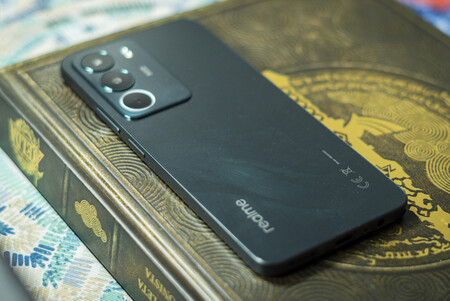
This is enhanced by a “modern” construction style: flat sides with rounded corners that connect the back and front panels stylishly. While it doesn’t feel like an aluminum phone, using it with the bundled case alleviates any discomfort. Despite its large size due to its screen, it remains comfortable to handle, weighing 196 grams that feel well distributed.

Compared to the Realme C61, the C71 is notably longer, which improves ergonomics. However, it is slightly wider and thicker. This aspect can be beneficial, although it may not seem so at first (spoiler alert: battery). Its sides feature no surprises: one side reserved for buttons that feel a bit flat, and the other has the SIM card tray.
The back features a camera module with a familiar soft shape. It houses two cameras and a LED ring reminiscent of earlier Android designs: a notification LED. While I haven’t glanced at it much since it’s on the backside, it is nonetheless a visible addition for notifications such as low battery or incoming calls.
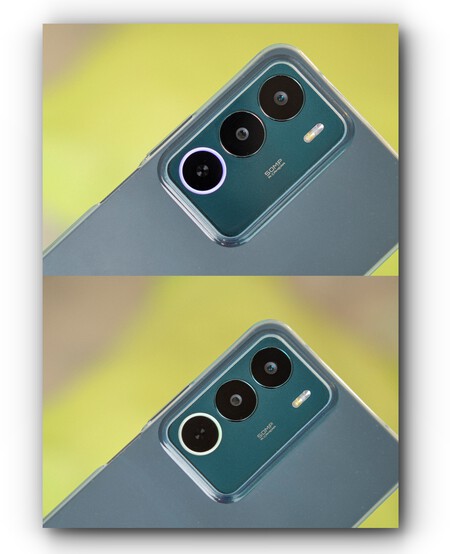
The Pulse Light feature of the Realme C71 can be configured for various alerts: low battery, notifications, and calls…
Moving to the front, the large screen is surrounded by bezels that reflect the phone’s pricing. It has an asymmetrical bottom chin compared to the top frame, while the sides are better utilized. The “full-screen” experience isn’t on par with pricier smartphones , but we hope further advancements will close that gap.
Realme has transitioned from a teardrop notch to a more standard circular cutout that accommodates the front camera.
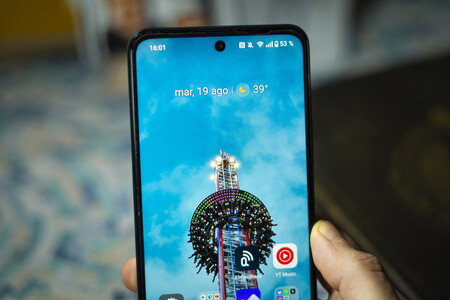
Continuing on the front, the 6.67-inch display is large, significant for a phone of this category. While it’s a decent screen, it’s another area where the budget constraints show. HD+ resolution at 120Hz with IPS technology doesn’t scream a novelty, and practically speaking, it doesn’t offer a very satisfying viewing experience.

The viewing angles are limited, with highlights from the upper and lower edges darkening (like around the front camera), and whites appear yellowish. While it’s not asking for much more, it does benefit from good calibration and is adequate for non-demanding users. Still, the low resolution stands out and is noticeably lacking in most scenarios.
On the bright side, the maximum brightness is sufficient for viewing in the shade, particularly in southern Spain, but it may fall short because it’s only 725 nits. Within the software, Realme offers several options for color settings.

It includes options to customize it to your liking and features a “Visual Comfort” mode that’s perfect for nighttime reading. Additionally, Realme has included a color enhancer for video, which slightly boosts colors for a more saturated appearance.
Is there a major issue with the display? Not really, aside from the low resolution and an inconsistent frame rate, but that largely depends on the chip.

Like most recent smartphones, the Realme C71 comes with a pre-installed screen protector, a great touch. Notably, this budget-friendly phone lacks a Corning protective glass or any alternative. Personally, I encountered no issues with the included protector.
Realme has opted for a single speaker on this phone, which limits its multimedia playback capabilities: I often found myself connecting to my Nest speaker at home when listening to music. The sound is mono, “canned,” and lacks bass. It’s adequate for alerts and notifications, though, at a high volume the brand dubs as “ultra loud.”

Because of this, I avoided using it on the couch for watching a series or lengthy YouTube videos. For that, I relied on wireless headphones, which dramatically altered the experience. There’s no Qualcomm codec support, but it fulfills SBC and AAC.
It’s worth noting that this phone includes a 3.5mm headphone jack . Many will appreciate this, as it’s useful for those who prefer a wired connection. The Chinese brand offers “OReality Audio” in the software, a type of equalizer that I’ve kept in “Smart” mode. There’s a slight difference when toggling it off, but the impact is subtle at best.
Biometry
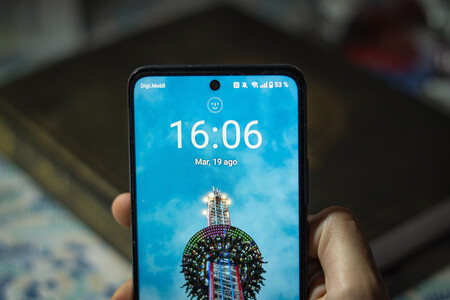
Includes a fingerprint sensor in the power button, plus facial recognition via the front camera
Due to the nature of its display, this Android doesn’t feature a front-mounted fingerprint sensor. Old-school style, you need to place your finger over the unlock button for biometric validation. Personally, I appreciate feeling the button when I place my digit—it’s a trivial pleasure, but sentiments have shifted, and such features are largely limited to entry-level models.
The sensor works faster and reliably, even with wet fingers. Precision is crucial, however: I recommend registering multiple fingerprints , as it enhances its performance.
Facial recognition is less secure; like most Android devices, it lacks a dedicated sensor. However, it is quick and a relief when not wanting to use the fingerprint feature.
The facial unlock feature doesn’t fail, as it uses the front camera for quick recognition, though like most Androids, it suffers due to the absence of a dedicated sensor. In bright conditions, it’s a go-to for quick checks on your phone, making for a seamless usage pairing between both methods.
Efficient by Nature

Whenever I have the opportunity to review a Unisoc chip aimed at the entry-level category, I prepare for the worst. This time, with the Unisoc T7250—fabricated with a 12 nm process—it turns out to be super efficient . Its performance? Decent, largely due to the lightened software I’ll discuss shortly.
System animations are minimal and straightforward. This design helps avoid stutters, although it does yield a feeling reminiscent of older Android versions. Opting for this approach is wise, as otherwise, user experience would suffer. Thus, expectations should remain modest for a processor focused on delivering efficiency, which shows when incorporating several Play Store apps, presented with signs of limitation.

Similarly, multitasking proves to be a challenge for the Realme C71, despite having a good amount of RAM: 8 GB in the unit I tested. The CPU is designed for minimal consumption, evident in the benchmarks typically applied in these scenarios.
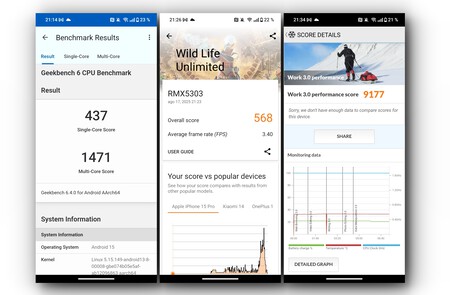
Realme C71 | Realme C67 | Xiaomi Redmi 14C | Motorola Moto G55 5G | |
|---|---|---|---|---|
PROCESSOR | UNISOC T7250 | Qualcomm Snapdragon 685 | MediaTek Helio G81 Ultra | MediaTek Dimensity 7025 |
RAM | 8 GB | 8 GB | 8 GB | 8 GB |
GEEKBENCH 6.0 (SINGLE / MULTI) | 437 / 1,471 | 474 / 1,588 | 413 / 1,411 | 1,020 / 2,424 |
3D MARK WILDLIFE UNLIMITED | 568 | Not applicable | 604 | Not applicable |
PCMARK WORK | 9,177 | 7,391 | 9,474 | 13,169 |
The chip’s reduced power consumption also means less heat production. You’ll notice it under heavy graphical demands, but it’s not alarming. Throttling is less of a concern given its already low performance.
What can be played on this GPU? It’s clear that the Mali G57 MP1 won’t meet extreme gaming requirements. You cannot expect it to run ‘Fortnite’, and while you can play ‘Genshin Impact’, it comes with several graphical concessions. I didn’t spend too much time on this game; the resolution is low, and there are jagged edges, with frame rates barely exceeding 25-30.
A Huge Battery with Basic Software
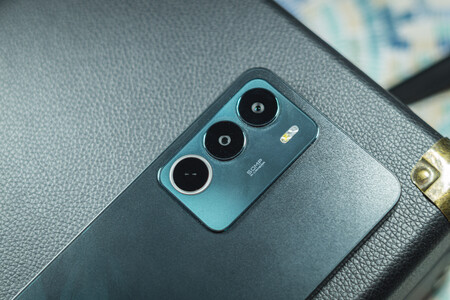
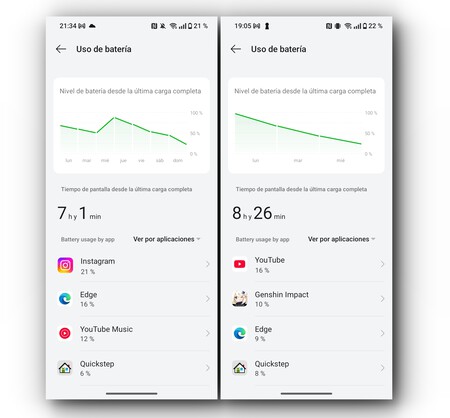
This section truly highlights the Realme C71, as it excels in this area like few others. What happens when you integrate a 6,000 mAh battery with an efficient chip and a lower resolution display? Absolutely remarkable battery life. I hadn’t experienced such longevity in years, with it lasting four days with minimal use away from home. Even when used extensively, it only required a charge at around 15% remaining.
To make it more relatable, with my return home and a typical usage pattern (one hour of YouTube, a few calls, music streaming, web surfing), I clocked in at eight hours of screen time over a day and a half. Quite impressive for a device in this range!
This impressive performance results in a fast charging feature of 45 W, allowing quick bursts of power. Filling up this massive battery does take over an hour, but even a 20-minute charge provides generous usage time—quite convenient in today’s busy environment.
As anticipated, Realme has not included a charger in the box—a trade-off that I’ve grown accustomed to, given multiple chargers already stored away at home.
Massive battery with decent fast charging, ensuring the Realme C71 won’t let you down mid-day.
When we talk about Realme, it’s impossible not to mention Realme UI, the custom software overlay that offers a different experience than ColorOS by Oppo. This Realme C71 is a toned-down version of Realme UI that does away with some heavy features.
This means fewer flashy animations—ideal for modest hardware. However, this does lead to a few bugs: notifications are hard to read when the quick access to the media player appears in horizontal mode, and there’s a volume bar that fails to indicate the current level. It doesn’t reach the extremes of bloatware seen in other devices, but a polish on the user experience remains needed.
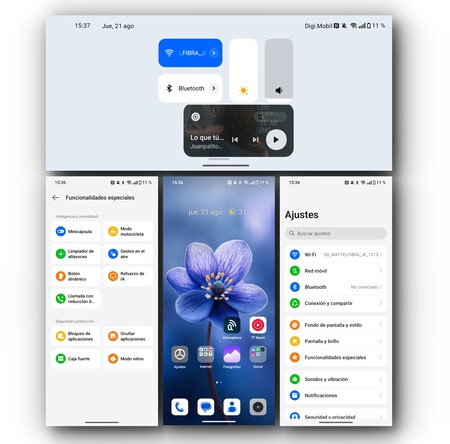
This “truncated” Realme UI is responsive, but I can’t help but feel it lacks refinement. Still, it comes packed with numerous useful features: three modes to enhance touch sensitivity when using gloves, quick actions when touching the fingerprint sensor, video playback enhancements, and much more. Despite its abundance of options, it doesn’t feel overloaded.
This Realme UI, by the way, masks Android 15. It won’t be a device known for many updates, but the security patch remains current (July 2025). Realme UI loses the animations and transitions typical of Android, making it odd that Google has recently introduced the predictive “back” gesture that feels disrupted here.
Gone is the AI technology typically integrated into higher-end models, leaving only Google’s Assistant, which runs a bit slower, but still performs adequately. Other functions like ‘Surround to search’ are also present, but underwhelming compared to others on the market.
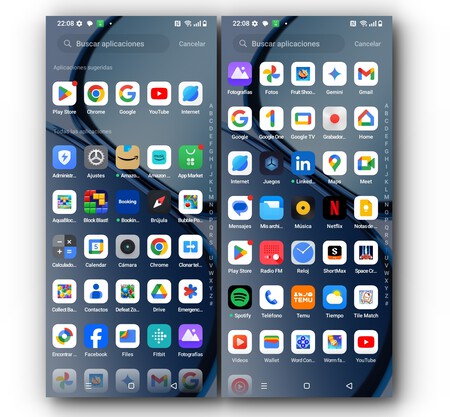
The most glaring issue with this phone is the excess bloatware pre-installed. There are numerous unwanted shopping apps, unknown games, and redundant software cluttering the internal memory. Fortunately, these can be uninstalled, but it’s annoying to deal with so much added bloat on a budget phone.
Everything at 50 Megapixels

Recently, I’ve encountered smartphones that are dropping the notion of excessive sensors , often only having one practical camera. In the case of the Realme C71, its camera system features two distinctly different sensors and an LED ring exclusive to this model.
Essentially, you can only utilize one effectively: a 50-megapixel wide sensor, f/1.8 aperture and an equivalent focal length of 27 mm. The front camera, on the other hand, is a modest 5-megapixel offering that doesn’t quite measure up.
The camera application is quite standard across Realme devices. The user interface includes tab navigation, a typical “Pro” mode, and options for high-resolution shooting, panoramic shots, and slow-motion capture.
One surprise is the inclusion of a ‘Pro’ mode rarely seen in entry-level phones. Although it lacks RAW capture and faces limits due to the hardware, it’s a cool addition.

When it comes to image quality, this solitary 50-megapixel camera performs reasonably well during the day—producing images that are sharp enough for social media—but struggles in low-light situations. Expect dynamic range issues and overexposure in certain conditions.
The detail captured is generally good in daylight; however, it can falter in brighter scenes. This remains true whether you choose the full resolution or not. The processing renders similar detail levels with both options.
The option for digital zoom (x2)—given the lack of a telephoto lens—encourages usage. Despite noticeable loss in clarity, the high resolution lends itself to use under certain conditions.
At night, however, the lack of stabilization turns every shot into a gamble, impacting both photo and night mode significantly. The camera can capture decent casual photos but doesn’t excel.

Despite decent portrait results from the front camera, the bokeh effect tends to miscalculate certain elements like hair or small accessories, leading to a rough finish. The 5-megapixel limitation significantly hampers overall quality, often resulting in noisy images.

Realme C71: Opinion and Rating

The Realme C71 epitomizes a straightforward, budget-focused smartphone. It boldly sacrifices display quality and fluid performance to focus on something else: battery life. Priced at roughly 150 euros, it’s tough to argue against its value, especially given its impressive longevity away from a charger.
The outstanding battery life is a standout feature, lasting several days on moderate use. However, this financial benefit comes with clear trade-offs in day-to-day usage, including a limited processor and bloatware-heavy software. It is perfect for users aiming to avoid chargers for basic tasks but may disappoint those looking for gaming or top-notch screen quality. Regardless, at this price point, it makes a solid phone for teenagers or emergency use.
6.2
Design 6
Display 5.5
Performance 5.5
Camera 6
Software 6
Battery 8
Pros
- Massive battery
- Light software for modest hardware
- Attractive design and solid construction
Cons
- One speaker lacks depth
- Very limited processor
- This Realme UI needs refinement
* Prices may have changed since the last review. The device was provided for review by Realme. Please consult our company relationship policy and how we conduct these reviews.