
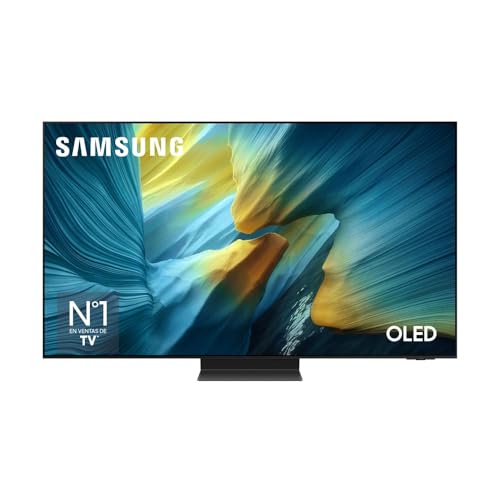
Just two weeks ago, I had the opportunity to thoroughly analyze Sony’s flagship OLED television for 2025: the BRAVIA 8 II model. As I explained in that article, I loved it. Its overall image quality is extraordinary and surely, it will stand as one of the best televisions of this year. There is a significant reason why I started this review of a Samsung television by mentioning a direct competitor from Sony: both utilize the same panel .
And it’s not just any organic matrix; it’s a 4th generation QD-OLED panel manufactured by Samsung . This review features a distinguishing trait compared to last year’s third-generation model: the blue subpixel has a noticeably higher brightness delivery capability. This parameter allows the new QD-OLED panel to theoretically deliver peak brightness close to 2,200 nits in a window covering 10% of the matrix surface while playing HDR content. That’s quite impressive.
Moreover, according to Samsung, this increase in brightness does not degrade color reproduction. We will verify this later in this article’s section where we assess its image quality. An important note is that, unlike LG Display’s OLED panels, which utilize white subpixels, Samsung’s panels rely on blue subpixels. This means that the nanocrystals will act on blue light to generate the other two primary colors (red and green), thus creating a true RGB source. Here’s an undeniable spoiler: in my opinion, this OLED S95F has the best organic panel that has hit the stores so far.
Samsung OLED S95F: Technical Specifications
samsung oled TQ65S95FATXXC | |
|---|---|
Panel | 4th generation QD-OLED 4K UHD, 65 inches, 100 Hz (up to 165 Hz), 16:9 |
Resolution | 3,840 x 2,160 pixels |
Available sizes | 55, 65, 77, and 83 inches |
Image processor | NQ4 AI Gen3 |
HDR | HDR10+, HDR10, and HLG |
Director Mode | Yes |
Sound | 4.2.2 channels 70 watts (RMS) Dolby Atmos OTS+ |
Connectivity | 4 x HDMI 2.1, 3 x USB-A, 1 x Ethernet, 1 x optical audio out, 1 x RF, 1 x CI, and 1 x USB-C |
Wireless connectivity | Wi-Fi 5 Bluetooth 5.3 |
Operating System | Tizen OS |
Energy label | Class F |
Typical consumption | 100 watts |
Maximum consumption | 540 watts |
Dimensions | 1,443.5 x 894.4 x 267.9 mm (with stand) |
Weight | 29 kg (with stand) |
Price | €2,299 |
Samsung TV 65 Inches OLED S95F 4K Smart TV with Vision AI
* Prices may have changed since the last review
Calibration Not Perfect, But Improved on Samsung OLED
Regarding its design and finish, this television is essentially identical to last year’s model. Its bezels are slim, and its central stand is relatively compact but heavy. The back panel is made of polycarbonate, and the low thermal conductivity index of this material is not an issue. This is because the glass cover responsible for protecting the panel and minimizing reflections also dissipates the residual thermal energy of the organic matrix.

The NQ4 AI Gen3 processor operates with 128 neural networks for scaling
On the other hand, the NQ4 AI Gen3 processor that Samsung offers with this television is quite interesting. According to the brand, it works with 128 neural networks for processing input signals that have a resolution lower than the panel’s native resolution. It is also responsible for executing the image processing algorithms and optimizing sound, and its NPU (Neural Processing Unit) is twice as fast as that integrated into the OLED S95D model from 2024. It sounds promising. We will check whether this chip lives up to its reputation in the image quality section.
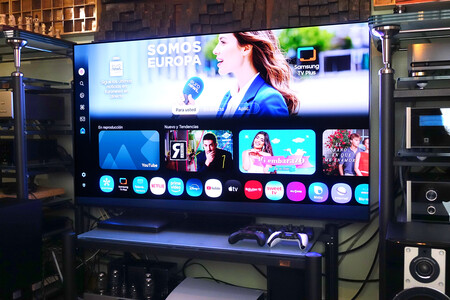
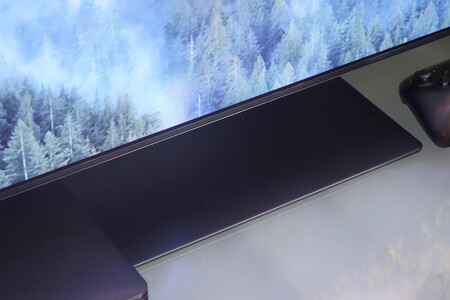
As I mentioned earlier, Samsung’s central stand is quite heavy. For 65-inch devices or larger, I have always preferred side feet, but I admit that this 10.1 kg base ensures perfect structural stability for the panel. Additionally, central stands offer an advantage over side feet that is worth noting: they allow us to place the television comfortably on a well-proportioned surface. If the stand fits and the shelf is sturdy, we won’t have any issues, even if the shelf is narrower than the television.
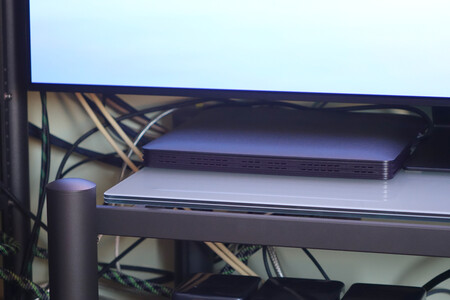
All four HDMI ports implement the 2.1 standard, which I believe is essential in a premium television
Samsung has also effectively addressed wireless connectivity by equipping it with Wi-Fi 5 and Bluetooth 5.3 , though it would have been nice to include Wi-Fi 6, as seen in other brands’ TVs. A noteworthy point: this connection module can be installed on the back of the stand if we prefer not to see it taking up additional space.
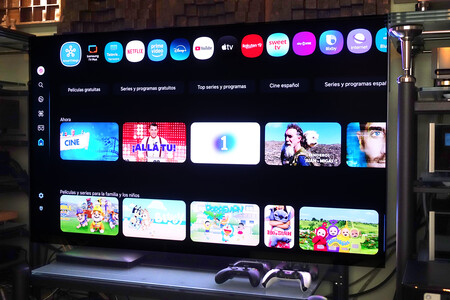
Switching gears, Tizen OS, the operating system Samsung has offered in its most advanced TVs for many years, is somewhat continuative. Each revision incorporates minor tweaks and interface changes, but in my opinion, a more significant revamp would do it good . Nevertheless, I do find it appealing. It is reasonably intuitive, the aesthetic is pleasant, and it allows us to perform any task rather swiftly (although it does experience occasional slowdowns).
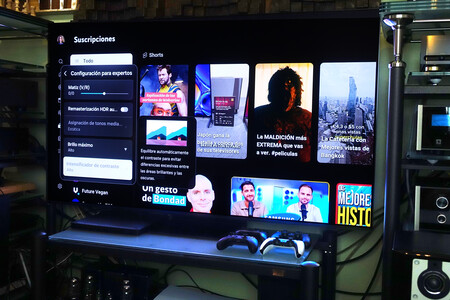
The flagship OLED television Samsung proposed last year, the S95D model, left the factory better calibrated than its predecessor. The S95F is calibrated even more effectively than the 2024 model. This is great news. Those who lack the necessary tools to carry out rigorous home calibration need not worry: they can enjoy their S95F without any adjustments. However, to maximize the unit I analyzed, I subtly adjusted the white balance, color temperature, and gamma value.
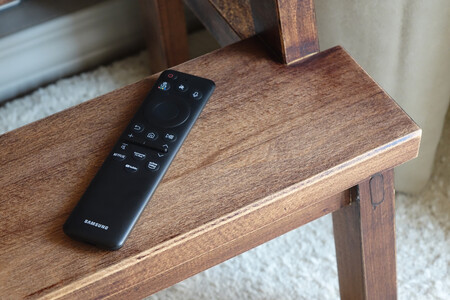
The remote control provided by Samsung with this television is made using 28% recycled polyethylene . Additionally, similar to the Eco Remote from the last four years, it includes a small photovoltaic panel that allows you to charge the battery using both solar and artificial light , though it can also be charged via the integrated USB-C port. One interesting note: according to Samsung, the battery life of this remote control is at least seven years, aligning with the average lifespan of a television today.
QD-OLED Panel and Image Processing Make It Hard to Beat
To test the image quality of this television, I used some well-known Blu-ray Disc and 4K Blu-ray films, including notable ones like ‘Oppenheimer’, ‘Dune: Part 2’, ‘The Revenant’, ‘Arrival’, ‘Interstellar’, ‘Blade Runner 2049’, or ‘Spider-Man: Far From Home’, among others. I also utilized content from Netflix and YouTube that I am very familiar with.
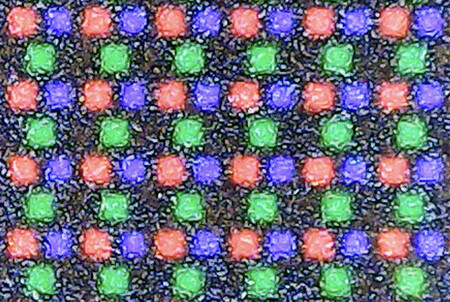
The geometry of the RGB subpixels in the 4th generation QD-OLED matrix of this television is quite similar to that of last year’s 3rd generation panel
The following photograph of the panel was taken using my digital microscope, clearly showcasing the diamond-shaped arrangement of the RGB subpixels in the organic matrix. This pattern is very different from what LG uses in its W-OLED panels, which we have investigated in various analyses, such as the LG OLED C5 model.
An intriguing fact: the geometry of the subpixels in this 4th generation QD-OLED matrix is quite similar to that of last year’s 3rd generation panel and slightly different from the 2nd generation panel from 2023. The subpixels of the latter were rectangular, while the ones in the S95F are square. One more note: the new anti-reflective coating of this television doesn’t allow us to identify the subpixels sharply, although, as we will see later, it performs its function excellently.
As I indicated earlier in this analysis, the 4th generation QD-OLED panel of this television can deliver peak brightness close to 2,200 nits in a window covering 10% of the matrix surface when playing HDR content. This performance is spectacular, allowing it to shine with HDR10 and HDR10+ images. However, and here’s a warning to Samsung, it does not process Dolby Vision content . It’s a pity that a premium television like this doesn’t support all currently used HDR formats. Another note: as can be inferred from the following photograph, it’s capable of recovering a significant amount of detail in shadow regions.
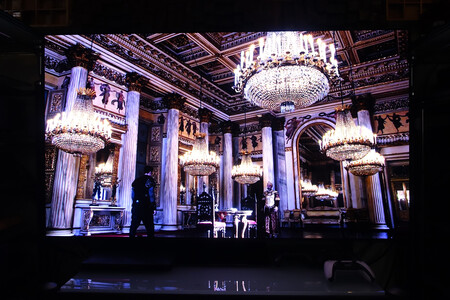
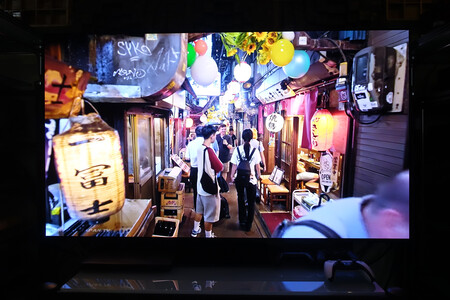
The maximum brightness delivery is one of the strengths of this television, but it has another highly valuable quality: the absence of the white subpixel used by LG’s W-OLED panels allows it to reproduce colors with great accuracy even in regions of the panel delivering a very high level of brightness. Its color restitution capability is excellent, whether reproducing SDR content or handling HDR movies or series. Additionally, when the processed input signal is of good quality, images achieve astonishing depth. In this respect, this OLED S95F is a delight. One last cherry on top: there is virtually no trace of high-frequency noise in almost any circumstance.
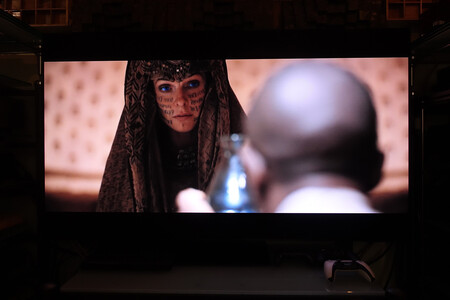
The sequence from ‘Dune: Part 2’ shown in the next photograph is particularly demanding as it contains many frames in low light with considerable information in shadow regions. Despite its difficulty, this television handled it excellently, delivering much detail and respecting color as a master monitor would. Definitely, this OLED S95F is one of the best televisions you can invest in to enjoy cinema at home.
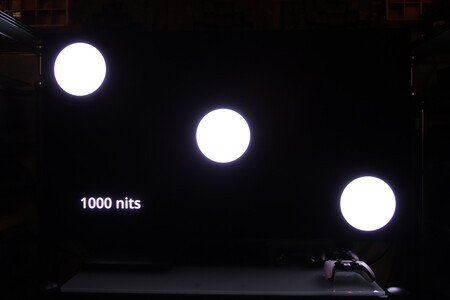
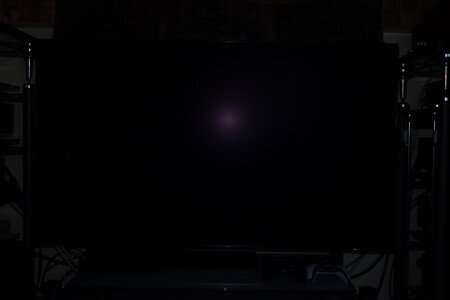
The following photograph illustrates a slight light bleed around the bright circles, but in reality, this television is completely immune to blooming (that defect manifested as halos surrounding the brightest areas of each frame). The responsible party for this effect is the camera I used to take the snapshots illustrating this article (a veteran yet competent Sony RX10), but I assure you that, like any other OLED television, Samsung’s offering shows no signs of blooming . Moreover, its maximum black level is absolute.
Here’s a very pleasant surprise: the anti-reflective coating of this television is simply incredible. I have never seen anything like it. It minimizes reflections even when light sources directly hit the panel, making it possible to use it in very illuminated spaces and with aggressive light-emitting sources. However, in such circumstances, the depth of its blacks does suffer slightly, but I do not find this problematic. The next photograph was taken by directing the flashlight from my smartphone directly at the panel, and as you can see, the reflection is practically negligible.
Before concluding this section of the analysis, it’s essential to discuss the sound of the S95F. While it does not match its outstanding image quality, it still delivers commendably. This television offers a noticeably dynamic sound and can sharply separate dialogues from ambient sound effects. This is clearly a point in its favor. Moreover, the artificial intelligence efficiently resolves resonances and interaction with surrounding objects. Yet, whenever possible, I would recommend installing a dedicated multichannel system or a good soundbar. A noteworthy point to mention is that it processes Dolby Atmos , but unfortunately not DTS .
This OLED S95F Is One of the Best TVs for Gaming
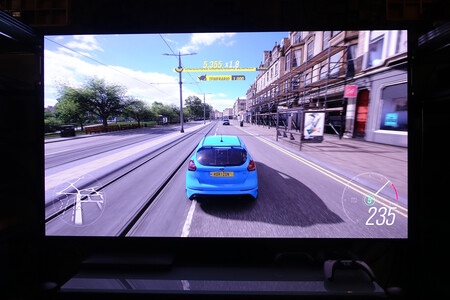
To assess the performance of this television for gaming, I used my beloved Xbox Series X and several titles sensitive to latency, such as ‘Mortal Kombat X’, ‘Forza Horizon 4’, ‘Gears 5’, and ‘Ori and the Will of the Wisps’.

During my tests, I measured an input lag of approximately 5 to 6 ms at both 1080p and 2160p at 120 Hz
OLED televisions possess a highly significant advantage for gaming: the panel’s response time is minimal. For this model, it’s approximately 0.1 ms . However, that’s not all. During my tests, I measured an input lag of around 5 to 6 ms at both 1080p and 2160p at 120 Hz . Those are spectacular figures. Unfortunately, as I mentioned earlier, it cannot process Dolby Vision for gaming.
Samsung OLED S95F: Xataka’s Review and Rating
This television is a winning bet. Its overall image quality with cinematic content and video games is outstanding, but if we pay close attention, I particularly appreciate its peak brightness capacity, which approaches 2,200 nits , and its precision in color reproduction even under unfavorable conditions. Additionally, the OLED S95F comes factory-calibrated impeccably, allowing those without the tools for rigorous calibration to enjoy it without any adjustments.
Its stellar brightness capacity allows it to shine with HDR content
Furthermore, as we have seen, its anti-reflective coating is extraordinary, the best I have tested from any brand. Adding to this, its latency for gaming fluctuates between 5 and 6 ms . These are fantastic figures . Nevertheless, it’s not perfect. Unfortunately, it does not process Dolby Vision . Also, it does not support DTS sound , and it provides Wi-Fi 5 instead of Wi-Fi 6. These three shortcomings seem uncharacteristic of a premium television like this. I hope Samsung takes note for next year’s model. Overall, I am very pleased with this television. The OLED S95F is set to become one of the best televisions of 2025, of that I have no doubt.
9.1
Design 9.25
Image Quality 9.25
Sound 8.75
Interface and Software 9.25
Pros
- Outstanding overall image quality with cinematic and gaming content
- Maximum brightness capacity of approximately 2,200 nits, shines with HDR10 and HDR10+
- Reproduces color with high precision even at elevated brightness levels
- Factory-calibrated impeccably
- Extraordinary anti-reflective coating
- Gaming latency between 5 and 6 ms
Cons
- Does not process Dolby Vision
- Does not support DTS sound
- Wi-Fi 5 only; lacks Wi-Fi 6
In conclusion, this television has been provided for this analysis by Samsung. You can consult how we conduct reviews at Xataka and our policy regarding corporate relationships.
More information | Samsung
In Xataka | LG and Samsung have a new unexpected pact, according to Reuters. One that aims to shake the television market.
In Xataka | China is devouring the television market, to the extent that Panasonic is considering leaving it.