

If you choose a high-end mobile, the chip profoundly influences your experience. With the Snapdragon 8 Elite Gen 5 , Qualcomm aims to redefine expectations in mobile performance. Officially labeled as “the fastest SoC,” this chip boasts a redesigned Oryon CPU, significant GPU enhancements, and a remarkable 37% increase in NPU speed. Its primary goal is straightforward: to ensure games run more stably, incorporate advanced artificial intelligence on the device, and maintain efficiency without draining the battery quickly.
The term “Gen 5” signifies the fifth iteration of Qualcomm’s 8 series under the current branding—it’s not about skipping generations. The term “elite” underscores the premium tier of Qualcomm’s offerings, promising unique experiences. The Snapdragon 8 Elite debuted with the Oryon architecture in 2024, setting a new standard for differentiating flagship devices from the competition.
Snapdragon 8 Elite Gen 5 Technical Specifications
Qualcomm Snapdragon 8 Elite Gen 5 | |
|---|---|
Manufacturing Process | 3 nanometers |
CPU | Oryon cores 2 Prime cores up to 4.6 GHz 6 Performance cores up to 3.62 GHz |
GPU | Adreno |
Artificial Intelligence | NPU Hexagon Hexagon Direct Link 64-bit memory virtualization Supports INT2, INT4, INT8, INT16, FP8, FP16, including mixed precision |
Modem | Qualcomm X85 5G Up to 12.5 Gbps Download Up to 3.7 Gbps Upload |
Connectivity and Location | Qualcomm FastConnect 7900 Mobile Wi-Fi 7 Maximum speed: 5.8 Gbps Supports 802.11be, 802.11ax, 802.11ac, 802.11a/b/g/n Wi-Fi Bands: 6 GHz, 5 GHz, 2.4 GHz Bluetooth 6.0 5G Sub 6 GHz |
Camera Support | Qualcomm Spectra image signal processor Supports up to 320 MP sensors Supports 8K video at 60 fps with 10-bit color depth |
Display Support | QHD+ 240 Hz Adaptive refresh rates from 1 to 240 Hz |
Snapdragon 8 Elite Gen 5: Setting the Bar for Upcoming Flagships
The Snapdragon 8 Elite Gen 5’s innovation lies not only in speed but also in its capacity to manage that speed effectively. The chip automatically adjusts voltage and consumption based on use cases, ranging from intensive gaming to capturing 8K videos. This intelligent regulation prevents overheating and extends battery life, which is pivotal for high-end smartphones.
Central to this is Qualcomm’s third-generation Oryon CPU, specifically designed for optimal internal interaction within the chip. This integration allows for sustained power peaks without degrading long-term performance, setting a new standard for fluidity during gaming or multitasking without adversely affecting battery life.
In terms of graphics, the Adreno GPU in the Snapdragon 8 Elite Gen 5 delivers a 23% improvement in performance when compared to its predecessor. Notably, Qualcomm has prioritized energy efficiency while supporting cutting-edge graphic technologies, aiming to ensure stable frame rates during prolonged gaming sessions—a critical feature for competitive players. Its advanced rendering and dynamic optimization functions position this chip as a go-to for high-end gaming smartphones.

The NPU’s prowess in artificial intelligence is another standout feature, boasting a 37% enhancement in efficiency . This opens up exciting possibilities, from real-time assistant responses to offline image enhancements. This shift towards on-device processing is a crucial step in ensuring user privacy and immediacy.

Camera capabilities are heavily influenced by the processor. Qualcomm claims that the Snapdragon 8 Elite Gen 5 can support sensors of up to 320 MP and 8K video with HDR . While not all devices will feature these specifications, they set a high benchmark for manufacturers to aspire to.
Connectivity remains integral to Qualcomm’s offerings. The Snapdragon 8 Elite Gen 5 is equipped with the Snapdragon X80 5G modem, enabling download speeds of up to 12.5 Gbps. Furthermore, it supports Wi-Fi 7 and Bluetooth 6.0, designed to minimize latency and improve connection stability during gaming and video calls.
The Snapdragon 8 Elite Gen 5 sets a new standard for upcoming flagship models from Samsung, Xiaomi, Oppo, and Sony . The chip promises enhanced user experiences, efficient performance, and significant advancements in photography and gaming. For consumers eyeing an upgrade, considering brands that can effectively translate this technical potential into enticing devices will be essential.
Comparing Snapdragon 8 Elite Gen 5 with Apple A19 Pro
With the recent launch of the iPhone 17 Pro and its new chip A19 Pro, comparisons to Qualcomm’s offerings are unavoidable. Early performance tests provide insights into where each chip stands.
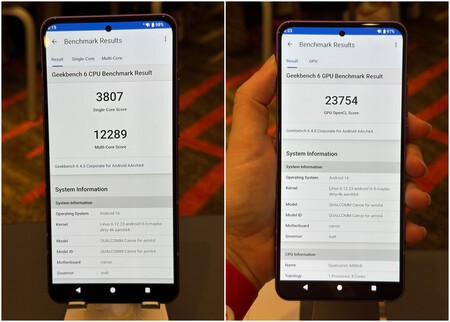
Based on statements from sources like Notebookcheck , the A19 Pro achieved 3,981 points in Single-Core performance and 10,798 in Multi-Core , while also scoring 6,557 in the 3DMark Wild Life Extreme benchmark. In contrast, initial benchmark tests for the Snapdragon 8 Elite Gen 5, conducted on a prototype, yielded 3,807 points in Single-Core and 12,289 in Multi-Core , alongside an impressive 8,428 points in the 3DMark Wild Life Extreme test.
While these figures should be interpreted cautiously—given that they come from non-final hardware and may be subject to software optimizations—they highlight strong initial trends: Apple excels in single-core performance, while Qualcomm seems to take the lead in multi-core efficiency and graphical power.
Images | Xataka | Qualcomm
In Xataka | Apple premieres the N1 chip: the final jump towards the total control of the iPhone