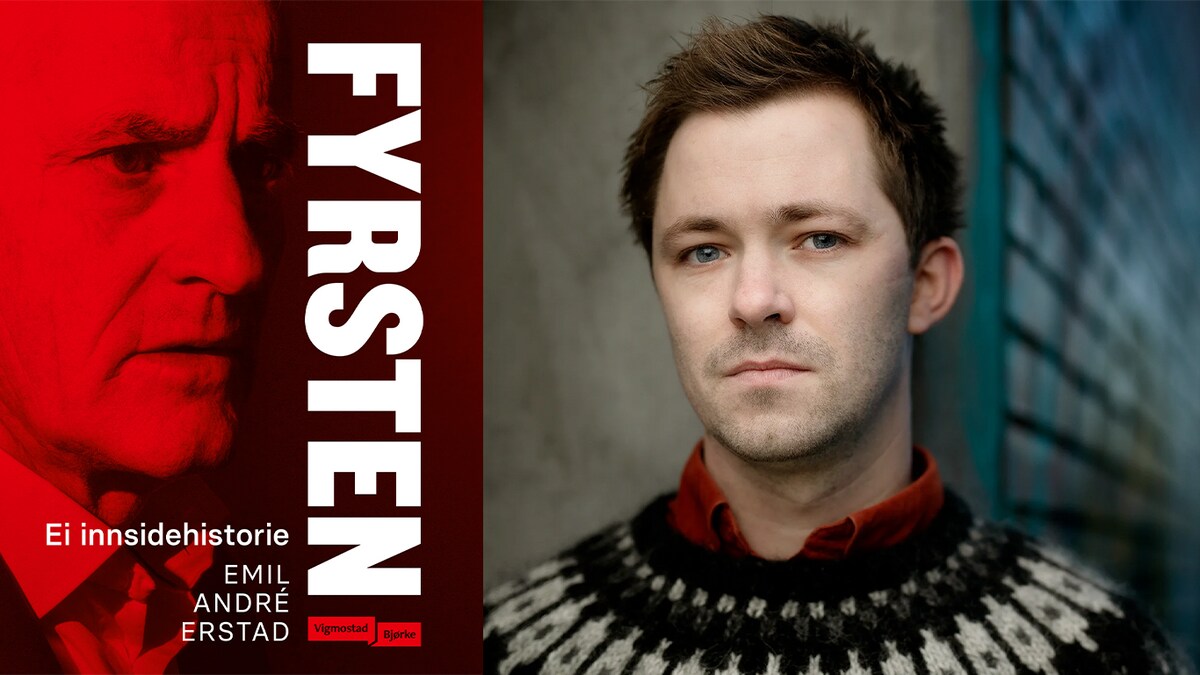
The “Prince” starts with the 2017 election campaign, which was to become a disaster for the Labor Party and Jonas Gahr Støre. The prime ministerial candidate voted for elections with two deputy leaders who did not tolerate the sight of each other. The last four years in government have also seen from the outside – been characterized by scandals that have made it difficult to get awareness of what has been of political victories. Skeleters in the closet first failed the newly elected prime minister in creating a new red -green government with both the SV and the Center Party. Then the skeletons fell out of the cabinets of one minister after another. OUT: Ingvild Kjerkol, Sandra Borch, Hadia Tajik, Odd Roger Enoksen, Ola Borten Moe, Anette Trettebergstuen and Anniken Huitfeldt all disappeared from the government after various scandals. Photo: NTB author Emil André Erstad sees these events from an interesting point of view. In 2018, he was an adviser to Knut Arild Hareide, who wanted a collaboration with the Labor Party, and Jonas Gahr Støre as prime minister. Støre has not graduated from the party. He has not spent his youth summers on Utøya. He has no anchoring in the labor movement. He is a personal Christian and runs with hot yoga. Then it is perhaps not surprising that until recently there was a commentator in a Christian daily newspaper who writes this – on the whole – positive portrait. The author: Emil André Erstad is a writer and author, until recently political commentator in Vårt Land. He has previously been the leader of the Christian People’s Party’s youth (but is not a member of the KrF today). He has also worked in the Norwegian Helsinki Committee, and is now editor of Panorama News. Photo: Leikny Havik Vestkant-millionaire in “Prince”, Erstad tries to get to the bottom of who Jonas Gahr Støre really is. It is possible to object that this is a prisoned project. Late in the book, Støre’s wife, gestalt therapist Marit Slagsvold, gets a correct counter -argument against such a human understanding. We are not just one person. We adapt and transform, depending on who we are with. Erstad provides a supplementary depiction of how Støre lost control of the image of who he was in public. All his heavy international experience and prestigious education were used against him. He was a millionaire from Oslo’s best west edge without anchoring in the Labor Party and in the working class. Even his two close advisers, Thomas Boe Hornburg and Tale Jordbakke, came from Bærum! Curls!: Støre in 1992, then with significantly more powerful hair butter. Støre was raised on Oslo West with a shipbroker father, and the mother’s side of the family operated for many decades fireplace and furnace company Jøtul, which they sold in 1977. Erstad explains two coup attempts: the first in 2021, when key people in LO and in the Oslo Labor Party wanted to replace Støre with Oslo City Council leader Raymond Johansen. The other must have happened as late as December last year, when several central Labor Party politicians wanted to get Deputy Chairman Tonje Brenna as prime minister. Sources states the trusting thing about Erstad’s presentation is that he does not pretend to be the first to mention these events. He has read the other books that have come in recent years. He is clearly concerned not to end up in a similar discussion about source use as Dagbladet journalists Steinar Suvatne and Jørgen Gilbrant ended up II last year. He has had good access to Jonas Gahr Støre, who clearly has Erstad’s sympathy. He has not had just as good access to Trond Giske, which Erstad obviously has no sense for. There are mildly shared opinions about whether Giske is a blessing to the Labor Party, but there is no doubt that he is a blessing for any book on the Labor Party. When Giske reappears in this story, as the initiator of Nidaro’s Social Democratic Forum, there will be Trønderfest on the room immediately. Erstad has spoken to several who say that Trond Giske had plans to take action against the Labor Party, because of the party’s handling of the Metoo cases, but that this was averted by the fact that the party leadership would not oppose Giske again building confidence in the party. Clarifying moments “Prince” are exciting reading all the way. For those of us who do not tread up and down in the Storting’s hiking hall on a daily basis, the book offers many clarifying moments. Few people will be aware that the then Minister of Petroleum and Energy Marte Mjøs Persen fought in vain internally to get the government to get on the track quickly with a electricity support scheme, without any impact. For Jonas Gahr Støre, this story could have ended with eternal perdition, to use a Bible language as journalists in Vårt Land (Erstad’s former employer) is well acquainted. But then it was before Jens Stoltenberg resurrected as finance minister. DUO: Jens Stoltenberg and Jonas Gahr Støre in action in the oval office, where they met US President Donald Trump last week. Photo: Cornelius Poppe / NTB Also this dispute in the Labor Party saga, Erstad has managed to get before the book went into print. In unsafe times, it seems that voters care to a lesser extent that the prime minister says “have” and “weekend”, and to a greater extent appreciate his heavy international experience. At the moment, the portrayal of the country’s prime minister seems to harmonize well with the mood of the people. As long as it lasts. About the book Title: “Prince” Author: Emil André Erstad genre: Case prose Published: April 30, 2025 Forlag: Vigmostad Bjørke Number of pages: 372 What is it about all the blue-hour pictures from Marka on Instagram? The Labor Party leader about the upbringing right by the forest and about the legacy he is constantly confronted with in “Driving Power” (episode from 2021): Published 30.04.2025, at. 00.00
ttn-69