
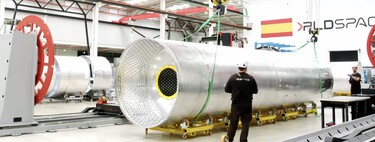
With Miura 1 , PLD Space became the first private company in Europe to successfully launch a suborbital rocket . Since then, the Spanish company has accelerated its plans with a clear objective: launching Miura 5 in 2026. Today, Spain’s first orbital rocket is not merely a future ambition; it is a concrete reality currently being assembled in Elche . PLD Space has already manufactured all its components and is preparing to start the engines for the first time.
The Treprel-C roars in Teruel. At its core, a rocket is a powerful engine with a substantial fuel tank. The Miura 5 rocket will feature five Treprel-C engines powered by turbopumps in its first stage. This powerful configuration will generate a combined thrust of 950 kN , which is an impressive 30 times more than Miura 1.
<img alt="He "First private rocket in Europe" It has been vacant and someone is getting hollow: Miura 5 of Pld Space" width="375" height="142" src="https://i.blogs.es/23ea6f/fabrica-pld-space/375_142.jpeg"/>The development of this pivotal engine component is progressing rapidly. The company has already tested combustion chambers at the Teruel airport , validating manufacturing technologies involving copper and nickel electrodes . The turbopumps, the largest developed by a European startup, have also undergone complete ignition tests prior to their final integration into the engine.
Essential elements, such as gas generators and cryogenic valves , were designed, manufactured, and tested in-house, utilizing the experiences gained from the development of Miura 1. This rigorous process has culminated in the initiation of engine serial manufacturing : four engines from the Treprel-C family are already in production for the final qualification campaign.
Aluminum plates have gained shape. Alongside the engine development, the construction of the rocket’s structure is also advancing swiftly. In a recent video, the company outlines how its Elche factory has been engaged in molding and testing metal structures—such as fuel tanks—and composite materials, including the separation module between stages and the fairing designed to protect customer satellites.
These components have already been subject to rigorous testing, including trials under room temperature, cryogenic conditions , as well as compression and flexion loads, ensuring that the structure can endure the extreme conditions during launch. The objective is to refine the design based on prototype results to maximize operational efficiency . Following the validation of engineering models, PLD Space is now focused on manufacturing the final qualification components, a crucial step before the serial production of Miura 5.
The launch ramp is running. To facilitate launches, the company has signed a development contract with the French Space Agency ( CNES ) to create its own launch complex in the European Spaceport located in Kourou, French Guiana . Civil works are set to commence this summer at the site, recognized for launching France’s first rocket, the Elm-Diamant.
The geographical advantages are significant; the proximity to the equator allows for optimized trajectories for Miura 5, enabling the launch of heavier payloads with reduced fuel usage. However, PLD Space is not stopping there. The company has also inked an agreement with Oman to establish a second launch base in Etlaq Space Port , granting direct access to the Eastern market .
A plan to be the European rocket factory. In parallel with Miura 5’s development, PLD Space is working on establishing a robust industrial complex aimed at serial production. The company has devised a plan to scale up its production to 32 units per year by 2030 .
This ambitious industrial endeavor is underpinned by a supply chain comprising nearly 400 partners , primarily from Spain and other European countries, which has invested around 50 million euros since the start of 2024. PLD Space has achieved a series of pivotal milestones, crafting a clear and ambitious roadmap bolstered by European confidence.
Back of the European Space Agency. PLD Space is now officially recognized as one of the five companies preselected by the European Space Agency (ESA) , aimed at ensuring sovereign access to space in Europe . The European Launcher Challenge has allocated contracts totaling up to 169 million euros to these five selected companies, including esteemed contenders like Maiaspace from France and Orbex from the UK.
PLD Space has proposed Miura 5 as its immediate operational rocket, with the Miura Next , a future reusable and heavy rocket, anticipated in subsequent stages. The ESA’s final decision regarding contracts will be made by November 2025. However, the company’s pre-selection already positions it as a key player and an industrial leader within Europe’s launch sector.
Image | PLD Space
In a rapidly evolving landscape, PLD Space is paving the way for a new era in European space exploration. As it gears up for the ambitious launch of Miura 5, the company’s vision and commitment serve as a testament to the emerging possibilities in the commercial space sector.