
When workers excavate in a city rich in cultural heritage like Madrid, the ground can reveal a trove of surprises. Recently, during the expansion of Metro Line 11 , workers discovered a wall of the Royal Canal of Manzanares , an ambitious waterway envisioned by Felipe II . While the significance of this structure was undisputed, questions arose regarding its preservation due to its delicate nature and the complexity of the area. The dilemma? How to rescue it without causing damage.
The solution, it turns out, was to look back in time. They drew inspiration from Ancient Egyptian techniques .
Underground Discovery. Spanish architects are well aware that in a city like Madrid, excavation often uncovers archaeological remains . This was evident in the works associated with the Expansion of Line 11. Just a few months before the discovery, the excavation team found not just rocks, but also remains of the Royal Canal of Manzanares.
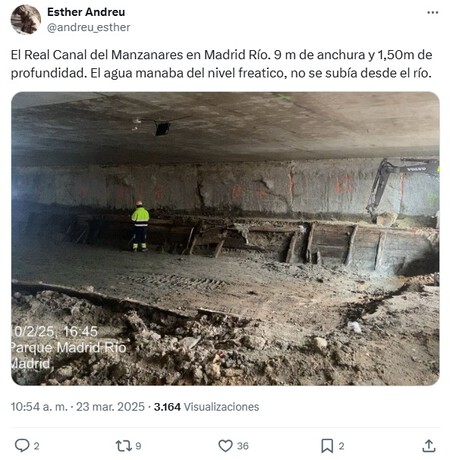
<span>Click on the image to go to Tweet.</span>Curiosity Meets Reality. While this finding is fascinating, it did not catch experts off-guard. According to archaeologist Esther Andreu , “it was not surprising to encounter this section of the canal here.” With previous archaeological efforts in the area, experts had been using laser scanning to study the landscape extensively.
The Vision of the Royal Canal was perhaps one of Felipe II’s grandest aspirations. In the 16th century , he pondered why Madrid couldn’t have its own port connected to the Atlantic Ocean. While it may sound fanciful, the monarch envisioned a waterway that would connect Madrid with Lisbon , resembling the locks and canals he had observed in Flanders. This ambitious project led to plans for a 600-kilometer navigable route, requiring the ability to navigate a 650-meter elevation difference.
Progress and Setbacks. By 1584 , Felipe II traveled from Madrid to Aranjuez to inspect the project. However, neither his efforts nor those of the engineers—most notably Juan Bautista Antonelli , who led the project—were sufficient to bring the canal to the scale originally envisioned. Ultimately, the structure extended only 22 kilometers , significantly shorter than anticipated, with ten locks and various facilities. Several challenges impeded progress, including Antonelli’s death in 1588 and the political distancing from Portugal.
Considering the Remains. The pressing question now arises: what should happen to the remains of the Royal Canal? Their historical and cultural significance is undeniable. While historical remnants like small stones or metals can be handled with relative ease, the proper care and management of a structure weighing several tons present unique challenges. Moving the wall without causing deterioration raises critical questions.
<img alt="Valladolid was the capital of Spain for a very brief period of time. The reason: real estate speculation" width="375" height="142" src="https://i.blogs.es/72e493/valladolid/375_142.jpeg"/>According to Andreu, the unearthed section was approximately nine meters wide and 1.5 meters deep. “It was not very deep, as it paralleled the Manzanares River .” Faced with this complex situation, the project managers decided to adopt methods inspired by Ancient Egypt.
A Complex Procedure. Although daunting, the task took on a new life under the guidance of Miguel Ángel López Marcos , an expert in archaeological recovery. He successfully handled similar projects before, such as restoring the colossi in Luxor . “The extraction had to be done in block. Disassembling would compromise the wall’s integrity,” he explained, emphasizing that conventional engineering tools lacked the necessary capability for this kind of task.
<img alt="Jerónimo de Ayanz, the forgotten Da Vinci who designed a submarine and air conditioning systems in the Spain of the Austrias" width="375" height="142" src="https://i.blogs.es/967863/submarino-antiguo/375_142.jpg"/>A Unique Solution. To manage this challenge, López Marcos and his team innovated a protective cage—essentially a shield beneath the structure that involved placing steel bars to support a 14-ton wall. Hydraulic beams and jacks allowed them to safely lower the wall so it could be transferred to a crane truck. Moreover, to facilitate movement, steel rollers were utilized under the cage.
The Final Goal. The ultimate aim is to restore and showcase these historical remains. Once the Madrid River station project is completed, the public will be able to view the wall as a tribute to the ambitious project that once sought to make Madrid a powerful port city. This endeavor not only highlights the challenges of modern engineering but also pays homage to the rich history that lies beneath the streets of Madrid.
Images | Wikipedia and Silke Baron (Flickr)