
A Patch on the Forehead Reveals What Happens in the Brain During Sleep
The Cleansing Power of Sleep
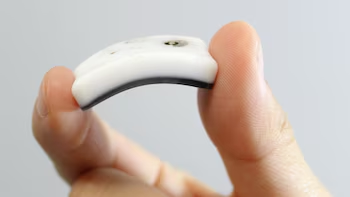
While sleeping, the brain performs a critical function: it cleans itself. This process has remained largely invisible to us—until now. Researchers from the United States and South Korea have created a flexible, wire-free patch that adheres to the forehead, allowing for real-time monitoring of the brain’s cleansing processes in patients’ homes.
Monitoring Brain Dynamics
The innovative device detects variations in water content in the brain throughout different sleep stages. These fluctuations may indicate the activity of the glymphatic system—an intricate network that utilizes cerebrospinal fluid to help remove toxic waste accumulated during waking hours. This groundbreaking study was published in the journal Science Advances.
Understanding the Glymphatic System
The glymphatic system plays an essential role in maintaining brain health. It relies on cerebrospinal fluid to sweep away the buildup of waste products that occur naturally throughout the day. Research shows that this cleaning process is particularly effective during deep sleep, and any malfunction in this system can lead to serious neurological issues, including Alzheimer’s disease.
Current Limitations of Sleep Monitoring
Traditional methods of monitoring brain activity during sleep, such as MRI and polysomnography, have significant limitations. MRI scans are costly and cannot be used during natural sleep, while polysomnography is only available in clinical settings. Therefore, researchers sought a portable, home-based alternative.
Innovative Technology: The NIRS Patch
The new device incorporates near-infrared spectroscopy (NIRS), a technique that uses invisible light to measure changes in brain tissue. The patch consists of an adhesive layer, a flexible circuit embedded with LEDs, and a silicone cover. These LEDs emit light at specific wavelengths, allowing the device to measure both oxygenated and deoxygenated hemoglobin, as well as the water fraction in the brain.
Accuracy and Feasibility
The study involved four participants across 16 nights in their homes, and the results were promising. The signals collected from the electroencephalogram (EEG) and electrooculogram (EOG) were processed using a hybrid machine learning model, achieving an impressive accuracy rate of 80% to 90% in classifying sleep stages.
Implications for Neurological Health
The device’s capacity to monitor water dynamics in the brain during sleep could offer critical insights into the relationship between sleep quality and neurological diseases. Researchers believe that understanding this connection is essential for advancing the field of neuroscience.
Future Prospects
While encouraging, the current study does have its limitations, including the inability to directly measure cerebrospinal fluid flow and the influence of movements during sleep on readings. Future research aims to refine this technology, potentially by incorporating reference signals to enhance the accuracy of the identified spectral components.
Conclusion
The development of this innovative sleep-monitoring patch represents a significant step forward in understanding how the brain cleanses itself during sleep. By providing a non-invasive, home-based method for tracking brain activity, this technology could illuminate new pathways in the study of sleep and its critical role in overall brain health.