
President Gustavo Petro’s Defense of Imprisoned Ministers
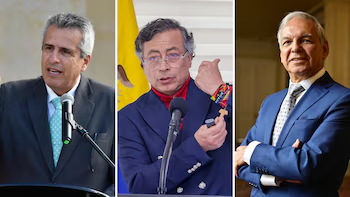
On the night of December 23, during a presidential address, President Gustavo Petro addressed the ongoing situation surrounding his former Minister of Finance, Ricardo Bonilla, and former Minister of the Interior, Luis Fernando Velasco. Both officials have been implicated in a corruption network, which has sparked considerable political debate.
Legal Backdrop and Charges
The Superior Court of Bogotá, via Judge Aura Rosero Baquero, has mandated the preventive detention of Bonilla and Velasco while investigations into alleged corruption continue. The former officials face serious accusations related to the misappropriation of funds intended for the National Unit for Disaster Risk Management (UNGRD), an agency responsible for managing national emergencies.
While both Bonilla and Velasco have publicly maintained their innocence, claiming that they will demonstrate their integrity, their detention raises concerns around the integrity of the anti-corruption policies initiated by Petro’s government.
Political Context of the Accusations
During his speech, President Petro not only discussed the economic situation of the nation but also addressed the chaotic political landscape that unfolded after Congress rejected his proposed tax reforms. He pointedly accused the persecution of his former ministers of being less about corruption and more about ideological and political differences.
In his assertive tone, Petro stated, “In other words, they were only teaching ideology. And on top of that, they put us teachers who teach heterodox economics in prison.” He criticized the judicial system’s treatment of Bonilla and Velasco, asserting that their arrests were political maneuvers disguised as corruption charges.
The Implications for Judicial Integrity
Petro expressed his profound disappointment with the handling of the cases, labeling the actions taken against his ministers as a “persecution of science.” He contended that the real issues stem from internal political disputes rather than actual acts of financial impropriety.
In showing his solidarity, Petro extended greetings to both Bonilla and Velasco, emphasizing their struggle against “immense arbitrariness” during this challenging time. He suggested that their current plight is a direct result of their positions on legislative projects that did not align with the interests of various political actors.
Understanding the Charges: A Closer Look
The Prosecutor’s Office has charged the former ministers with severe crimes, including aggravated conspiracy and bribery, based on assertions that Velasco manipulated votes in Congress for contracts, while Bonilla allegedly facilitated the misallocation of more than $92 billion in public funds. This alleged corruption also reportedly involved directing contracts to specific municipalities favored by allied congressmen.
A Broader Political Narrative
For Petro, the accusations against Bonilla and Velasco are emblematic of a broader political struggle rather than straightforward corruption. “They are not being judged for having stolen a peso,” he articulated, “but because they had political positions that did not coincide with those of the dominant political system.”
The ongoing legal battles for both former ministers not only put the spotlight on their individual cases but also question the integrity and motivations of the Colombian judicial system as a whole. As this situation continues to unfold, it remains to be seen how it will impact Petro’s administration and the political landscape in Colombia.