
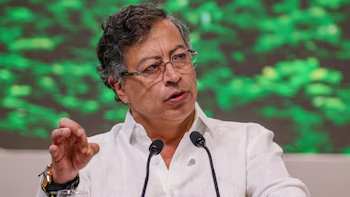
Petro Defends Controversial Bombings Involving Minors
Background of the Situation
Colombian President Gustavo Petro is currently facing intense scrutiny for his justification of military operations in Mondomo, Cauca, and Guaviare. These operations have resulted in the deaths of minors recruited by FARC dissidents. Opponents are quick to highlight a striking inconsistency between Petro’s current stance and his previous statements condemning such actions.
The Controversy
In 2019, Petro explicitly condemned military operations resulting in the deaths of minors, labeling them as “crimes of war and humanity.” However, during recent heated discussions, he defended his decision to authorize airstrikes aimed at eliminating threats posed by a heavily armed group of dissidents led by an individual known as alias “Mordisco.”
Responding to critics, including presidential candidate María Fernanda Cabal, who suggested that his actions could be classified as a war crime, Petro vehemently disagreed. “It is not a war crime,” he stated, asserting that the decision was made in the interest of protecting Colombian soldiers, who were at risk from an advancing enemy.
Justifications Behind the Bombings
Petro explained that about 150 armed combatants were advancing towards a platoon of twenty soldiers, which created an imminent threat of ambush. He considered various options to counter this threat before concluding that a pre-emptive strike was necessary. “Risky decision, bomb before they reach their objective. That’s what I did,” he emphasized, claiming that this was the only method to ensure the lives of military personnel at risk.
Broader Implications and Responses
The president’s justification led to further criticism from public figures like Juan Manuel Galán, who expressed outrage over the loss of minors. Galán insisted that six children lost their lives in these operations, stressing the need for the government to foster security, nutrition, and opportunities for youth rather than resorting to violence.
In his defense, Petro maintained that the operations were crucial for national security and that his larger peace policy incorporates necessary military actions. He also highlighted achievements during his administration, noting the progress in reclaiming territory from illegal groups, claiming that efforts have led to a drop in illicit coca cultivation and the recovery of numerous children from armed groups.
Child Protection Initiatives
Despite the heavy criticisms, Petro pointed out that his administration has rescued 2,411 children from illegal armed groups, showcasing his commitment to child protection amid ongoing conflict. This statistic serves as a counter-narrative to the tragic outcomes of the recent bombings and highlights the complexities involved in addressing security and humanitarian issues in Colombia.
Conclusion
The ongoing debate surrounding Petro’s defensive stance illustrates the delicate balance between national security and the ethical implications of military operations impacting minors. As Colombia grapples with its turbulent past and the persistent threats posed by illegal armed factions, the government’s approaches will continue to be scrutinized in the quest for peace and stability. The conversations ignited by these events are not merely political but resonate deeply within the societal context of Colombia’s young and vulnerable populations.