
A Call for State Policy to Combat Insecurity in Colombia
One of the most pressing issues facing Colombia today is insecurity. As citizens grapple with a rise in crime, including violent acts perpetrated by organized armed groups, the need for effective governance has never been more urgent. In light of the upcoming 2026 presidential elections, security is at the forefront of political discussion.
The Role of Political Candidates
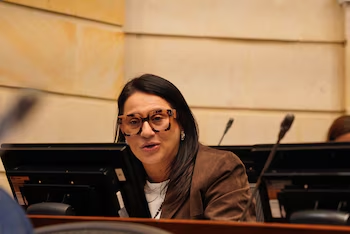
As the political landscape shifts, various candidates have begun outlining their strategies to address the growing insecurity. Several opposition politicians have emphasized the necessity for stringent measures against crime and armed groups. Among the major voices calling for change is Senator and presidential candidate Paola Holguín, a member of the Democratic Center party.
Holguín, opposing the current administration led by President Gustavo Petro, posits that security should be regarded as a public good and a fundamental human right, rather than a partisan issue.
A Comprehensive Approach to Security
Holguín argues that the country needs a state policy that reinforces territorial control and protects the fundamental rights of its citizens. Advocating for the strengthening of public forces, she calls for modernizing Colombian justice, enhancing strategic intelligence, and combating illicit activities like drug trafficking and cybercrime.
The senator emphasizes that the focus of the debate should not lie in the dichotomy of “hard hand” or “soft hand” approaches but rather on the presence or absence of the State in various territories. Historical government neglect has allowed armed groups to exploit vulnerabilities in certain municipalities, contributing to the rise in insecurity.
Implications of Increasing Violence
“When order weakens, the violent fill the void, and the common citizen pays the price,” Holguín stated. This alarming sentiment underscores the reality that without security, freedom cannot thrive. The data supports her stance: according to the Ministry of Defense, attacks targeting public forces have surged, with a staggering 288% increase against the National Police from January to May 2025.
Furthermore, the Ombudsman’s Office estimates that criminal structures have a foothold in 70% of the nation, with impunity rates exceeding 97%. Citizens are feeling the impacts, with many perceiving insecurity as the nation’s top issue, surpassing concerns over the economy and politics.
A Struggle for Public Safety
In urban centers such as Bogotá, Cali, Barranquilla, and Cartagena, many residents believe the State has lost control over public spaces. This has led to dire consequences: merchants are reportedly paying extortion fees, rural families face displacement due to threats, and numerous young people are leaving in search of safer environments.
Conclusion
As Colombia prepares for its next presidential elections, the urgency for a robust state policy to combat insecurity cannot be overstated. Paola Holguín’s insights illuminate a critical discussion on reestablishing authority within the country. As citizens yearn for safety, it is imperative that the upcoming leaders take decisive actions to reclaim control and protect the livelihoods of their people. Without effective governance, the path to peace and security remains obscured by the shadows of violence.