
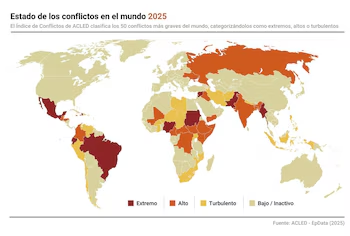
One in Six People Globally Exposed to Conflict in 2025
According to the recent Conflict Index published by the Armed Conflict Location & Event Data Project (ACLED), one in six individuals worldwide was touched by conflict within the past year. Despite a relatively stable level of conflict compared to 2024, Palestine remains at the forefront of this distressing trend.
Overview of Global Conflict Statistics
ACLED documented 204,605 conflict events from December 1, 2024, to November 28, 2025, a figure consistent with the 208,219 incidents recorded in the preceding year. Tragically, these conflicts resulted in over 240,000 deaths globally. The organization classifies conflict into five main categories: state repression, insurgency, large-scale civilian atrocities, terrorism, and foreign armed force involvement.
Stability in Conflict Levels
ACLED’s director, Clionadh Raleigh, noted that while conflicts didn’t escalate, they stabilized after peaking in 2024. This stabilization could represent a possible new norm, suggesting a halt rather than a decrease in violent incidents. The scope of exposure to conflict is staggering, with estimates indicating that around 831 million people, or 16% of the global population, faced some level of conflict.
Increased Violence Against Civilians
The situation for civilians is increasingly dire. The study reveals that more than 56,000 incidents of violence against civilians occurred in 2025, marking the highest rate in five years. This figure represents a 50% increase in incidents and a 70% rise in civilian fatalities compared to 2021.
Non-state armed groups and mobs were responsible for approximately two-thirds of these attacks. The Rapid Support Forces (RSF) in Sudan emerged as particularly deadly, accounting for over 4,200 civilian deaths during the year. Alarmingly, government forces were implicated in 74% of violent incidents, the highest proportion recorded in ACLED’s six-year history.
Geographic Analysis of Violent Trends
Despite ongoing conflicts in the Middle East, ceasefire agreements in Lebanon and Gaza, along with the conclusion of Syria’s civil war, contributed to a 48% reduction in violence in that region. However, the conflict in Ukraine witnessed a sharp escalation, representing the largest increase in violence within Europe.
Ranking of Conflict Zones
ACLED has developed a Conflict Index that ranks countries based on lethality, risk to civilians, geographic diffusion, and fragmentation of armed groups. Palestine ranks as the most conflict-ridden area globally, followed by Burma, Syria, Mexico, and Nigeria. In particular, while Palestine is labeled the most politically violent region, it ranks third in terms of fatalities, with Ukraine and Sudan surpassing it in death tolls.
Emerging Conflicts
Countries like Ecuador and Haiti have seen significant increases in their conflict rankings due to rising gang violence and political unrest. Ecuador moved up 36 positions in the index, reflecting the activity of various armed groups that resulted in more than 1,000 civilian deaths.
Conclusion
The troubling data presented by ACLED emphasizes the persistent and complex nature of global conflicts. As violence increasingly affects civilians—often in regions with fragile ceasefires—the international community must prioritize conflict resolution and humanitarian assistance. Understanding the multifaceted nature of these conflicts is essential for developing effective strategies to mitigate their impact on human populations.