
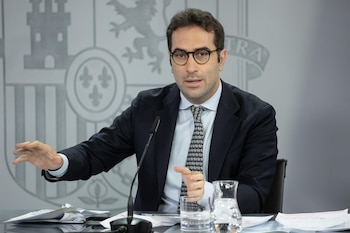
The Eurogroup, which serves as a forum for Eurozone finance ministers , is set to undergo a significant leadership change. Among the candidates vying for the position is Spain’s Minister of Economy, Carlos Body , who will compete against the incumbent, Irishman Paschal Donohoe , and Lithuanian socialist Rimantas Sadzius . The outcome will have far-reaching implications for the Eurozone, particularly at a time when the financial landscape is characterized by geopolitical tensions and the increasing influence of the U.S. dollar over the euro.
The competition is notable for one primary reason: the candidates represent a mix of political ideologies . While Body and Sadzius come from a socialist background, Donohoe represents the conservative wing. With many Eurozone states perceived to favor Donohoe, Body faces an uphill battle. However, sources close to the Spanish government mention that Body’s candidacy has been met with a “good reception,” generating a sense of optimism.
To secure his position, Body will have to rally a majority of support from conservative ministers, particularly those members of the European People’s Party (EPP) , which includes finance ministers from Belgium, Croatia, Greece, Ireland, Latvia, Luxembourg, and Portugal . His ability to bridge the political divide will be crucial in this regard. Currently, only the Slovak government led by Social Democrat Robert Fico has openly expressed support for Body, emphasizing the challenge he faces heading into the election.
The election procedure calls for a simple majority, necessitating multiple rounds of voting should no candidate achieve sufficient support in the initial round. This raises the stakes significantly, especially considering that both Body and Sadzius share similar ideologies, which could split the socialist vote. In Eurogroup elections, tradition has shown that the candidate with the least support often withdraws in subsequent rounds, further complicating Body’s prospects.
Historically, Spanish candidates have faced challenges in this arena. For instance, Donohoe previously outmaneuvered former Spanish Minister Nadia Calviño for the presidency in 2020 , despite Calviño being the frontrunner. Similarly, Luis de Guindos , another former Spanish minister, was defeated in 2015 by the socialist Jeroen Dijsselbloem . Despite these setbacks, Spanish politicians have positioned themselves within various European institutions, which highlights the ongoing struggle for representation within the Eurogroup.
The concerns over geographical representation and the distribution of prestigious positions within the European Union (EU) adds another layer of complexity to Body’s bid for the presidency. The current sentiment among some Spanish officials suggests that this electoral contest is overshadowed by the broader need for unity in a crucial financial bloc.
Body’s agenda aspires to elevate the role of the euro on the global stage. His vision prioritizes not just the stabilization of the financial landscape but also the establishment of fiscal responsibility and support for the common European project. Body believes the Eurogroup should act as a powerful lever for amplifying these aspirations, especially as Europe grapples with various economic challenges.
The urgency of Body’s message was previously echoed in a joint document issued by the five main European economies: Germany, France, Italy, the Netherlands , and Spain. This coalition pushed for reforms aimed at reshaping the Eurogroup’s role in a fast-changing economic landscape. The strategic focus is on ensuring effective decision-making capabilities and bolstering the Eurozone against external financial shocks.
Diplomatic channels indicated that this initiative stems from a collective understanding among member states that improvements are necessary to increase the Eurogroup’s efficacy. Sources close to the negotiations clarify that the intent behind these proposals is constructive, steering clear of direct criticisms toward Donohoe’s leadership.
As the Eurogroup prepares for this pivotal election, the outcome is far from certain. While Donohoe appears favored due to his incumbency, Body’s campaign and objectives could sway the political dynamics. The next steps will require astute maneuvering and a commitment to fostering Consensus, as finance ministers seek to navigate the complexities of the upcoming term with emerging geopolitical realities.