
NVIDIA’s Innovative Approach to Cooling in AI Data Centers
For years, efficient data centers have been synonymous with cold environments, frigid air corridors, and the constant hum of cooling machines. However, the explosive growth of artificial intelligence (AI) is challenging this conventional wisdom. Data centers now demand infrastructure capable of supporting more advanced chips while keeping power consumption in check. In response to this growing challenge, NVIDIA has proposed a surprising solution: a coolant operating at 45°C, which is actually warmer than many hot tubs.
Scaling AI Infrastructure: The Need for Change
The rapid advancements in AI technology demand increased computing power, leading to heightened electrical requirements and heat intensification within data centers. NVIDIA, under the leadership of Jensen Huang, emphasizes that energy efficiency goes beyond just reducing energy consumption. It involves maximizing computational output for each kilowatt-hour of energy consumed—a crucial metric for modern digital infrastructure.
Introducing the Rubin System: A 100% Liquid Cooling Solution
NVIDIA’s latest venture, the Rubin system, is the forefront of AI infrastructure technology, marking a significant leap towards 100% liquid cooling. This means every chip and network component within the system is immersed in coolant within a closed-loop design. In this innovative architecture, noisy fans are eliminated, making air cooling redundant. Heat is managed closer to the source, directly on the components’ surfaces.
The Efficiency of Higher Temperatures
Interestingly, employing a hotter coolant can lead to decreased energy usage. Operating at 45°C reduces the need for extensive refrigerant cooling before it cycles back to the servers. NVIDIA explains that this allows heat to be transferred to external circuits, dissipated through large radiators known as dry coolers. Consequently, large-scale installations can see significant reductions in electrical use dedicated solely to heat removal.
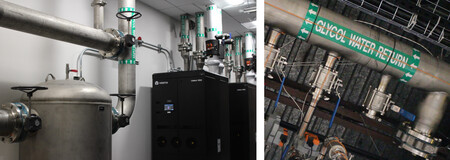
This is how coolant flows in an AI factory: from the distribution unit to the servers
Water Conservation and Structural Changes
NVIDIA’s closed-loop system promises not only increased electrical efficiency but also significant water conservation. Unlike traditional systems, where water is consumed in each cycle, the Rubin design employs a method that aims to reduce water usage to nearly zero in suitable locations. In contrast, conventional cooling towers can waste approximately 9.8 million liters of water per megawatt per year. The shift to a liquid-cooling paradigm fundamentally alters the physical layout of the data center.
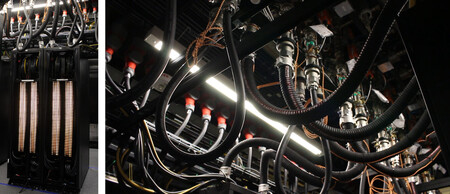
The aerial pipes carry the refrigerant to the servers, exemplifying a shift from air to liquid as the primary coolant
Redesigning Server Architecture for Maximum Efficiency
Transitioning to this model necessitates a redesign of server architectures. NVIDIA notes that previous liquid-cooled setups were hybrids that still relied on air for certain components. The Rubin system redefines these connections, implementing a streamlined liquid pathway aimed at maximizing efficiency. The result is sealed front panels and racks capable of housing more computing power in minimized space, as opposed to traditional air-cooled models that featured open grills.
Considering Geographic Variability
While the adaptability of the 45°C cooling circuit presents vast opportunities for data centers, geographical considerations remain vital. As NVIDIA acknowledges, climate plays a critical role in data center design. For example, a facility in colder climates will differ significantly from one in hot regions like Phoenix, Arizona, where external temperatures may necessitate mechanical cooling. However, the aim is to minimize reliance on these systems as much as possible.
Conclusion: Shifting the Paradigm of Data Center Cooling
The increasing demands of AI technology require innovative cooling solutions that do not exacerbate existing challenges. NVIDIA’s approach of harnessing a hotter coolant to efficiently manage heat generation via a liquid circuit marks a significant departure from traditional cooling methods. Rather than focusing solely on achieving colder temperatures, the emphasis is on adapting to heat management, ultimately transforming the landscape of data center operations.
Images | NVIDIA