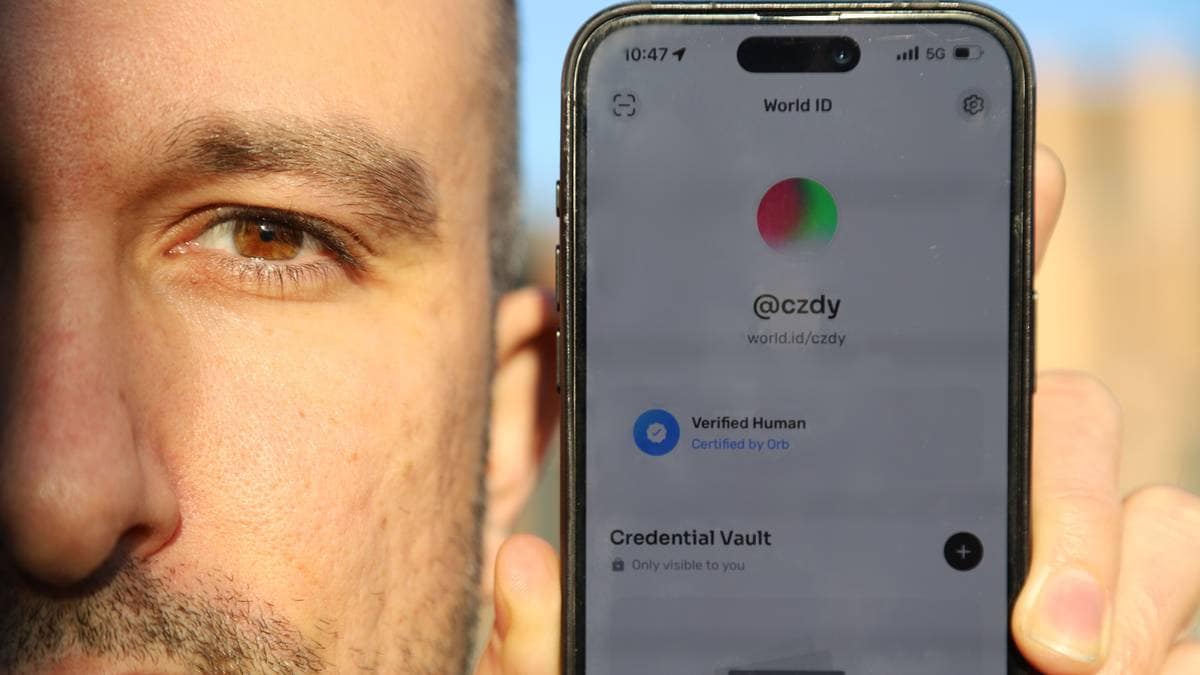
– I think this is a technology that is going to be big, and I want to be an early adopter. I have the prerequisites to navigate new technologies that most people might find scary, says Nicolas Cassis. This summer, the technology enthusiast who lives in Stavanger embarked on a planned tour of Europe with his family, with a special purpose for Cassis: A quick stop in Berlin to have his irises scanned by the company Worldcoin. Nicolas Cassis planned his summer vacation so he could go to Berlin to verify himself. Photo: Maja Mathisen / news Tech giants will reduce online fraud Worldcoin was founded by Sam Altman and Alex Blania, and is run by the company Tools for Humanity. Sam Altman American entrepreneur, and is one of the founders of Worldcoin. CEO of OpenAI, which is behind ChatGPT. Considered a leading figure in artificial intelligence. According to Forbes, has a net worth of 1 billion dollars (2024). Worldcoin’s purpose is to verify that you are in fact a real human, and not a robot. This is achieved through a so-called world ID, which allows people to prove their humanity in digital services. According to the company, this ID will reduce the number of fraudsters online, and provide easier access to banks and social services. The “orb” that scans your iris To be verified as a real person, you must seek out one of Worldcoin’s “orbs”. The “Orb” is a round ball in silver. You look into this, so that it can scan the iris in your eye. These spherical scanners are found in 433 locations around the world (external link). This is what the “orb” looks like. Photo: Worldcoin / X – The nearest “orb” was either in South America or in Germany. So then I went to the nearest destination, says Cassis. Inside a design museum in Berlin, Cassis was met by a guide and a security guard. After showing his passport, he peered into the sphere. By scanning the iris, Worldcoin gets a biometric identification tool that is difficult to copy or counterfeit, since each person’s iris has unique patterns. It was all over in seconds. – It was a bit anticlimactic. All that happened was that the app responded when it was done. So it wasn’t very sci-fi. This is what it looked like at the museum in Berlin, where Cassis was supposed to verify himself. The two spheres are orbs. Photo: private When you choose to have your iris scanned, two things happen: 1. You get a share of Worldcoin cryptocurrency. 2. You are verified as a real person. Cassis wanted to participate because he believes technology can help shape a safer and fairer world. – I think innovation and technology are central to creating a better future for everyone. I believe this will contribute to a better world and I hope I can be a part of helping us move in that direction, says Cassis. What does cryptocurrency have to do with this? Worldcoin is about offering a digital identity that verifies that the user is a real person, while combining this with a cryptocurrency. The company reasons this way: The cryptocurrency in Worldcoin acts as a reward to get people to sign up. Worldcoin positions itself as a project for global financial inclusion. In many parts of the world, people lack access to banking services, but many have access to the internet. The cryptocurrency can thus be a tool to provide financial value to those who do not have access to traditional banking services, the company believes. By users owning tokens and participating in the network, the project attempts to distribute power and control away from a single entity. Part of the vision behind Worldcoin is to explore the idea of a universal citizen wage, where all people receive a basic income through the cryptocurrency. Source: world.org I don’t think it will be legal in Norway During 2023, Worldcoin faced opposition from supervisory authorities worldwide. India, South Korea, Kenya, Germany and Brazil began investigating the company’s data collection practices, and in August of that year Kenya’s government suspended all local activity related to the platform, including the use of biometric identification (external link). In March of this year, Spain banned Worldcoin’s biometric data collection (external link). IT expert, Torgeir Waterhouse, believes that storing the biometric data can be challenging. Torgeir Waterhouse, IT expert and partner in the consulting company Otte. Photo: Hans Kristian Thorbjoernsen / Hans Kristian Thorbjoernsen – There is always a privacy challenge in something like this. It is not the actual scanning of the iris that can be problematic, but what comes after. The fact that the data is protected today does not mean that it will be so tomorrow. So there is a significant follow-up responsibility, says Waterhouse. Svein Ølnes is among those who question Worldcoin’s ambitions. He believes the project combines technology and visions that can be both impractical and problematic. – These will be far too difficult thoughts and visions, and I have little faith that you can get a world ID – at least linked to such a company. Technologically, it may be possible, although it will also be difficult. But politically it is completely impossible, I think, says Ølnes. Svein Ølnes, researcher in cryptocurrency and blockchain technology and former researcher at Vestlandsforsking. Photo: Tore F. Lie / Falkeblikk AS Ølnes emphasizes that the technology can have potential if it is used in regulated forms, and with the responsibility of national authorities – not private IT companies. He is also critical of the link between identification and cryptocurrency. – There is no need for another cryptocurrency. This system could have been used just fine without it. So why have they introduced their own cryptocurrency? Yes, to entice the venture capitalists to inject money into the project. And if there will be any scanning of the iris in Norway in the first place, he hardly thinks so. – Worldcoin will never pass GDPR. That this has happened in Germany is strange. No, I don’t think this works in any EU or EEA country. Absolutely not. What do you think about Worldcoin? Cool – thought I’d give it a try 🤖 Identification might be fine – but why cryptocurrency? 💸 What nonsense! Relates to BankID, passport and real money 🆔 Show result news has contacted and presented the criticism for Worldcoin, but has not yet received a response. Have ordered my own “orb” – I feel a responsibility to test new things and see if they actually have something for them, says Cassis. Cassis has signed up to be able to order her own “orb”. To get a place in the queue, he paid around NOK 1,000. But how much the orb itself will cost remains to be seen. – You will be offered to either buy or rent when it becomes available in the first quarter of 2025. I don’t know what that means, I don’t even know if I will be allowed. Norway has not been approved yet. Cassis wants to use the technology in its own projects. Photo: Maja Mathisen / news He wants “Orben” so that it will be easier for others in Rogaland to verify themselves. – I imagine that people will book a time and place with me, where they can come and verify themselves. But there is still much that I myself do not know, which I am looking forward to finding out. Cassis, who is a developer himself, wants to be able to use this technology in his own projects. – For example, on Tinder, people are not sure whether the person they have matched with is a bot or a human. It would have been cool to be able to develop applications where I could promise that on our app everyone is verified people. He also believes that technology can contribute to better customs. – I want to return to a society where people are a little careful about what they say. So if you don’t behave online and you get banned as your individual, then you can’t create a new account and get back in. So then I hope people behave a little nicer. Hello! Do you have any input or thoughts about the case you have read? Is there something that interests you that I should take a closer look at? Then I would like to hear from you! Published 06.12.2024, at 23.03
ttn-69