
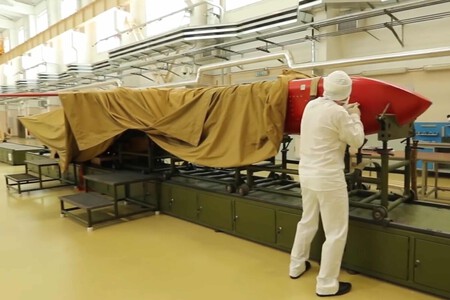
The Resurgence of Nuclear Technology: Russia’s Burevestnik
In the landscape of modern warfare, technological advancements often raise both interest and alarm. One of the most contentious innovations is Russia’s Burevestnik, a nuclear-powered cruise missile that echoes the Cold War-era Project Pluto, which the United States abandoned due to its alarming implications.
A New Era of Missile Technology
In 1964, Project Pluto was scrapped primarily because it left a radioactive trail, making it virtually impossible to use without causing widespread contamination. Fast forward to today, Russia is reviving this concept with the Burevestnik, a missile touted by President Putin in 2018 as a pinnacle of military superiority. But recent analysis from MIT reveals that its implications may be even graver than previously thought.
The “Flying Chernobyl”
The Burevestnik has earned the ominous nickname “flying Chernobyl.” Unlike traditional nuclear missiles, which rely on a warhead, the Burevestnik generates radioactive contamination throughout its flight. The technology allows the missile to operate a nuclear reactor, transforming its trajectory into a source of radioactive waste, thus posing far-reaching health risks even before it engages its target.
How Does the Burevestnik Operate?
The MIT study delineates how this missile functions using a direct cycle turbojet. Air enters the missile, passes through the reactor core, and is expelled after being heated by nuclear fission, thus generating thrust. While this compact design allows for the entire reactor to fit within a 9.5-meter shell, it comes with a destructive consequence: uncontaminated air enters the missile, but irradiated exhaust is released into the atmosphere.
Implications of Radioactive Contamination
The Burevestnik’s exhaust includes hazardous materials like argon, krypton, and radioactive carbon, which, according to researchers, could contribute to what amounts to a contamination corridor in the missile’s wake. This constitutes a drastic inversion of traditional nuclear military strategy; instead of a single point of destruction, the entire journey of the missile could become a radiological event.
Historical Context and Accidents
Historically, both the U.S. and the Soviet Union explored the potential of nuclear reactors in aircraft, as evidenced by projects like the Convair B-36 Peacemaker and Tupolev Tu-95. However, the risks proved too extreme. The Burevestnik’s development has not been without trouble; prior accidents, including spikes in radiation detected by the Bellona Foundation and the explosion that claimed the lives of five scientists in 2019, spotlit the inherent dangers involved in managing such technology.
Strategic Advantages and Limitations
The strategic allure of the Burevestnik lies in its nearly unlimited operational range. It can be launched from distant locales like the Arctic, remaining airborne for hours or even days, and strike from unpredictable angles. This unpredictability poses a challenge to existing air defense systems. However, the missile is subsonic, not particularly stealthy, and can be tracked through its radioactive emissions.
The Future of Nuclear Technology
Ultimately, the Burevestnik may serve more as a testbed for further advancements in nuclear technology than as an immediate weapon. Russia appears keen to validate technologies that might be adapted for nuclear surveillance drones or other militarily significant platforms. This program could also stem from a personal fascination of President Putin with the concept of long-range, nuclear-powered systems.
Conclusion: A Dangerous Revival
By achieving sustained flight powered by nuclear energy, Russia has resurrected a perilous technology that many thought was buried in the annals of the Cold War for good. The repercussions raise significant ethical and safety concerns; the innovations of the past may lead to an increasingly hazardous future. As the world watches, the implications of the Burevestnik unfold with profound seriousness, forcing nations to reconsider their strategic approaches in an era defined by uncertain nuclear capabilities.