
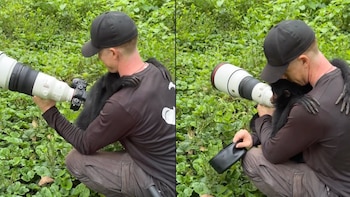
The Heartwarming Reunion Between Casey Cooper and Mikah the Spider Monkey
About four years ago, the photographer from the United States, Casey Cooper, had an experience that would forever change his life. While working as a volunteer in Wildlife Rescue Onca, a Bolivian sanctuary dedicated to rescuing and rehabilitating wild animals, he met a remarkable Mona spider monkey named Mikah, who had fallen victim to illegal wildlife trafficking.
Cooper recalls that when he first encountered Mikah, he felt a wave of nervousness wash over him due to the monkey’s size. “He looked at me strangely. He then approached me, jumped, gave me a hug around my neck, and stayed there. It was incredible. I fell in love with her immediately,” he shared in an interview with The Dodo for Animal People, a platform dedicated to animal welfare and advocacy.
Mikah had a history as a pet, which made her somewhat accustomed to human interaction. However, the mission of the sanctuary was to help her regain her wild instincts so she could eventually reintegrate into a troop and return to her natural habitat in the Amazon jungle. Cooper noted, “When these animals arrive at a sanctuary, they lack social skills. They are marginalized by their species and take years to be accepted.” He chronicled Mikah’s recovery process on his Instagram, documenting the remarkable transformation.
For several months, Casey dedicated his life to accompanying and protecting Mikah throughout her transition. “We spent together six to eight hours a day,” he remembered. “I oversaw her interactions with the wild herd to ensure that the resident females wouldn’t attack her, as new females can be defensive when a new alpha tries to integrate with the pack.”
Each time Mikah felt insecure or threatened, she would seek comfort from Cooper, relying on him as a refuge during her reintegration into wild living. With time and patience, she was finally accepted by the troop and successfully released back into the jungle.
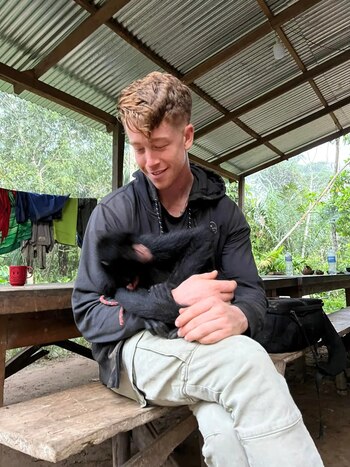
Yet, the narrative does not end here. Years later, during a return visit to the sanctuary, something extraordinary occurred. As Cooper explored the tropical jungle near Mikah’s living area, fate intervened.
“I immediately locked eyes with her,” Cooper remarked. Mikah, perched atop a tree, recognized her former caregiver and swiftly descended to greet him. “She approached and hugged me,” he recalled with nostalgia.
The encounter was made even more poignant when Mikah revealed that she was nurturing young. “It was like she was saying, ‘Look at this, look where I am now,'” Cooper gleefully shared. However, he also recognized the necessity of maintaining boundaries. “I wanted to acknowledge her, but right after the video, I pushed her away and distanced myself,” he stated. “It was a beautiful meeting, but when working with wildlife, maintaining a certain distance is crucial.”
Cooper elaborated to Newsweek about how transformative this experience was for both him and Mikah. “It has been a great blessing to witness how animals that, frankly, seem unlikely to survive in nature thrive,” he said. “It’s akin to observing someone recovering from addiction and realizing their potential. These animals just needed someone to believe in them.”
For both the photographer and rescuer, this connection goes beyond mere empathy. “I personally relate well with these animals because I was a drug addict who went to rehabilitation. Their experiences resonate significantly with mine,” he confessed.
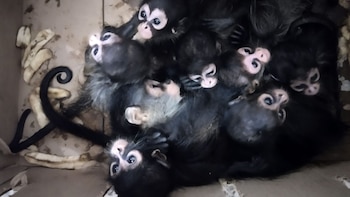
Unfortunately, Mikah’s story is not unique. Every year, thousands of primates are victims of illegal wildlife trafficking. Spider monkeys, in particular, face severe threats due to habitat destruction and hunting for the exotic pet trade. According to the Association of Zoos and Aquariums (AZA), traffickers often capture young monkeys in their natural habitats, resulting in the death of their mothers and pack members who defend them. This brutal act leaves infants orphaned and traumatized.
Furthermore, wildlife trafficking often intersects with other forms of organized crime, becoming part of broader networks that include drugs and weapons, as the AZA warns.
The rise of social media has exacerbated the issue, as the demand for wild animals as pets skyrockets, fueled by viral videos and accounts portraying these animals as cute household companions, which ignore the suffering and ecological damage inherent to this trade.
“Spider monkeys are under immense pressure,” explained Keith Lovett, President of the New World Primates Taxon Advisory Group and Vice President of Programs of the Society for the Conservation of Wildlife at the Bronx Zoo. “This pressure involves habitat loss and poaching for the exotic pet market.”
In light of these challenges, organizations like Onca Wildlife Rescue play a crucial role, restoring dignity and freedom to animals like Mikah through dedicated rescue, rehabilitation, and release efforts. Such initiatives are essential in combating the crisis of illegal wildlife trade while fostering a better understanding of the plight facing these endangered species.