
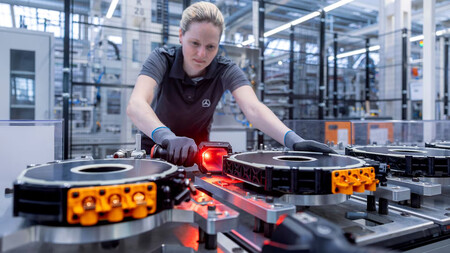
A few days ago, Mercedes finally announced the start of series production of its axial flux motor at the historic Berlin-Marienfelde plant. This has serious implications for the future of electric cars, as the technology that powers this engine promises to redefine what a high-performance electric vehicle can do. That is why under these lines we are going to tell you all the details.
Mercedes and Its Major Announcement
On June 9, Mercedes confirmed the start of serial production of this new engine in Berlin-Marienfelde, the historic factory founded in 1902. This facility has now become the hub for the brand’s high-performance electric motors.
The first production model to feature this new technology is the Mercedes-AMG GT 4 Door Coupe, which has recently been overshadowed by discussions surrounding Ferrari’s inaugural electric vehicle, Luce. However, this new model will be the first to showcase Mercedes’ axial flux motor, entering large-scale manufacturing in a sprawling 30,000 square meter facility equipped with three pavilions and seven production lines.
Revolutionary Engine Design
What sets the axial flux motor apart from conventional radial flux motors is its unique structure. While traditional motors direct the magnetic field radially from the center outward like bicycle spokes, axial flux motors run the field parallel to the axis of rotation. This allows for a more compact design, facilitating a lighter engine that generates substantial power.
The Genesis of Axial Flux Technology
The journey of this technology began in 2009 when engineers from Oxford University established the British company YASA. YASA initially aimed to develop axial flux electric motors and had already made a name by supplying engines to brands like Ferrari, Koenigsegg, and Lamborghini. In 2021, recognizing the immense potential these engines offered for their future AMG models, Mercedes acquired YASA.
However, transitioning this advanced technology from the lab to mass production posed significant challenges. Mercedes mentioned that, for a long time, this transfer was deemed “barely feasible” due to the complexity involved.
Power and Efficiency
In its initial development phase, YASA produced a remarkably lightweight engine weighing just 13.1 kilograms, generating 550 kW (approximately 738 HP) with a power density of 42 kW per kilogram. More recent iterations have further enhanced these figures; one engine weighing 12.7 kg achieved 750 kW, nearing a jaw-dropping 1,000 HP.
The AMG GT 4 Door Coupe: Performance Data
The AMG GT 4 Door Coupé will feature three axial flux motors combined into modules known as High-Performance Electric Drive Units. These modules integrate both the motor and the reducer into a compact housing. One motor is installed on the front axle while two are placed on the rear axle.
Despite their compact size, the most powerful AMG GT 63 configuration delivers an astounding 1,169 HP and 2,000 Nm of torque, capable of accelerating from 0 to 100 km/h in just 2.1 seconds and reaching a top speed of 300 km/h with a specialized high-performance package.
Manufacturing Challenges
Producing this engine on a mass scale required previously untested processes. According to Mercedes, of the 98 stages in its manufacturing, 65 are first-time processes for the company, with 35 completely unprecedented globally. This has led to over 30 patent applications.
One of the most challenging aspects of production is known as “the wedding,” which involves placing the stator between two magnetic rotors. The magnetic forces at play are equivalent to approximately 900 kilograms, with a margin of error of less than a tenth of a millimeter. To ensure precision, a sophisticated control algorithm adjusts components during the final seconds of assembly.
Looking Ahead: Beyond the AMG GT
This axial flux engine is not merely destined to power an elite electric supercar like the AMG GT. Its compact and modular design allows for easy adaptation across various platforms. As per industry trends, increased production volumes may likely lead to reduced costs, offering the possibility of future models featuring this state-of-the-art technology.
For instance, reports suggest that the CLA could be a potential future candidate for an axial flux motor.
Mercedes isn’t alone in exploring axial flux engines, but it stands out as the first to successfully mass-produce them. Other brands like Ferrari, BMW, Koenigsegg, and Alpine are also researching this technology. Given the heavy nature of electric vehicles, a lighter, more compact engine could significantly enhance performance without added weight. Tim Woolmer, YASA’s CEO, emphasizes this potential, indicating that such advancements could “change the game in the high-performance automotive sector.” Only time will tell if this prediction holds true.
Cover image | Mercedes-Benz
In Xataka | Michael Leiters, CEO of Porsche: “We rushed with the Taycan; a 911 will never be an electric car.”