
The Timeless Enigma of the Vitruvian Man
The history of art is filled with universal icons, but few reach the popularity level of the Vitruvian Man, created around 1490 by Leonardo da Vinci . This artwork seamlessly blends artistic and scientific principles, making it a longstanding cultural reference. Although the original is preserved at the Accademia di Belle Arti in Venice, the same figure has adorned everything from t-shirts to posters , continuously captivating audiences worldwide.
Despite its widespread reproduction, the ‘Vitruvian Man’ remains shrouded in mystery . Recently, a London dentist claims to have cracked the complex mathematical puzzle hidden in this iconic work.
The Inspirations Behind the Vitruvian Man
A name: Marcus Vitruvius. While Leonardo da Vinci’s rendition is undoubtedly the most renowned, he wasn’t the only artist to depict the Vitruvian man . Works by figures like Francesco Di Giorgio Martini and Giacomo Andrea de Ferrara also explored this concept, which originates from Marcus Vitruvius , a Roman architect and engineer. In his seminal work, Of Architecture, he theorized about human physiognomy long before da Vinci’s time.
“In the body, the central point is the navel,” Vitruvius remarked, suggesting that if a man lay on his back with extended arms and legs, a compass centered on the navel would yield a geometric correlation. This theory connects human proportions to geometric forms—a concept that fascinated da Vinci.
Decoding Leonardo’s Methodology
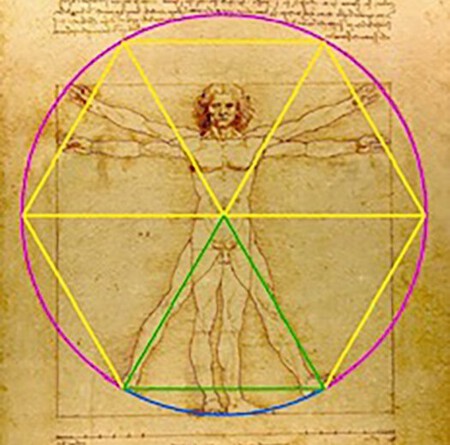
But how was this executed? While various artists attempted to represent human physiology inspired by Vitruvius’s canon, Leonardo successfully merged technical precision with artistic beauty in his 1490 masterpiece. The drawing showcases a man in multiple overlapping positions, appearing within a square and a circle in a way that might have intrigued Vitruvius.
The mystery behind how Leonardo achieved this has persisted for centuries. Despite the drawing’s availability for reproduction, the precise geometric methodology he employed remains elusive. According to British dentist Rory Mac Sweeney , the quest for understanding da Vinci’s geometric technique has given rise to many theories, each attempting to explain the intricate relationship between the square and circle in this renowned drawing.
“For more than 500 years , Vinci’s geometric system relating to his drawing of the ‘Vitruvian man’ has eluded resolution,” Mac Sweeney noted, recently publishing a study on this subject in the Journal of Mathematics and Arts.
Exploring the Golden Proportion
What if the key lies in the golden proportion? Mac Sweeney’s theory offers an alternative to the widely accepted explanation that attributes Leonardo’s methods to the golden ratio . According to him, the traditional interpretations have significant flaws, leading to inaccuracies that would seem unlikely given Leonardo’s meticulousness.
Challenging Existing Explanations. Various scholars have suggested that Leonardo based his work on octagons or heptagons, yet Mac Sweeney critiques these theories for their lack of relevance to Leonardo’s evident interest in human anatomy and functional relationships.
“These theories remain mere abstract mathematical exercises without a connection to the themes that genuinely engaged Leonardo,” Mac Sweeney asserts.
Solutions Hidden in Plain Sight
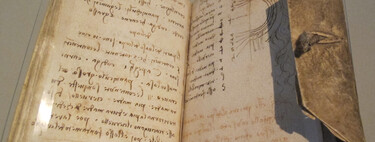
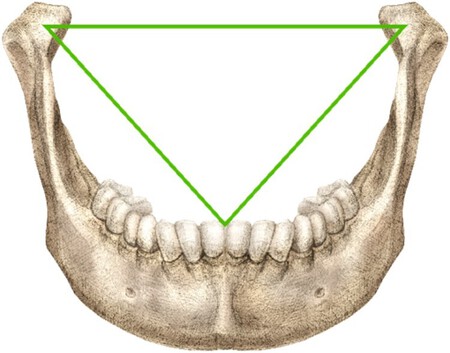
Revealing the Invisible. Curiously, Mac Sweeney believes that the answer has been right before our eyes in da Vinci’s own annotations. He points to a note where Leonardo specifies that the space between the legs forms an equilateral triangle. Initially dismissed as poetic flourish, Mac Sweeney argues this remark holds the key to unraveling the mystery .
Why is this significant? If Mac Sweeney’s discovery holds true, it could not only resolve longstanding questions about the Vitruvian Man but also suggest that Leonardo anticipated principles of human anatomy long before their formal scholarly recognition. This revelation offers a pathway that interlinks history, mathematics, and even dentistry , paving the way for future explorations.
In sum, the Vitruvian Man stands not just as a cultural artefact but as a bridge connecting diverse fields of knowledge that continue to captivate and inspire generations. Each new discovery surrounding this iconic figure adds another layer of depth to our understanding of Leonardo da Vinci and his lasting impact on art and science .