

Martín Tetaz Discusses Retirement Benefits and Government Strategies
The national deputy Martín Tetaz has expressed significant concerns regarding the potential presidential veto of a 7% increase for retirees, emphasizing the implications this decision bears for the most vulnerable sectors of society. Speaking during an interview on Infobae Live, Tetaz pointed out that the proposed increase is not expected to impose a heavy tax burden but, rather, would be seen as a prudent measure by the government.
During the conversation, Tetaz remarked, “If Milei reasonably vetoes the two laws, it will result in public discontent,” referring to the legislative initiative aimed at granting an increase in retirement benefits. He warned that the ruling party seems intent on creating confusion around how the pension system is financed, suggesting that “the government is trying to create a large misunderstanding about where the money comes from.” He elaborated that “[t]ax collections also rise with inflation, so they have no valid arguments or discussions about possible inheritance issues; they can indeed implement this increase.”
Despite the limited financial relief provided by the proposed increase, Tetaz considers it essential for retirees to receive this additional income. “There are 20,000 pesos; they do not solve much for retirees, but since it is something, I favor distributing it,” he affirmed. He expressed that a veto might enable the Executive Branch to disentangle the reasonable components of the original legislation from the more contentious elements, such as the proposed 7% adjustment. “The government has a dilemma because the veto package combines sensible proposals with those that have caused controversy. If the government can discern between these elements, it could help them politically as well,” he noted.
Questioning the long-term viability of the pension system, Tetaz categorized existing policies as flawed. He asserted that the current model carries the weight of distortions created by decisions made by previous administrations. “Kirchnerism chose to retire individuals who had neither worked nor contributed, leaving many with minimal pensions,” he stated.
In advocating for a more sustainable framework, Tetaz explained the concept of proportional retirement within the Base Law, which correlates pension amounts directly with the years individuals have contributed to the system. “We propose a shift to proportional retirement, where those who contribute more will receive more,” he explained. Given that the current system claims to cover 98% of older adults, he emphasized that sustaining this coverage with decent pension amounts is unfeasible. “There is no country in the world that successfully achieves 98% coverage of its older population while providing sufficient pensions,” he contended.
Beyond the pension discussion, Tetaz also shared insights on his political strategy within the Autonomous City of Buenos Aires, asserting that it faces distinct challenges when compared to the conurbano. “CABA presents a vastly different reality than the outlying areas. It has become one of the least favorable districts under both current administrations, LL and Kirchnerism,” he remarked. According to his projections, achieving 25% of the vote could secure a second national senator from Buenos Aires. “With 25%, we will have our second senator in CABA; that’s the baseline goal,” he noted.
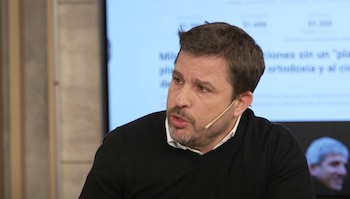
In discussing electoral dynamics, Tetaz emphasized that the political landscape must provide alternatives to existing extremes. With a clear message, he aims to rally those who refrain from aligning with either end of the spectrum: “We aspire to create a space that embodies the diagonal of wisdom,” he asserted. He maintains that collective goals supersede his personal ambitions, remarking, “I will support the initiative wherever necessary; my position on the list is not what matters.”
Addressing the internal politics of the opposition, he acknowledged a lack of communication with Jorge Macri but mentioned his strong ties with notable figures such as María Eugenia Vidal and Mauricio Macri. Reflecting on the fragmentation within the radical movement, he minimized criticisms by stating, “Political fragmentation has impacted all groups. Each has suffered differently, but it is a reality that touches everyone. Kirchnerism used to attract, but today it is the progress of libertarian ideals leading the way.”
Understanding the discernible shifts within the political movements, Tetaz reaffirmed the necessity of finding a balanced approach. He concluded, “The path of extremes is misguided; we should pursue a rational middle ground that resonates with all who aspire for a more thoughtful political discourse.”
For more information and insightful discussions, viewers can follow Infobae Live on YouTube, featuring interviews from notable figures and continuous updates on pressing issues, airing between 9 AM to 12 PM and 6 PM to 9 PM.
You can access the full interview by following this link.