
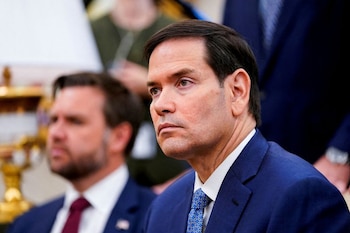
Marco Rubio’s Stance on Nicolás Maduro’s Regime
In a recent interview, Marco Rubio , the Secretary of State of the United States, made strong statements regarding the Venezuelan government led by Nicolás Maduro . He asserted that the Maduro regime is “not a legitimate government,” characterizing it instead as an organization primarily engaged in drug trafficking . Rubio’s remarks come amidst a backdrop of growing political instability in Colombia and the rising influence of criminal groups operating from Venezuela.
Rubio emphasized the severity of the situation, noting that the rewards for information leading to Maduro’s capture now stand at an astonishing $50 million . He asserted that the president should be viewed not just as a dictator but rather as the leader of a “logistics organization” responsible for massive drug operations, specifically pointing out the role of the Los Soles cartel , which he claims is effectively controlled by Venezuela’s military.
According to Rubio, these drug-related activities are bolstered by military infrastructure and that the Venezuelan government has indeed “taken control” of its national territory to facilitate these operations. He went so far as to label Maduro’s regime as “a narcoterrorist regime,” extending its influence to Mexican drug cartels and criminal gangs throughout Central America . Rubio warned, “flooding our country with poison every day,” highlighting the devastating impact these actions have on American families and communities.
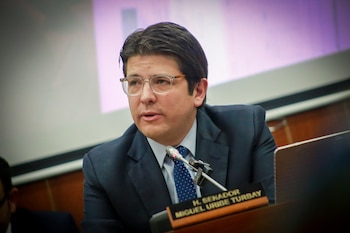
Concerns for Colombian Democracy
Shifting focus to Colombia, Rubio expressed concern over the recent assassination of Miguel Uribe , a promising candidate for the Colombian presidency. He urged Colombian institutions, including the military, courts, and legislature, to preserve their independence during this tumultuous time of violence and instability. As elections loom within a year, Rubio highlighted the necessity for Colombia to return to the path of democratic governance and stability, emphasizing that Colombia is one of the United States’ most robust allies in the region.
Speaking about Uribe’s tragic fate, Rubio noted that Uribe’s family was already affected by violence; his mother was kidnapped by drug traffickers and perished during a rescue operation. This personal tragedy underlined the pervasive pain linked to political violence in Colombia. Rubio recounted that Uribe’s death occurred amidst a rally in Bogotá , a grim reminder of the political risks present in the country.
“We are very concerned about Colombia,” Rubio stated, expressing dismay at the actions of the country’s current president, Gustavo Petro . He characterized Petro’s decision-making as “‘erratic” and indicated that it potentially impedes efforts to combat the powerful drug trafficking organizations that enjoy a haven in Venezuela. According to Rubio, these criminal syndicates are extending their influence into Colombia’s borders, threatening decades of progress against drug trafficking.
In light of these developments, it is evident that the geopolitical landscape in Latin America is fraught with difficulties. As Venezuela’s regime continues its operations and Colombia grapples with political violence, the United States stands at a crossroads in its diplomatic endeavors in the region.