
Over 1,200 medical professionals and researchers have mobilized for over a month against certain articles of the Duplomb Law . In an open letter addressed to parliamentarians, they express their concerns regarding the reauthorization of banned pesticides and the jeopardizing of the independence of Anses , the agency responsible for evaluating the dangers of pesticides. They argue that this text, which aims to “lift the constraints of the agricultural profession,” lacks any solid scientific basis and endangers the health of farmers, the population, and ecosystems.
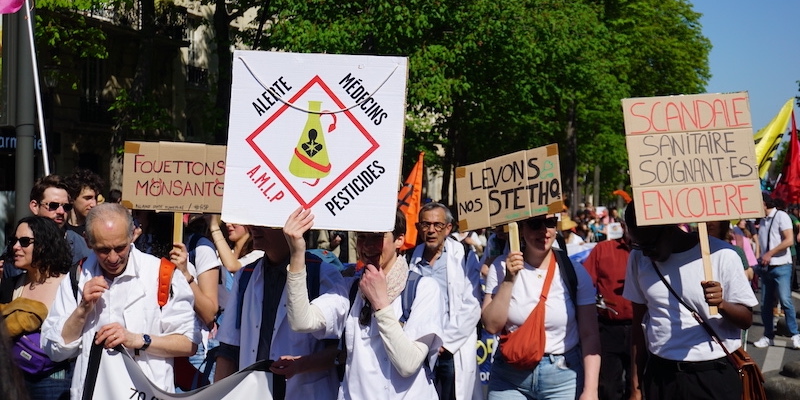
Rarely has a proposed law faced such overwhelming criticism from the scientific community. *“And for good reason; rarely have policymakers listened so poorly to researchers,”* laments Sylvie Nony , a science historian associated with the CNRS. On May 5, she was among the 1,200 scientists who signed a statement asserting that *“the impact of pesticides is no longer up for debate”* and rejecting *“a tutelage of science”* that the Duplomb Law would allow.
A False Dichotomy Between Ecology and Agriculture
*“This law places a false opposition between ecology and agriculture at the heart of the debate, while scientific consensus shows that the only way to lift the constraints on farmers is to develop alternatives offered by agroecology ,”* advocates the researcher. Today, the same collective of scientists publishes an open letter to the members of the joint committee that will review the law by mid-June. They aim to *“put science back at the center of the debate”*, as the provisions of the Duplomb Law propose measures favoring industrial agriculture.
Formally named the *Law to Lift Constraints on Farmers*, this text is the government’s response to the agricultural protests that occurred in 2024. It is *“predominantly co-authored with the dominant agricultural union, the FNSEA,”* according to the Ministry of Agriculture, proposing the reauthorization of acetamiprid , a neonicotinoid pesticide. Dubbed the “ bee killer ”, this chemical was definitively banned in France in 2023 but has effective alternatives readily available for nearly all uses. However, the FNSEA and its allies in the National Assembly are adamant about its return, regardless of scientific evidence.
Read also: Neonicotinoids: “alternatives exist, science is unequivocal”
This is not the only regressive measure contained in the Duplomb Law that undermines environmental rights. Scientific unions particularly denounce the proposal for the creation of a *“crops orientation council”*, which would compromise the independence of Anses , the agency that evaluates the dangers of chemicals used in agriculture. Essentially, the state could dictate Anses’s priorities, obstructing the study of certain pesticides’ dangers. Patrick Dehaumont , the president of Anses’s board, has stated he would resign from his post should the law pass in its current form.
A Brief Glimmer of Hope
The scientists who signed the statement and the open letter are particularly bitter given that, for a moment, they felt heard. *“During the legislative journey of the Duplomb Law between the Senate and the National Assembly, the text passed through various committees, where the present parliamentarians seemed attentive to our arguments,”* recalls Sylvie Nony. The Sustainable Development Commission and the Economy Commission had indeed *“softened”* the text, removing articles that proposed reauthorizing acetamiprid and creating the contentious crops orientation council.
Yet, just as researchers were celebrating the fact that their voices had been heard, an unprecedented legislative maneuver in the history of the National Assembly dismantled their efforts. Supporters of the text voted on a motion to reject , a tool normally reserved for the opposition, to prevent the text from further discussion in the National Assembly. It will thus be a joint committee , composed of deputies and senators, that will debate the Duplomb Law based on the version passed by the Senate—a “maximalist” version that includes the reauthorization of acetamiprid and the initiation of the crops orientation council.
An Avalanche of Fake News
After this turnaround, biologist Marc-André Selosse from the Museum of Natural History in Paris accused certain parliamentarians on LinkedIn of *“trampling on science.” “Ultimately, Trump is more forthright,”* he continues. *“Shutting down research institutes is cheaper than paying them to ignore.”* Sylvie Nony, who has studied misinformation, mentions the receptiveness of parliamentarians to lobbyists’ arguments . *“The Minister of Agriculture propagated a fake news story about acetamiprid, claiming it is found in dog collars, thus implying it is harmless. This argument is completely false and widely disseminated online by advocates of this pesticide.”* Nonetheless, the mobilized scientists remain hopeful. They now aim to influence members of the joint committee that will examine the text in the upcoming weeks.