
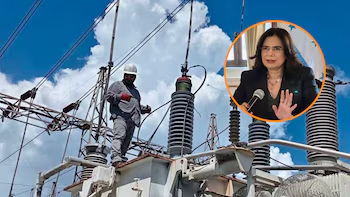
Libre Party Rejects Electrical Reforms Amidst Privatization Concerns
The Freedom and Refoundation Party (Libre) has firmly reiterated its opposition to the electrical reforms proposed by President Nasry Asfura’s government. This initiative, according to Libre, threatens the integrity of the National Electric Energy Company (ENEE) and could lead to a significant loss of state control over Honduras’ energy system.
Concerns Over Privatization
During a recent statement, Rixi Moncada, the deputy coordinator for Libre, expressed grave concerns over the proposed reforms. The statement, titled “Let’s Save the ENEE, Reform and Counter-Reform,” emphasizes that the changes would jeopardize the public nature of the electrical service. Moncada highlighted that energy was declared a public good, essential for national security and a human right during Xiomara Castro’s administration.
“Electric energy was recognized as a right of the Honduran people and not as a private business,” Moncada stated.
Structural Changes and Risks
Moncada further argued that the reforms aimed to modernize the sector would primarily serve the interests of the private sector. He characterized these reforms as representing “a structural and fundamental change” that would result in Honduras losing public ownership and sovereignty over its electricity sector.
He also warned that such changes would effectively be a “coup de grâce” for ENEE, especially concerning the potential transfer of the National Dispatch Center, a key body within the electrical system.
Regulatory Commission Concerns
One of the pivotal points raised by Libre revolves around the proposed integration of the Electrical Energy Regulatory Commission (CREE). Moncada cautioned that the new proposal could increase private sector influence in the regulatory body, potentially compromising decision-making associated with the electrical system.
According to Moncada, the proposed selection mechanism for this regulatory body would mirror the process used for electing judges to the Supreme Court, thereby allowing more significant private input in public decisions.
Ongoing Political Debate
While Libre presents its concerns, the National Congress is still deliberating the reforms to the General Law of the Electrical Industry. The ruling party argues that ENEE faces monthly losses of approximately 1,500 million lempiras and a staggering historical debt exceeding 120 billion lempiras.
Carlos Ledezma, the secretary of the National Congress, has indicated that the project has gathered enough support for potential approval, claiming the necessary 65 votes are already in hand.
The government maintains that the reforms do not entail privatization but are designed to rescue the struggling ENEE financially. However, Libre continues to criticize proposed conflict resolution mechanisms and highlights their fears that such decisions might be increasingly dictated by private interests.
Mobilizations and Public Response
In the wake of these developments, Libre has called for assemblies and mobilizations to defend the ENEE, emphasizing the need for more extensive national discourse regarding energy reforms. The ongoing political contention indicates that this topic will not only influence legislative outcomes but will also resonate deeply within the Honduran populace.
As the National Congress approaches the third debate on these critical reforms, the political landscape in Honduras continues to polarize, with Libre steadfast in its resistance against what it perceives as a significant risk to public ownership and the right to energy access.