
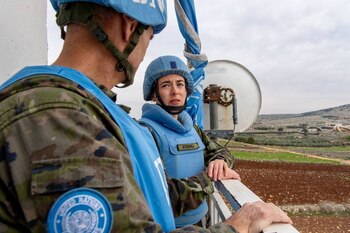
On Tuesday , a military court in Lebanon handed down the death penalty to Mohamad Ayyad, accused of killing Sean Rooney, a 23-year-old Irish peacekeeper serving in the United Nations’ Interim Force in Lebanon (FINUL). This verdict follows a December 2022 attack on a convoy that tragically left Rooney dead and injured three other members of the UN mission.
The Convoy Attack and Judicial Proceedings
During the attack on December 15 , multiple assailants opened fire on two armored vehicles from the UN mission in Al Aqbiya , a town near Beirut . The vehicles were transporting eight military personnel toward the Lebanese capital when they came under fire. This incident sparked immediate national and international outrage. In the aftermath, the then-acting Prime Minister of Lebanon , Nayib Mikati, promised that those responsible would be brought to justice. Following extensive investigations, the military court concluded its proceedings, convicting six individuals for their roles in Rooney’s death .
Interestingly, Mohamad Ayyad was tried in absentia . He had briefly been in custody but was released due to purported health issues and had not subsequently appeared before the court. The court’s decision has drawn various responses, including a statement from FINUL, which expressed condolences to Rooney’s family and friends , while reaffirming its support for both the Lebanese and Irish authorities in the ongoing judicial processes.
Response from the UN and the Irish Government
In a statement following the verdict, FINUL emphasized its commitment to supporting efforts in bringing the perpetrators of this heinous crime to justice. It stated: “From the attack, [the mission] has provided its full support to the Lebanese and Irish authorities in their respective judicial procedures. Once again, we offer our most sincere condolences to the family, friends, and companions of Rooney, and to the Government of Ireland.” This solidarity reflects the UN mission’s broader commitment to peace and stability in a region marked by conflict and tragedy.
Background of the UN Mission in Lebanon
The United Nations Interim Force in Lebanon (FINUL) has been operational since 1978 , primarily tasked with maintaining peace and security in the region. Its role gained further importance following the 2006 conflict between Israel and Hezbollah, which resulted in significant loss of life and infrastructure damage. The mission was reinforced during this period, aiming to stabilize the region and prevent further bloodshed. The tragic loss of a young UN peacekeeper underscores the ongoing risks those in the mission face in a complex and often hostile environment.
Despite the dangers, the commitment of the UN to maintain a presence in Lebanon indicates its vested interest in regional stability. The recent court ruling serves as a message that those who engage in violence against peacekeepers will face consequences, thus hopefully setting a precedent in accountability and justice.
The Role of International Law
International law protects peacekeeping missions under various treaties and frameworks, emphasizing the necessity of safeguarding those working to maintain peace in conflict zones. The tragic fate of Sean Rooney has led to renewed discussions about the protections that need to be assured for UN personnel. The strong stance taken by the Lebanese military court is a step toward reinforcing the legal protections afforded to these individuals, although the effectiveness of such measures remains to be truly seen in the tumultuous landscape of Lebanese politics.
As the situation continues to unfold, the Lebanese military’s resolve in this case will likely impact both local and international perceptions of the country’s commitment to law and order. It remains vital that justice is seen to be done, not only for *Sean Rooney* but also for the integrity of international peacekeeping as a whole.
Every aspect of this case highlights the complexities and dangers that accompany putting oneself in the service of peace. The tragic consequence of a peacekeeper’s life lost is a reminder that for every mission, there are risks that stretch beyond borders, affecting families, communities, and nations.